
Bow Hunting Mexico's Carmini Whitetail - An Affirmation
The wrinkles become more pronounced on his sun darkened face as laughter overtakes him. A face that has seen 92 revolutions around the sun. A face creased from the worries of hard times, but also one that has witnessed love from generations of family.
It’s also a face that lets me know there is hope for the longevity of my obsession.
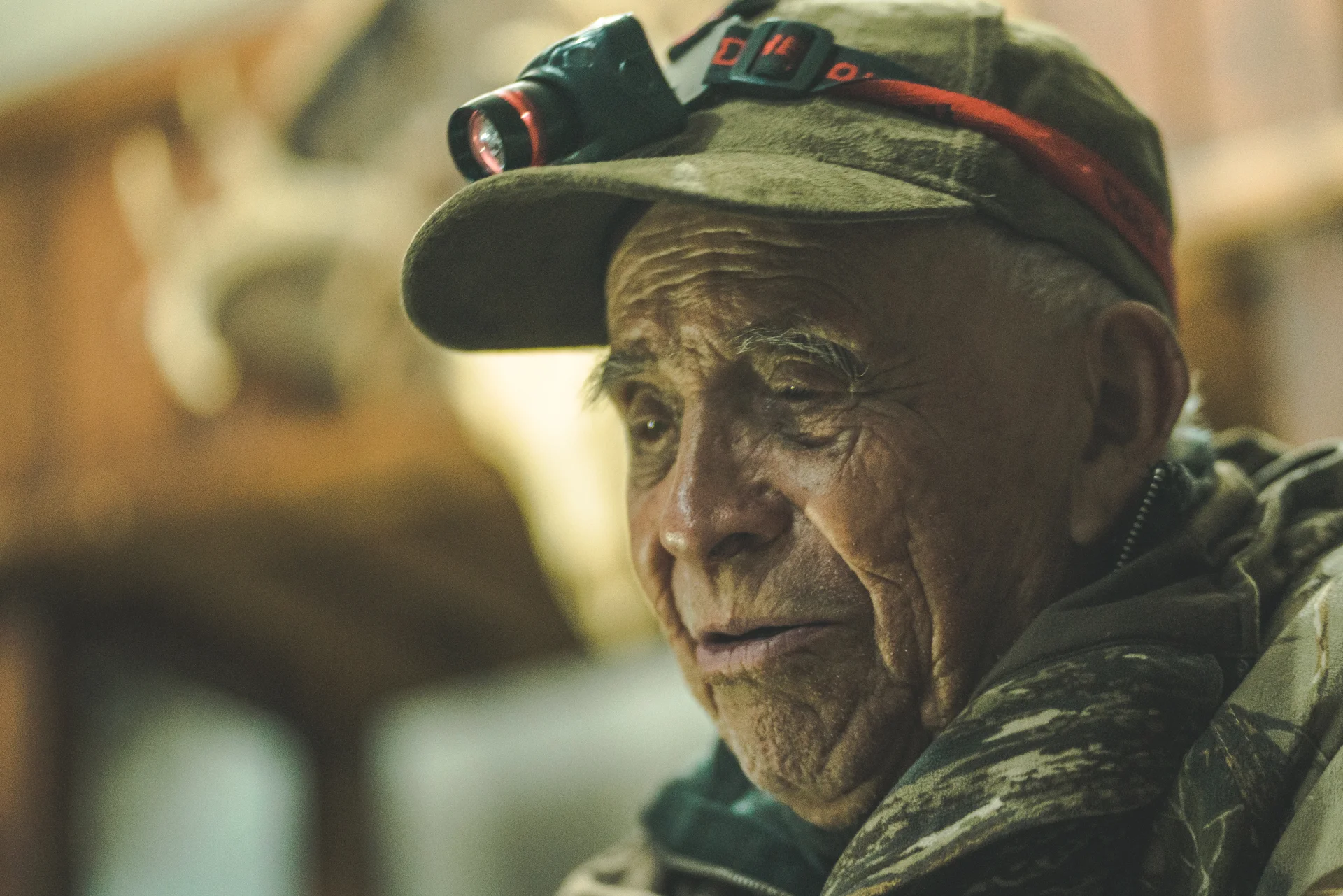
His story continues, temporarily interrupted from time to time by the roaring laughter of friends and three generations of family that have encircled him.
I catch the gist of the narrative through his body gestures and the little spanish I remember through higher learning and restaurant kitchen classrooms.
We are all back from our morning hunts, me empty handed, the old man with a fine specimen of an 8 point Carmini whitetail. He’s ecstatic, as if he were an early teen with his first buck in his crosshairs.
I’m thrilled, both for him and for the affirmation received while watching him tell his tale. For some time now I have been questioning how long this can last, how long can an obsession burn before blinking out into oblivion. A hot fire burns out quick or so the saying goes.
Here in the deep backcountry of Mexico I find my answer in the face of this old man. Apparently this feeling is a feeling that doesn’t die with time.

The story winds down and I step out of the walled tent to the consistent growl of the desert winds. I pause and look at the panorama in front of me. What I see is three generations of hard work and dedication laid out before me.
Taming this land would be impossible, hell not desirable to tell the truth. But the camp I now stand in shows a family’s vision to integrate themselves into a hostile landscape through sheer willpower and effort alone.
Bumping down switchback after switchback that was hand carved out of the mountains that guard this valley on our approach the day before proved that willpower can move mountains. Willpower, calloused hands and a vision.
I thought I came to Mexico seeking Carmini whitetail deer. Shortly after arriving I knew my subconscious intentions were different. I was here to see how a single purpose can bleed down through three generations of family.
I came here to prove what I was personally seeking in life could and had been obtained by others. I am here for inspiration.
Gustavo the mastermind of this ten thousand acre playground pops out of the tent and clasps me on the shoulder.
“This evening you will kill a big Carmini,” he says to reassure me.
I smile to myself. I have five more days here and the last thing on my mind right now is sinking an arrow into a deer. My goals have shifted. I’m here to learn how something as beautiful as this can happen and how I can translate it and take it home with me to replicate with my family.
“This evening it is,” I reply.
I know it’s a lie and that I don’t want to shoot anything yet, but I play along.

I settle into the stand, the heat from the day still pounding down on the desert floor. I push back into the cedar tree as far as I can to eek out any shade it has to offer. There isn’t much to be had so I accept my punishment for heading in too early.
The image of the old man’s laughing face once again pops up in my head. I can’t shake it for some reason and I know if has more significance to me than what I am currently understanding, I just can’t peel back the layers at this point to know why.
He’s happy because of hunting, I get it. Why is that so important to me at this point in my life?
I sit back and look inward, letting my breathing slow to the pace of the desolate land. Everything here is slow, there seems to be no rush and I let that calm me and relax my thinking.
The creases of the old man’s face come back to me. Moreso the look of admiration from his son and grandson burrow their way into my brain.
“Three generations of shared vision,” I repeat to myself.
Not just shared vision but action. For vision without action is just a pipe dream. Long hours of cutting trail and forming the earth to meet their needs. The foresight of an end goal and the patience required in seeing little progress towards this goal. In the world of instant gratification this is its antithesis.
This is twelve years of three generations working this land to create a family legacy.
With that last thought it all sinks in. Legacy. To create something that will be enjoyed by those you love long after you’re gone.
Legacy. This seeps through my body as my thoughts wander to what my children are doing back home. How are they feeling about the absence of their father? Is my intended purpose of teaching them that you have to give every last ounce of your soul to obtain your dreams getting through or do they see my absence as a slight against them.
You’re damned if you do and you’re damned if you don’t.
I’m here to find out how it’s done. To see how a legacy is formed. How to replicate it in my own world.

I see the headlights of the side by side cruising along the trail, headed to pick me up. Caught up in my own thoughts I almost forget where I’m at.
Oh yea, treestand. Don’t fall out.
Gustavo and his son park beneath the stand as Gustavo calls up to me.
“See anything?”
A donkey wearing a sombrero could have been playing the tambourine below the stand and I wouldn’t have had the slightest clue. I was lost in my own head.
Feeling I owed him some type of response I shot back.
“Just a couple of small ones. Tomorrow morning I’ll get one for sure.”
I hop in the back seat of the side by side and we slither our way back down the windy trail towards camp.
I notice the admiration in Carlos’s (Gustavo’s son) eyes as he talks to his dad in the front seat. He points out at different locations along the way about where stand should be placed or maybe a better spot for a trail. Normally it would have passed right by me, but I’m looking for it. Looking for the relationship between this father and son.
There’s admiration in his eyes. One that I know comes from a son being inspired by a father who thinks big and grabs the world by the balls.
I smile to myself. More affirmations. I came to Mexico seaking Carmini whitetail, I’ll go home with a better understanding of legacy.
// Fred Bohm
To find out more about hunting Carmini whitetail in Mexico, check out Aqua del Oso Safaris.

Wyoming Pronghorn Hunt - By John McAdams
“Sometimes I let my buddy John McAdams tell his stories on here. I like hearing someone else besides myself yammer their mouths from time to time. Besides, his grammar is a lot better than mine.”
My heart sank after yet another unwelcome sight: a herd of pronghorn over 800 yards away and running as fast as they could. I was up on Wyoming on the opening day of pronghorn season and finding pronghorn wasn’t a problem. Unfortunately, I was really having trouble approaching to within shooting distance.
The wide open country made things difficult enough, but I was also hunting on public land and there were dozens of other hunters out there with me trying to fill their tags on the first day of the season. While I came close to pulling the trigger on a nice buck during the early in the morning, he turned tail and ran after spotting a couple of other hunters who took a little too much interest in him.
It didn’t take long at all for most of the other pronghorn to learn that hunting season had opened and they didn’t stick around after spotting human activity. I spent most of the rest of the day driving around the GMU and getting a feel for the land. I saw literally hundreds of pronghorn, but they were always hundreds of yards away and would take off at full speed the minute I stopped or even slowed down.
However, I also noticed a few very encouraging sights. First, most other hunters stayed very close to the roads and did little walking. Second, the pronghorn were concentrated in areas close to water.
Now, neither of those things were very surprising. After all, the GMU had very good road access and was pretty dry. However, I discovered a couple water holes that weren’t visible from the road that afternoon. The pronghorn hanging out in one especially promising location spotted me and left, but I figured that would be a good place to hit first thing in the morning the next day.
Well, that’s just what I did.
I woke up long before the sun rose and parked two ridge lines away from the valley full of water and green grass that I intended to hunt. In contrast to the previous day, there was not another hunter in sight that morning. I slipped out of my truck and readied my gear.
Keeping the rising sun at my back and doing my best to use the terrain to mask my movements from the pronghorn I couldn’t yet see, but knew were there, I stealthily crept across the prairie. After a few hundred yards, I reached a dry creek bed that ran towards the valley I intended to hunt. I climbed down its steep walls and used the concealment it provided to move faster without worrying about being spotted.
Every hundred yards or so I’d pop up like a prairie dog and search the surrounding countryside for pronghorn. After doing that a couple of times, I saw what I was looking for: a buck feeding along a ridge about a mile away. He was too far off to judge accurately, but he was obviously a mature buck.
I shot an azimuth to the buck with my compass and used that information to plot his location on my GPS. He was exactly where I’d hoped I’d find some pronghorn that morning. He was also in a spot where nobody could see him from the road, which eased my fears that another hunter would spook him. The buck obviously knew he’d found a good spot and was casually feeding without a care in the world.
Reasonably confident that he wouldn’t leave any time soon, I identified a good shooting position on the ridge opposite the buck and planned my stalk. After backtracking a few hundred yards, I scurried out of the creek bed using the cover of another ridge. At a brisk trot, I covered over a thousand yards behind the ridge until I was parallel with the buck.
While taking a minute to catch my breath, I quietly chambered a round in my rifle and put on hearing protection. After slowly creeping up the ridge, I dropped down onto my belly and slithered over the top.
The buck was right there where I left him. Unfortunately, a quick check with my laser rangefinder confirmed that he was still over 400 yards away. While I was considering my next move, the buck miraculously turned and started walking directly in my direction and dropped out of sight below me. Inch by inch, I crawled over the crest until the buck and about twenty does and fawns came into sight.
Fortunately, my caution had paid off that morning and I was in an ideal shooting position above a big group of pronghorn that had no idea I was there. A quick inspection of the herd through my rifle scope determined that the buck in question was indeed the biggest one there.
The shot from my .300 Win Mag echoed across the prairie and the rest of the pronghorn took off, leaving the buck where he fell. Less than an hour later, he was in my cooler as I drove back to camp.
Read more from John McAdams at The Big Game Hunting Blog and follow him on Facebook, Instagram, and YouTube.

Capturing Action - Shutter Speed and Motion Blur - Hunting Photography Series - Part 5
Part 5 - Capturing Action - Shutter Speed When and Why - Hunting Photography Series
Capturing action in a photo? Doesn’t sound like something that photographers worry about, it sounds more like it should be in the realm of film. If you believe this to be true you are missing out in a very important element that can take your photos to the next level.
Some may think we are at a severe disadvantage when it comes to telling a story with photography compared to guys who shoot video. We don’t have thousands of frames running together to show what is going on in the scene, we lack audio to inform the viewer of what is going on and no music to set the mood. Disadvantage perhaps, impossible to do with photography? Certainly not. Capturing action within the photo is an art form and can be a powerful way to tell your story through a still image.
You should always be thinking how you can add action to your shots. It’s not always appropriate, but at least having it in the back of your mind will help you determine if it should be used or not.
There are a couple of different ways to catch action in your still photos that we’ll go through in this article.
Implied Action - Capturing movement that the viewer understands is occuring due to the nature of the shot.
Motion Blur - The streaking of objects implying their movement within the image.
Both of these tools are simple to use, but can have a powerful effect on your imagery. Capturing action helps tell story better and with a lot more excitement. Plus its under utilized by many photographers so it will help your imagery stand out.
Look back to some of the photos you have previously taken and ask yourself if action could have enhanced the image. More than likely in just about all of them the answer would be yes. It doesn’t always have to be the subject performing the action as well. Moving background elements can be just as beneficial.
A technical heads up. You will need a tripod to be able to shoot with slower shutter speeds. You are trying to capture motion within the scene, not the shake of your hands. A general rule of thumb is to use a tripod for shutter speeds slower than 1/60 seconds.
Let’s break down the two ways I described above on how to capture action so you can get started on using this tool in your own photos.
Implied Action
Implied action is pretty simple. Often times it’s more about being aware of it than actually creating it. It’s as simple as having something in your image that the viewer assumes is moving.
Perhaps it’s a train locomotive moving towards the camera with smoke billowing out of its stack and covering the train cars behind. The viewer’s brain will automatically assume the locomotive is moving. Why? The smoke pouring out and covering the cars behind is likely occurring because of the train’s forward movement. Add a subject in front (and off to the side, let’s not get anyone killed here) and you have yourself one powerful image.
What can we do with our subject that will suggest action? Instead of just standing there how about making them do something? Look for simple actions they could take that would help create a story in your image.
Jumping can be a great way to add action to a shot. There is no other way that the subject could be in that position other than jumping. Implied action at its best.
Here’s a shot I took of myself jumping a gap in the rocks. There is no other way I could be in that position other than jumping. An instant injection of action.

Or how about water flying off of your bow after a rainstorm? A pretty cool way to enhance a shot.
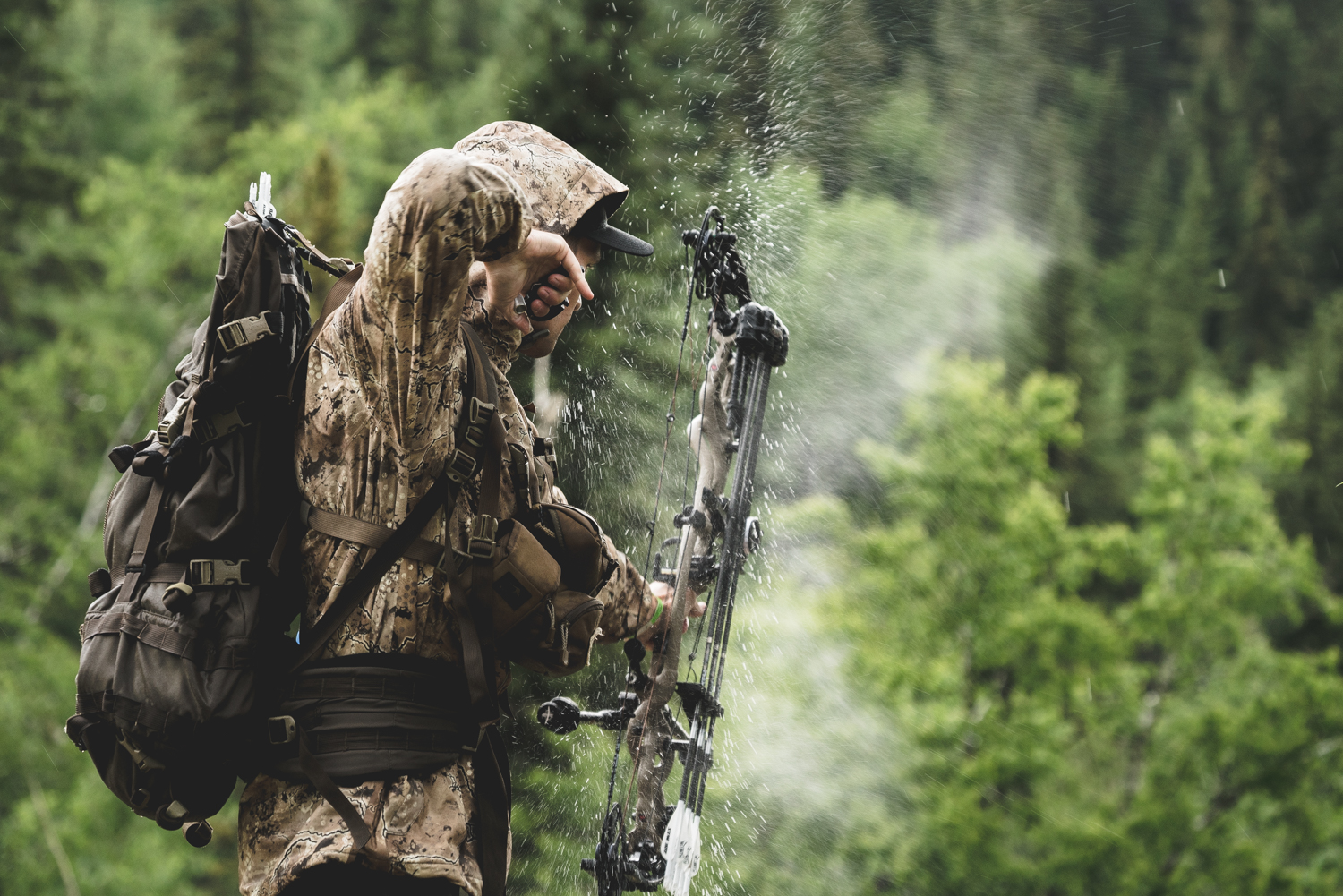
If you’re trying to show off a piece of gear lets say, a great way of doing it would be tossing it in the air and freezing it there. A levitation effect so to speak.

This is a great spot to jump into our next section as capturing the techniques above will take some forethought when it comes to the shutter speed you choose.
Motion Blur
To motion blur or not motion blur, that is the question. But perhaps I’m putting the cart before the horse. Let’s go over what motion blur is and how we can capture it for those of us that haven’t heard of it.
Motion blur is the apparent movement of an object in a scene that shows itself in streaks. What is happening here is that the shutter of your camera is open long enough that the moving object isn’t completely still in the photo, rather you see where the object starts and stops during the time the shutter is open. Basically a very fast shutter will make the image appear still and therefor crisp in the scene. A slower shutter will show motion blur that represents movement.
Both can capture action, but you’ll have to determine which will look better and tell the story better in each particular instance.
What determines a “slow” shutter speed is how fast the object itself is moving. You might have to speed up the shutter to say 1/5000 to capture a hummingbird without motion blur, but a human walking might only require 1/100 of a shutter speed. You will need to determine what is the appropriate shutter speed to get look you want. Luckily in this age of digital cameras you get instant feedback and can make appropriate adjustments almost instantly.
Let’s take a look at some photos and determine how they were created using motion blur to our advantage.
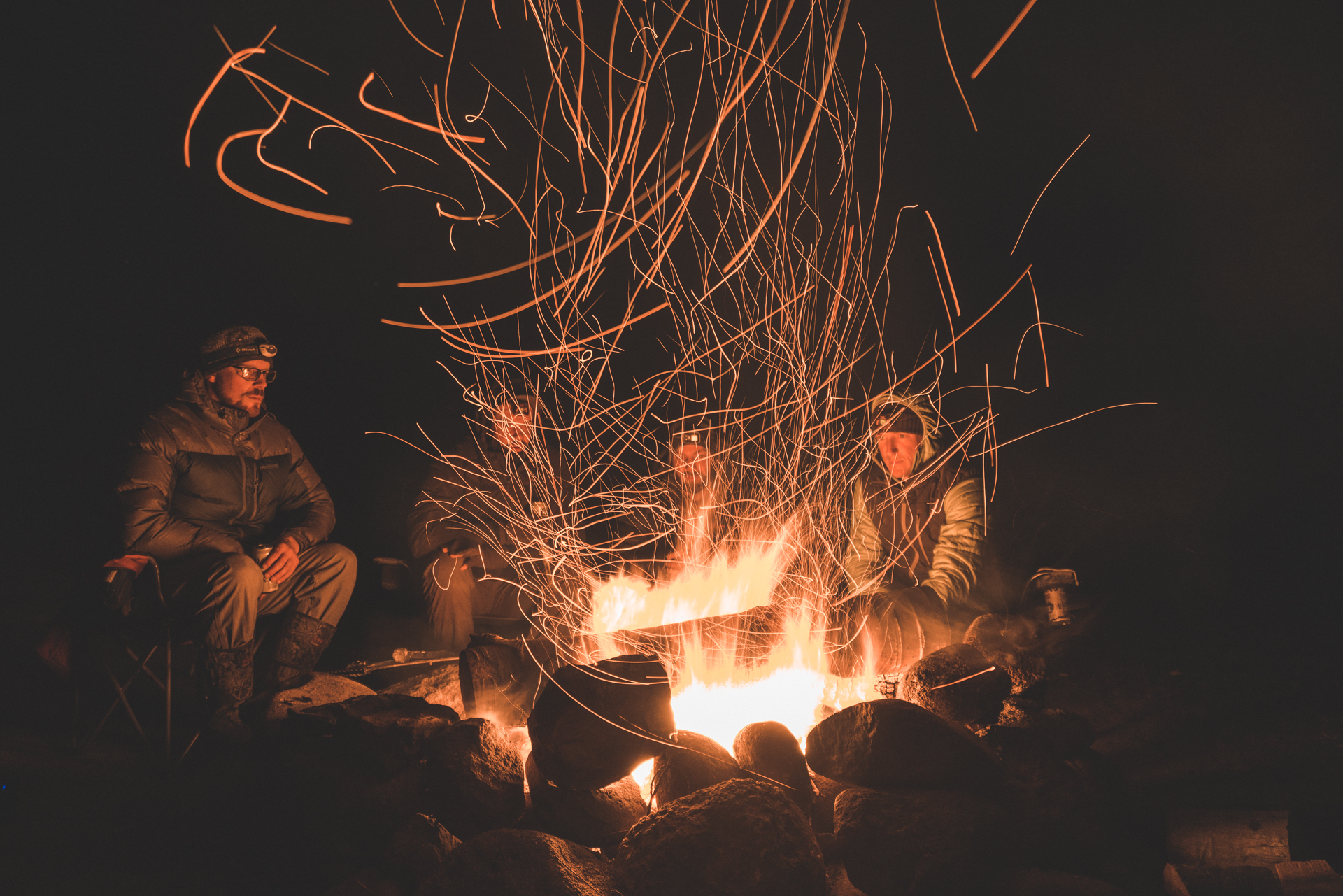
Here is a picture of me and some buddies sitting around a campfire. I set the shutter speed to ⅕ of a second in order to capture the trail of the campfire sparks. At that shutter speed we get beautiful streaks that both make the image interesting as well as imply action. Warning: at that slow of a shutter speed it is easy to pick up motion blur on your human subjects. You will need them to hold as still as possible to avoid “ghosting”.

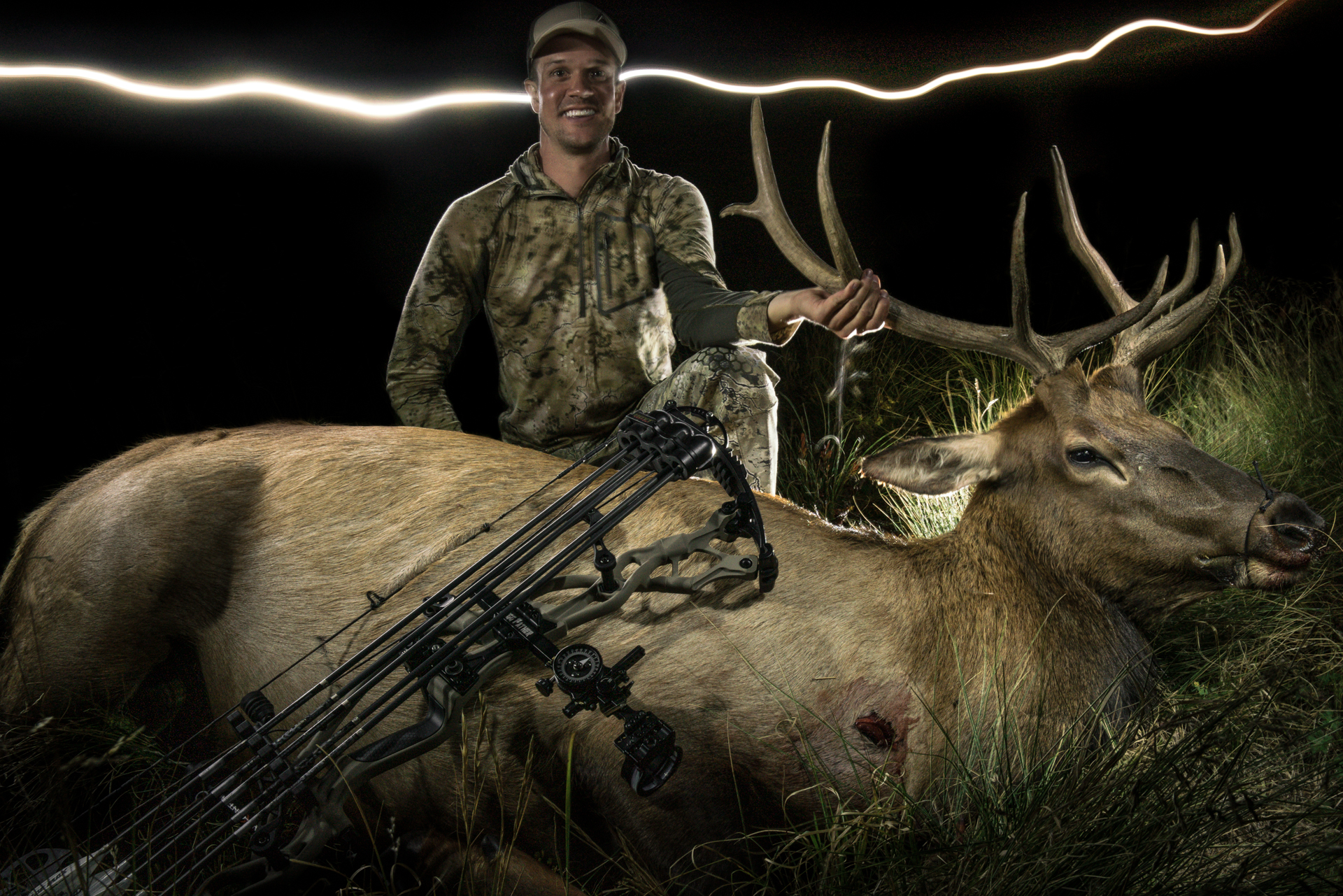
Here’s one of my favorite ways to capture a trophy shot at night. Most of us don’t carry a flash in the backcountry so it can be hard to capture a kill in the dark. Considering most animals are shot early in the morning or late in the evening this can prove to be a photographers nightmare for the later. So we have to improvise.
“Light Painting” is a really cool way to light the scene as well as create a really cool light streak from the motion blur of your light source. In this instance it’s my headlamp.
For this shot I used a shutter speed of 10 seconds. That’s really slow so any movement in the scene will create motion blur. Your subject is going to have to stay as still as possible so that they don’t look blurry.
What I did here was open the shutter and then shine the light all over the front of the hunter and elk. Then I slowly walked around the subject painting the back of them and making sure the camera lense received a healthy dose of headlamp as well. I also used a second headlamp to backlight the subject to create a rimming effect behind the hunter and elk. I didn’t worry about me showing up in the image although I walked completely through it. My movement was fast enough that I didn’t show up in the image.

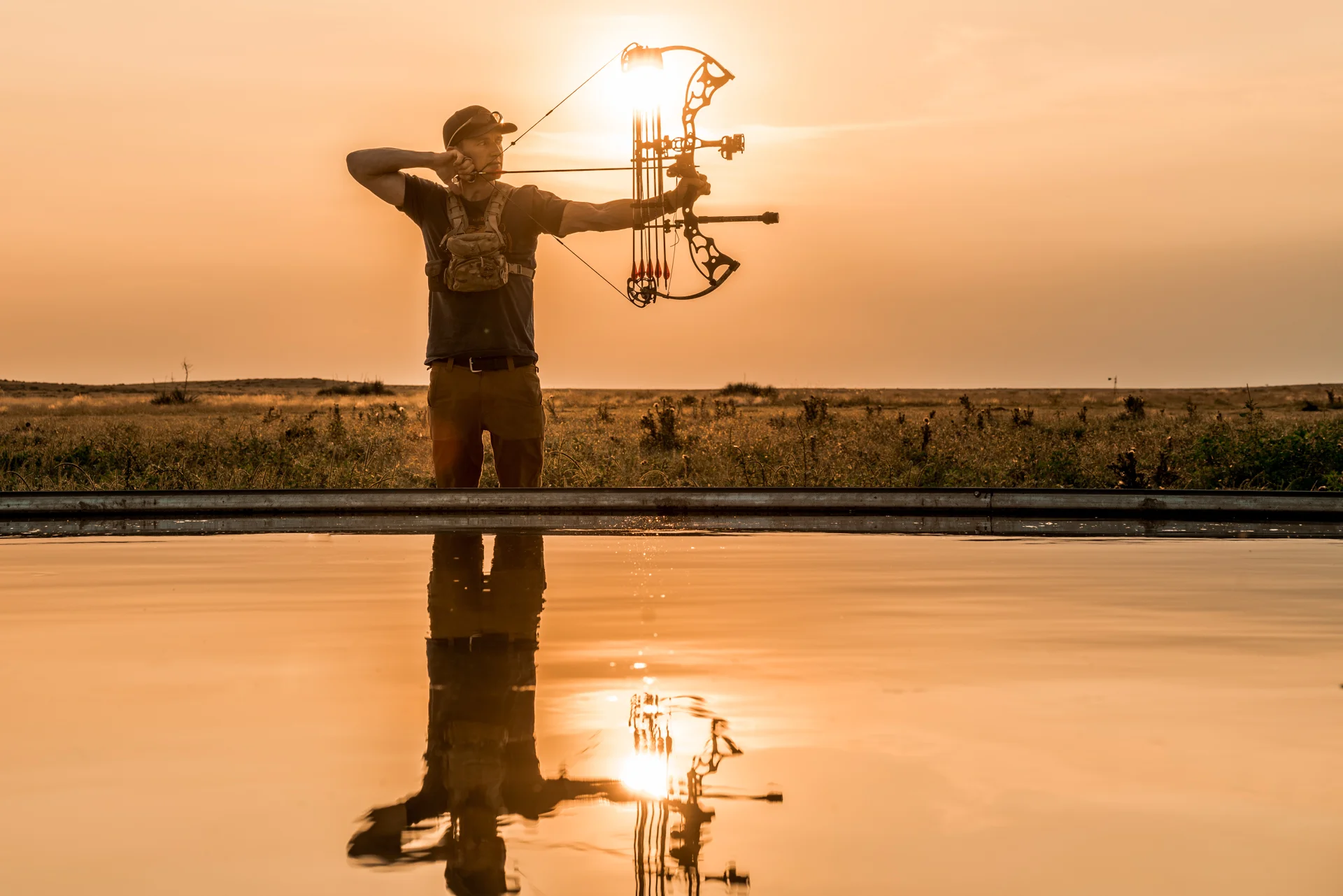
Another example of how we can use as slow shutter speed and motion blur to make a more interesting picture. Here the archer is shooting with a lighted nock. I set the shutter to 0.4 seconds. As you could imagine this is a tough window to hit for the arrow flight so there was a lot of 1,2,3 shoot! In there to get it right. But hey, pixels are cheap so let them fly.
Whip Zoom

This is a fun way to add motion blur and force the eye of the viewer. What you’re looking to do here is use a slower shutter speed, let’s say around 1/30th of a second, and zoom in real quick with your lens. This will give you the above effect. Adds more motion to a picture instantly.
Another variation of this is to use a slower shutter speed again and move the camera quickly to follow the subject. The subject will be relatively unblurred while the background has considerable motion blur.
Putting It Into Practice
And there you go. It’s as simple as that. Slow down your shutter speed, use a tripod and start making your picture more interesting. Start looking for action in every picture you take. You will start looking at how you use your camera and what’s going on around you in a completely different way. Is it raining? That’s action. Are the clouds moving fast in the sky? That’s action. Is your subject moving over an obstacle? That’s action. Now use it to your advantage and start making some really cool images!
Find me in Instagram at fredbohm and start tagging me in your shots. I’d love to see what you’re up to and how you are using action in your shots.
Now stop listening to me and get out there and shoot!
Continue on to Part 6 - Framing Your Hunting Trophy
// Fred Bohm

South Dakota Whitetail Bow Hunt - Come Home As a Killer Or Don't Come Home at All
“You got three days. Come home with a deer or don’t come home at all,” Hazel says to me as she pops her head into my office.
“I’ll see what I can do,” I smile at her as I shut down my computer.
The smile wasn’t returned.
Shit. She’s might be serious.
With family coming for the holidays, the list of wild game recipes stacking up on the fridge and the way we blow through meat like a socialist blows through other people’s money, I was taking this as a threat, not a suggestion.
“Let me rephrase that. Can do,” I say as I kiss the kids goodbye and headed for the packed truck.
Three days, a snowstorm coming, a tag in my pocket that has the ghost of four previous misses on it and I didn’t need much more motivation. But I received it anyway.
I gas up the truck up and look east to the wall of steel grey clouds building over the plains. The smell of cow manure clings to my nose hairs. Any Denverite knows the smell all too well. A surefire sign that snow is coming by the winds screaming across the cowtowns to the north.
An hour into an eight hour trip and I’m already in four-wheel drive at a breakneck speed of twenty-five miles an hour.
This may take a while.
I pass the time by looking for roadkill as a backup plan as Hazel’s last words echo in my head.
The extended drive time due to the ice skating rink that I’m now driving on also lets me replay ad nauseam the multitude of misses from my previous South Dakota foray a few short weeks ago. Certainly not long enough to let the wounds to start scabbing over.
Deep down I knew I needed to prove to myself that I wasn’t building a bad habit of folding under the pressure of a kill. There was a bit of redemption attached to this trip, but mostly it was way more simple than that.
I. Love. To. Hunt.
Plain and simple, I love to hunt. I don’t care if it’s chasing rabbits with my bow, pounding the mountains with my bird dogs or hunting big game. This is why I am here, this is what I planned my life around and this is what I do. I hunt.

Thirteen hours later and I’m looking for lodging. Being that it’s fourteen degrees out, the bed of my truck isn’t looking too appealing. I look for a hotel where even the cockroaches are afraid to sleep, you know the type of hotel where you sleep with your boots on. My kind of place, cheap.
The next morning I slip and slide my way to the killing fields. I don’t want to set a stand in the dark so instead I sit on a hill and watch where the deer make their way back into the security of the trees.
They leave the salad bar in droves. Noticing the first one make it in safe, they relax and follow suit.
The fresh snow makes it even easier as I follow them in a few hours later. You might as well of highlighted a trail on a map for me.
I set my stand as high as the climbing sticks will allow. There’s no cover since the leaves are down and being that these whitetails walk staring at treetops more than the ground, I know I’m going to be put to the test to control my fidgeting self.
I plunk myself down and zone out. A half hour before sunset the woods comes alive. On cue the herd makes their way no more than twenty yards from my stand.
They pile through and on multiple occasions I start to draw back on my bow. Death is twenty yards from them and they never know. I let them all pass, doe, fawn and buck alike.
“You see any today?” Hazel asks as the Campbell’s soup comes to a simmer in my Jetboil.
Did I see any? I think the Miss Whitetail South Dakota pageant was held today and the runway was right under my stand.
“Uh, yea a few I suppose,” I reply sheepishly. “How are the kids?”
I throw out the smoke screen. Safe for the moment at least. I know she has faith that I’ll get it done. Me on the other hand I’m not so sure. Passing up a couple of chip shots might not have been the wisest move. I’m on a meat run, not window shopping at the mall.
“I’ll knock one down tomorrow,” I tell her before hitting the sack.
Hell, I still have two full days to redeem myself.
Day two is a bit more challenging as the winds shift to a less optimal direction and the deer decide to visit a new trail. Just far enough away to not be able to get a clear shot, but close enough to reveal themselves and taunt me and my decision making skills.
The sky fades to black and I call an audible. I break down my stand and shift locations for the mornings hunt.
“Nothing came close today,” I murmur as I flick a unidentified bug off of my bed. “I’ve got them dialed now. Don’t be alarmed if you hear a victory scream waking you up in the morning all the way in Denver. That’ll be me as I celebrate the two-hundred inch whitetail I’m standing over.”
“Riiiiighttt,” comes the drawn out response from Hazel.
Stop dicking around, it’s go time.
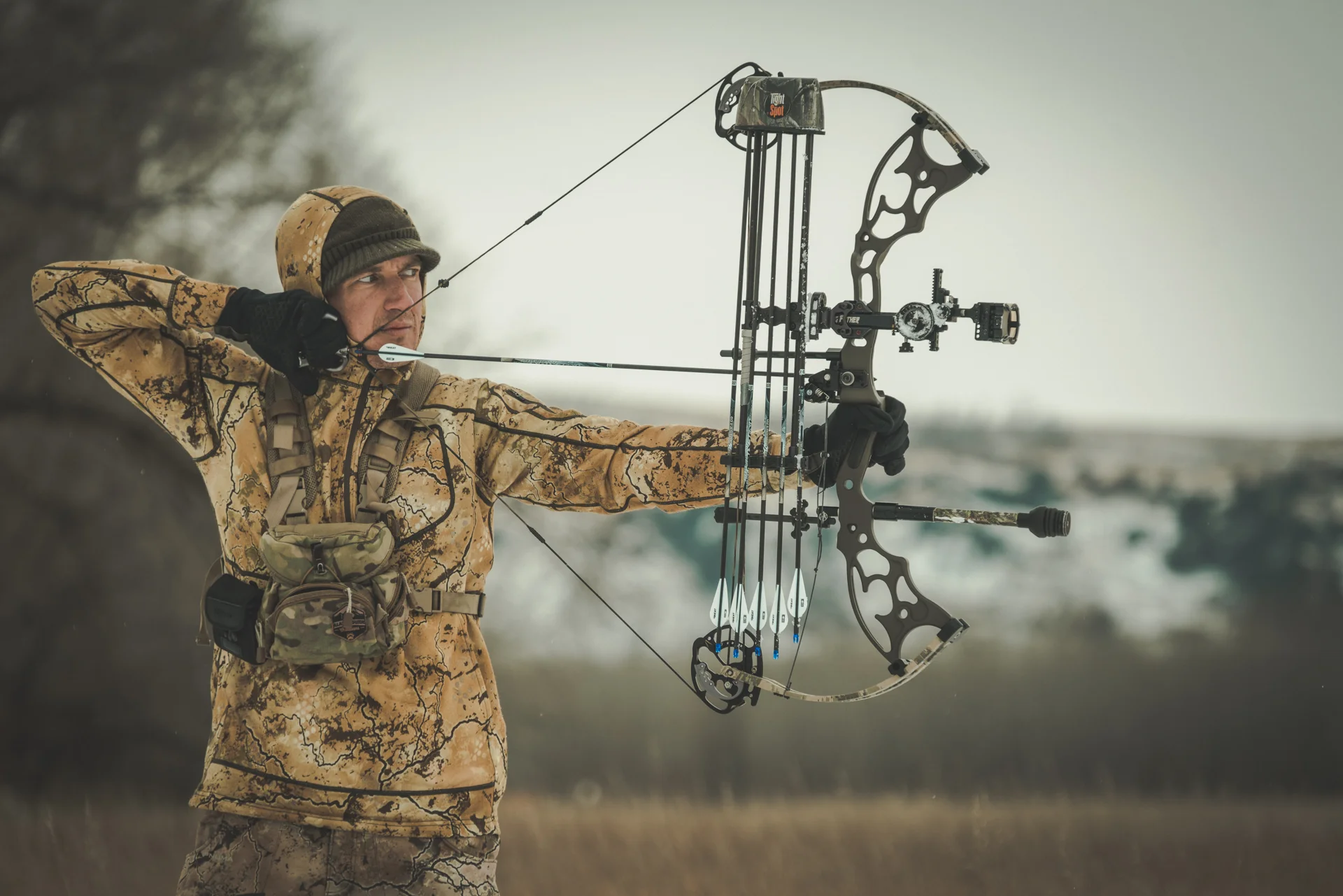
Damn it. Fifty yards off. Right location, wrong tree. A midday relocation and I’ve got my relationships stability hanging from a tree. I either made the right choice and go home to a happy woman or I start to question how I’m spending my free time.
I settle in and suck in my breath to thin myself against the small trunk behind me. I’m not overly happy with the position of my stand as it puts me smack dab in the middle of the game path, but no other nearby tree was sufficient to accept the temporary residence of my stand.
I throw every layer I own on, knowing that the shivering that will ensue is not going to help my chances.
Stay still, draw your bow back slowly and close this deal.
First I need a deer to walk by.
This comes at the predicted time in a ball of full with legs protruding out like a centipede. They’re clumped up and moving my way, eyes fixated on the green fields behind me.
I pull air in through my nose and slowly exhale through my mouth, slowing my heart rate in the process. With the speed they’re moving this could be tight on time as the forest turns a deeper shade of blue.
All does. There’s got to be at least one buck still thinking he’s got a chance of scoring around here.
They move closer.
Don’t look up, don’t look up.
Poof! She smells my fear and acts on it. A doe’s head rockets up like a periscope and her eyes lock on me.
This grabs the attention of her lady friends and everything goes still. They know something is wrong but not wrong enough to blow out of there.
The head doe gives a few stomps on the ground like she is packing in dirt around a fence post. You can feel the tension in the air and it doesn’t look like this is going to go my way.
How are you going to explain this one to Hazel. A herd of deer not thirty yards from the stand and you can’t kill one?
The drama continues as the doe tries to get a better angle on me, tries to figure out if I’m just a lump in a tree or something there with more nefarious reasons.
Some of the does have enough and decide another trail close by would be the better option to get to the green fields that I’m cutting off. Why chance it?
I catch movement deeper in the woods, a large bodied deer making his way with his head down.
That has to be a buck.
Not just a buck, but my favorite kind of buck, a clueless one. He has no idea what is going on and makes his way to the front of the herd. He moves on as if this theatrical scene hasn’t been playing out for the last ten minutes.
Lights almost gone and this is your last chance. The time for caution is long past.
I lock onto him and slowly raise up my rangefinder. I pick a clearing he is on a trajectory for and angle myself for the shot.
The does don’t like this once still lump moving on them and they let everything within earshot know it.
They scatter, snort and throw a temper tantrum to rival any three year old toddler.
The buck freezes, still not knowing what the drama is about. According to him there has been nothing odd going on and the drama queens behind him are stopping him from a mouth full of green clover.
Come on, come on!
The dark blues of the forest let me know that time is very short now. His vitals are comically located behind a large tree trunk as if he were framing this story with the necessary suspense.
Time moves on and not a twitch from him. So much so that I’m starting to question if I was just seeing things and I’m standing there like an idiot staring at a stump.
I no longer can feel my fingers as the cold works through the bows aluminum riser and seeps into my hand.
Just one more step and this will all be over.
And it is.
He transforms from a stump back into a deer. In one smooth movement my bow is drawn and the arrow is loose.
I hear the telltale “thwack!” as the arrow punches through hide.
With the dimming like and shaking from the cold I’m not sure of the exact location of the shot but I know deep down that it will suffice. A huge exhale is released along with the tension of the pressure to get this job done.

The woods is silent as I pull my cell phone up to my ear.
“You got one?!” I hear on the other end of the line. It startles me hearing a human voice in an area where human voices typically are avoided at all costs.
“Yes ‘mam. Now I just need to find him. I’ll let him sit the night and find him tomorrow. I’ll be home by dinner,” I reply with obvious relief in my voice.
I can imagine her flipping through more recipe books as I’m relaying her the information.
“So I can come home?” I ask knowing this will get a rise out of her.
“I suppose this will get you a free pass through the front door,” she kids back.
I break down my setup in the dark and as I do so an odd feeling creeps over me. I feel like I’m not alone in this woods. That there are thousands of others around me that have done this same exact thing a thousand other times for the same exact reasons.
They were here to provide. To them perhaps they didn’t analyze what they were doing as much as we do these days, but there is a simple connection. We are here because there are people we love elsewhere depending on us to be successful.
// Fred Bohm

Composition - Angles, Framing, Rule of Thirds and Image Depth - Hunting Photography Series - Part 4
Part 4 - Composition - Angles, Framing, Rule of Thirds and Image Depth - Hunting Photography Series
Now we’re getting into the good stuff. We’re starting to understand a good bit about lenses and how to use them through the last two parts to the series. Now we’re going to talk about composition, how and where we want to frame what is in our image. We will go into giving your image depth as well. This will make your image more robust and interesting and less flat and boring.
Why Does it Matter?
We as photographers are here to tell a story through our images. I’m sure you’ve heard someone spin a tale that had you leaning forward in your seat, had you captivated and hanging on the every word, just dying to see where the tale would take them next. I’m also sure you’ve listen to a five year old tell you a story about his day. The amount of “ummms”, nose pickings and jumble of incoherent and unintelligible words may have had you looking for the closest exit to save.
So we can probably agree that not all stories are created equal. And I’d imagine you’re reading through this photo series because you don’t want to be that five year old babbling words, but rather the Hemingway of the photo world.
So just like a great storyteller we want to infuse our images with energy, interest and tension. We don’t have a lot of time to do this. While a storyteller may have a captive audience around the campfire, our audience is usually scrolling through hundreds of pictures on their Instagram feed, only stopping when something stands out and catches their eye.
We live in a world where grabbing someones attention is a near impossible event. There is just too much competition and too many people trying to get in front of eyeballs.
Being different and being better than the norm is what is going to grab attention. This is why different angles, framing, using image depth and implementing the rule of thirds is so important.
Now we know why. Let’s get after the how.
Angles
When you look at a typical family photo you should notice they can all look the same. Just swap out the people, add in new family members, it doesn’t matter. They all feel the same. Why is that? Usually all the members are lined up and stretch from one side of the frame to the other. For a really artsy feel they may add the family dog in the front of the line. Straight on, everyone facing the camera.
What could we do better? How about adding a new camera angle. Instead of a straight on shot, how about getting closer to one side and shooting down the line. Create a diagonal. Give the shot some depth. Or add in some really interesting elements. What is going on around you? Is there a cool backdrop you could use that describes your family? How about some props to help tell the story?

I took our family photo in grouse country because we hunt as a family. We were wearing our hunting clothes and I had my double barrel over my shoulder to help tell our story.
I once heard a photographer say, “Never take a picture standing as you normally would stand.” I hate to say never, but I’d say he’s right 99% of the time.
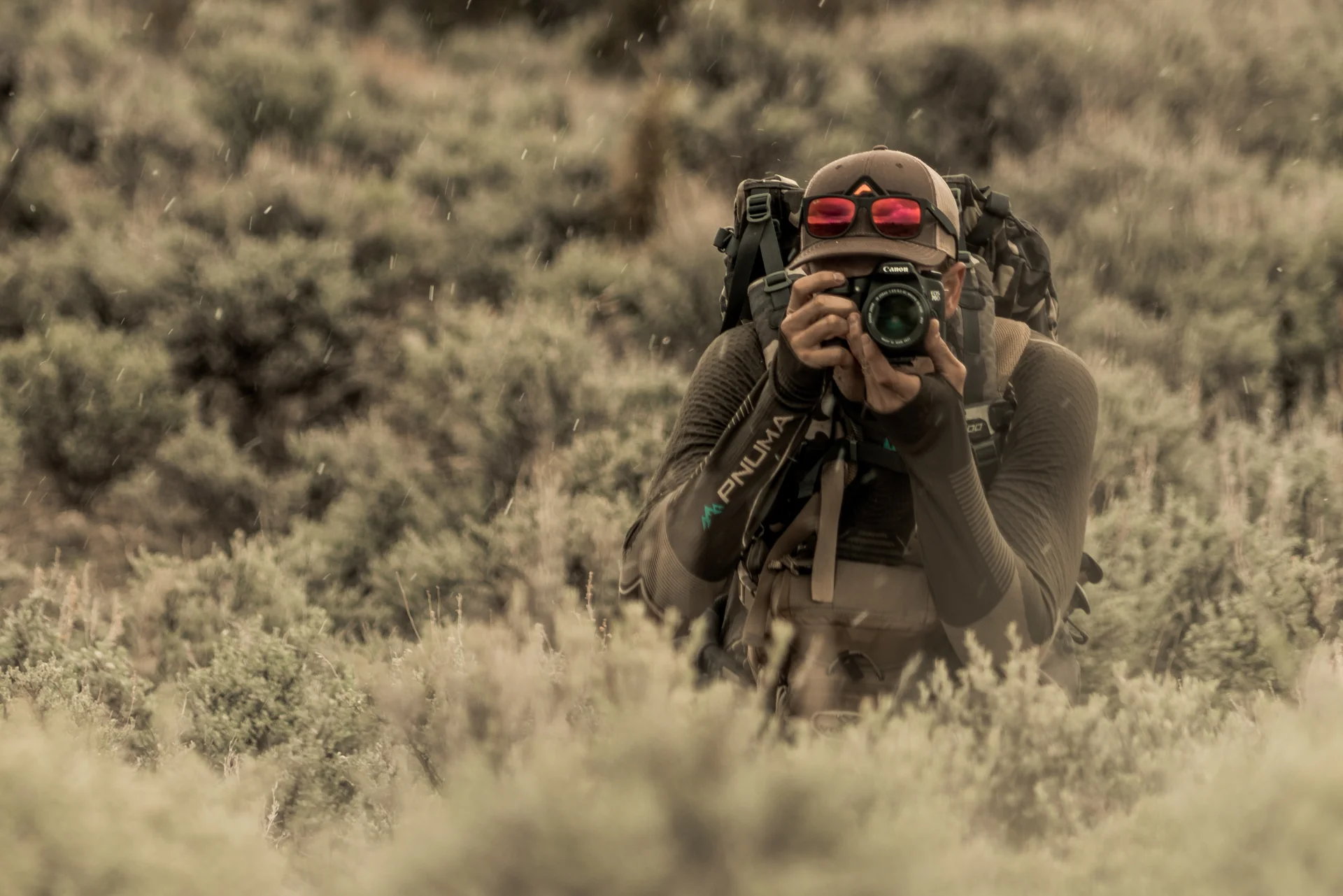
Don’t be afraid to bend those knees. Different camera angles will create more interesting compositions. Stop standing and pressing the shutter button!
If we are going to captivate our audience we need to start showing them a fresh way of looking at things. If we constantly shoot from our regular standing position we are only showing them what they see everyday. We need to offer them a new perspective.

Here’s an angle we don’t see everyday. I got up above this whitetail hunter and shot down while looking for a spot to place his stand. Variety goes a long way in photography.
When shooting a picture of your son on his first hunt carrying his bolt action .22, looking for the nearest squirrel, get down to his eye level, don’t simply stand there and shoot down at him. If you do that his background will be a bunch of browning leaves on the ground and will tell nothing about what is going on that day.

Get down to eye level when taking photos of the little guys.
Angles that angle up and ones that angle down say something very different and very powerful. If you have the camera on the ground pointing up at your subject it gives the subject the feeling of being in power. The opposite holds true if you shoot down on the subject. The viewer will have the power in this situation. Use these angles to help you tell the story of the image in a very simple way.
The use of leading lines in your images is another great way to force the viewers eyes to go where you want them too. Find natural lines in the image and have your subject placed at the end of them. When viewing the image, your eyes will naturally look down these lines and end on your subject.

Our eye naturally follows the center pivot irrigation line to the hunter above.
Finding diagonals in the scene is a great way of adding interesting elements. Use them and avoid the straight on flat looking shots.
Framing Your Subject
There’s a reason we put pictures in frames, they look good that way. What if we could frame our subjects within the image itself? Well we can!!
We can use elements around us to literally frame the shot. Now I’m not saying that it will be a perfect rectangle. It may only have one or two sides, but using something to help put the subject in a frame will help the viewer’s eye to go where you want it too.
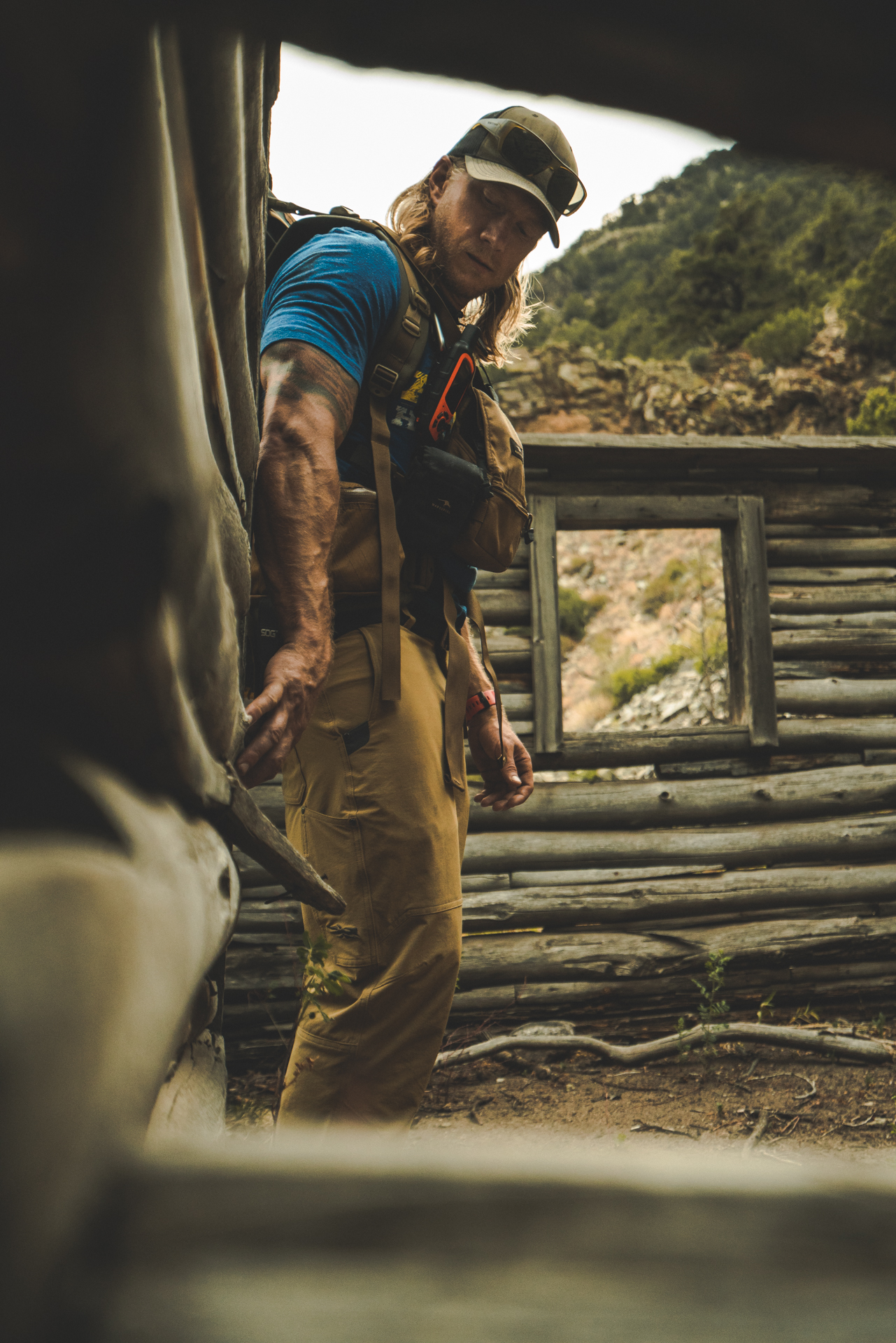
Using a window is a perfect way to frame a shot.
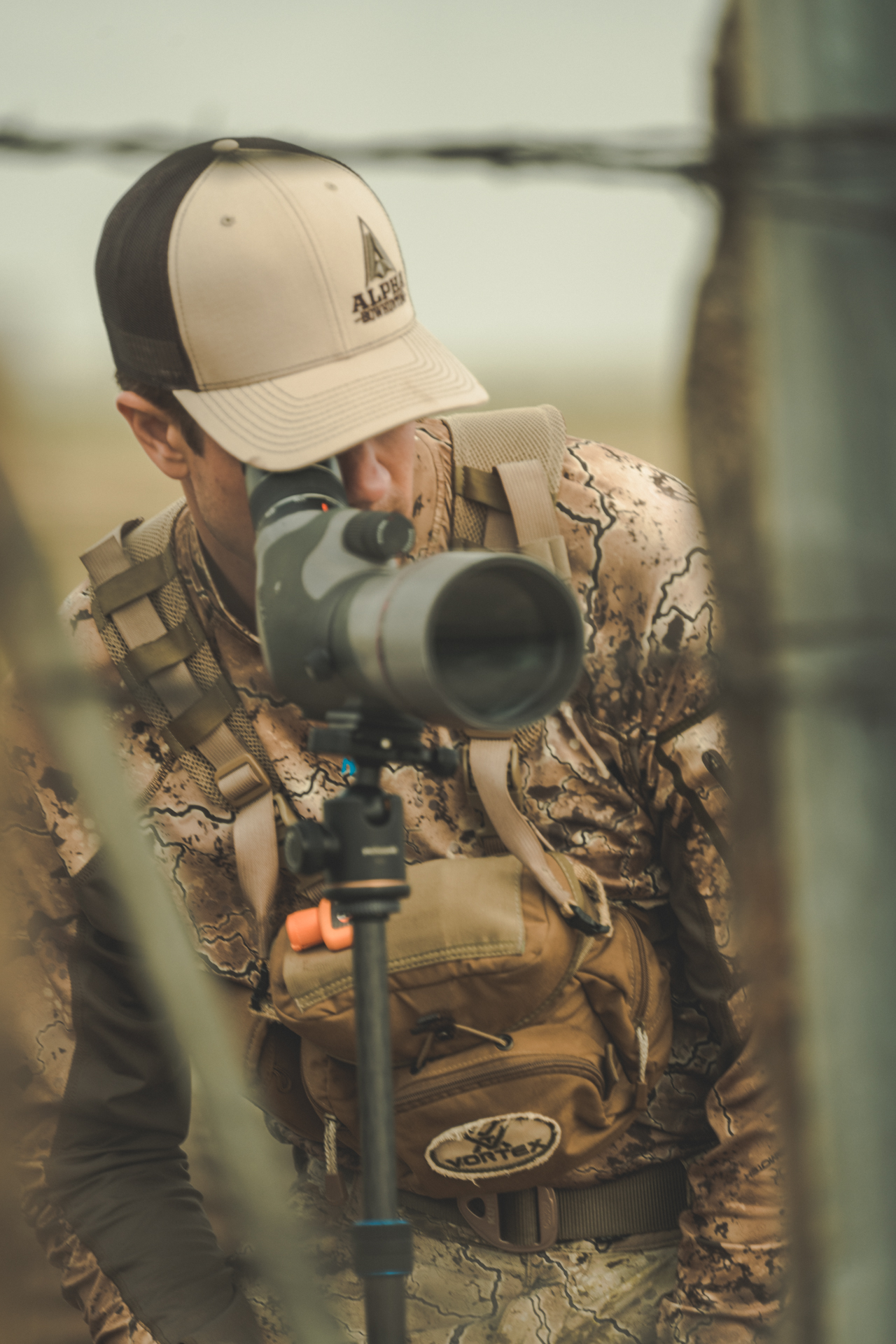
Fence posts also work great to frame your subjects.
Rule of Thirds
This rule was developed back in the late 1700’s and the world has been a better place for it since. Essentially it says that we divide up an image into nine equal parts with two equally spaced horizontal lines and two equally spaced vertical lines.

The horizon line was placed in the lower third (roughly) and our subject’s head in the upper right third for this composition.
Now we try to put the important parts of the image at the juncture of these thirds or if they’re long like a horizon line, running along the third.
Typically a subjects eyes will fall into one of the two top junctures of where the thirds meet. Horizon lines will be along the bottom third.
Image Depth
With image depth, we are attempting to take a 2D scene and make it as 3D as possible. We give it a foreground, the area where the subject is and the background.
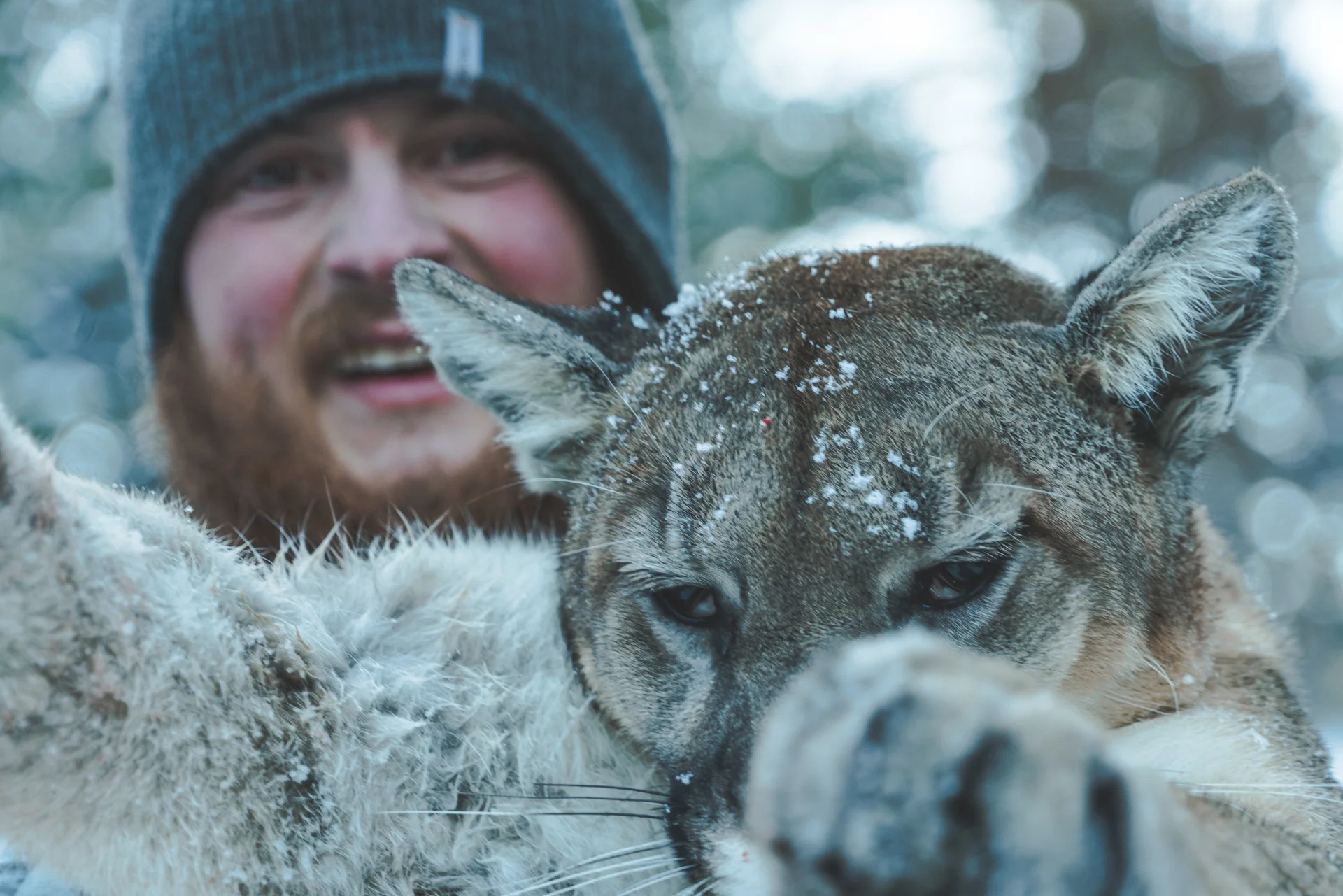
Notice the paw in the foreground that is out of focus. The subject, the lion, is in focus and the hunter which is the secondary subject is just our of focus. Finally the background is completely out of focus but gives a nice textural element for an appealing look.
Image depth has a lot to do with depth of field. We covered that in a previous article so I won’t bore you with it again here.
Typically we won’t want everything in focus when an image has a lot of depth. The foreground element will be out of focus while the subject is in focus and again the background out of focus. If you have everything in the scene totally in focus the viewer’s eye won’t know where you want it to go.
The background and subject are a given in a photo. Creating some separation between the two is important as to not have the subject blend in with the background.
A foreground element can be anything in the scene and you can use it to frame the shot. Just make sure that it isn’t overbearing. I often will take a branch with some leaves and actually move that into the shot in order to add a foreground element.

I put a corn stalk in front of the lens to add some texture to the foreground. Then the long line of corn allowed for a gentle drop off of focus. You’ll notice there is an obvious foreground, subject and background in this image.
This should get you started in telling a story with your images. Try these different techniques out and I can guarantee you will see an instant improvement in your photos and less yawns from the friends you show them to.
Hit me up on Instagram at fredbohm and tag me on some of your pics. I’d love to see how you’re composing your shots!
Continue on to Part 5 - Shutter Speed and Motion Blur
// Fred Bohm

Whitetail Hunting in South Dakota - A Lesson in Humiliation and Other Things
It must be a low gravity week.
I’m on my feet in a treestand, swaying with the pulverizing north winds that freezes snot to my face. Moments earlier I’d just released my fourth arrow of the trip. And moments earlier I sailed it high over the back of the fourth deer fortunate enough to be within my range.
“Welcome to Fred Bohm’s school of hunter education,” I mumble to the eight point buck as he heads for cover.
The sting of not knowing what I am doing wrong far outweighs the blast of the northerly winds. I just don’t get it. My brain is not making the connection. It’s not allowing me to rationalize what the error is.
Is it an equipment failure? Is my anchor point off? Has my form gone to shit or am I just getting frazzled.
There could be a litany of excuses, but they do me no good. To blame anything but myself is a way of protecting my ego and God knows I need less of that.

I ease back into the seat of the stand, trying to let the frustration seep from my body. But I know I’m fooling myself if I think it’ll go away.
This just isn’t fun.
You practice year round and base your life around bowhunting. You take it as seriously as anything ever taken in your life. Commitment wouldn’t begin to describe the obsession you have for this sport and come game time you choke. Four Pick-Sixes in a row and GM is making calls to get you traded.
What’s more is the heckling you know you’ll receive, people chomping at the bit, salivating at the opportunity to ridicule.
But perhaps you deserve it. I mean come on… four misses in a row?
I let the evening play out, damn well knowing the hunting gods don’t give fools a second opportunity to embarrass themselves. They’re too compassionate for that.

It’s just the way of it man. If you plan on having a long hunting career you better get used to this. Better yet learn to laugh at it and enjoy the humiliation as a character building experience. It’s going to be a long road and if you let something like this bother you. Hunting is going to eat you alive.
The air is a little less bitter as the day turns to evening. The sounds are peaceful enough and I forget that civilization is only a stone’s throw away.
A horde of sparrows clumped together looking for companionship in the desolate skies. They roar overhead. Alone they are silent passersby, but as a group they make the earth shake.
Why does this matter? Are you, Hazel and the kids going to starve if you don’t get a deer? If that were true you would have shot the first animal that walked by. This is a game. It’s as simple as that. It’s a game where the size of the animal you kill determines your pecking order in the tiny circle of friends and fellow hunters. You’re using these animals as social status.
I know it to be true but I don’t care. Hell, everything we do in life determines where we stand compared to the people next to us. It’s all a show for those willing to look in. One big dick swinging contest.
I willingly participate and know I will continue to do so. I know I’m not just out here for the full freezer. It would be a lie that would receive accolades on social media, but would also be complete bullshit that would make me feel like a phony.
I’m here for the challenge. I’m here to see if I can outwit or more likely out-patience an animal that eludes inept humans for a living. And its merit is based on is the size of its headgear.
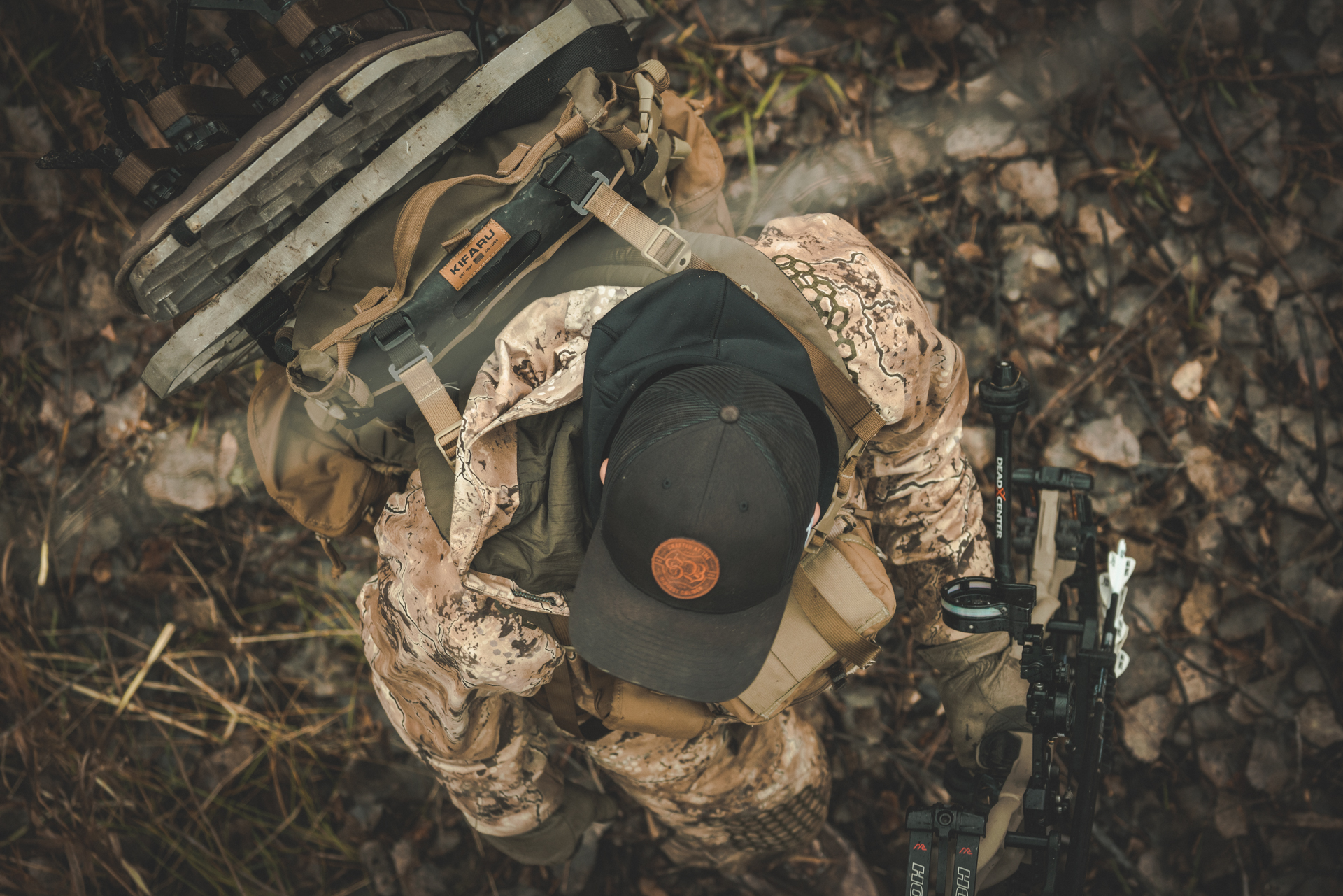
I continue to hold my bow, enjoying the deep burn as the cold conducts through the aluminum riser and numbs my hand. Just me, my weapon and my thoughts. Nothing could be simpler and nothing could make what’s laid before me more clear.
It doesn’t matter what you kill. The license allows for the life of one deer, it’s up to me to determine which one. Play your game and the law won’t step in. Media will encourage it. Your ego will thank you for it. Excuses on unfilled tags will abound when you’re hunting giants. Everything is rigged to encourage your to participate.
You’re letting your philosophy, which to be honest is non-existent, on trophy hunting distract you from the real problem here. Incompetent shooting and what it is causes. Missed opportunity.
A spike makes his way cautiously down the trail. His head jerks erratically looking for danger or from the suggestions from the voices in his head. Hard to tell.
I eye him over my neck gaiter that’s pulled up to my eyes. A god looking down on a lesser, determining if he’ll make it through the clearing with his life. Or just as likely spooked by an arrow that skims his back given my recent track record.
Such power. Maybe it’s something we revel in because we know there is something looking down on us at the same moment, determining the same thing.
He walks by without as much as a twitch from my bow hand.
By now the night has dug itself in deep. Things that were once clear only become shadows and memories of what should be there.
I make no move to get up. My hunt isn’t over yet.
// Fred Bohm

Close Up vs. Wide Angle - Hunting Photography Series - Part 3
Part 2 - Close Up vs. Wide Angle - Hunting Photography Series
Shot composition makes or breaks a shot, simple as that. Using the proper focal length is one of the more powerful ways of making sure you compose it right. When the photographer doesn’t consider how he frames a particular shot, the picture often doesn’t grab the attention of the viewer because nothing is being said.
An image tells a story. How you frame it will purvey the mood through perspective.
So you must first think what you want the photo to convey before you determine the focal length of the lens (or how much you zoom in or out for that matter).
Ask yourself some of the following questions before you snap the shot to help you determine whether to use a wide and or close up shot.
Are you trying to share the emotion, the frustration or elation of your subject?
Are you trying to show how insignificant the subject is in his/her environment?
Is it a landscape shot without a specific subject?
There are a ton of questions such as this that you should be asking yourself before you push that shutter button.
Focal Length Defined in Terms We Can Use
The focal length of a lens determines the magnification at which it images distant objects. This is how Wikipedia defines it. I could agree with that. A fancy way of saying how much you’re zoomed in. But that’s not what’s important to us, rather what it does to the images is what we care about.
So we’ll cover what the difference is between a wide angle vs. a zoomed in shot and how it will effect your composition.
We should talk about how focal length is measured. We’ll be conforming to the rest of the world here and be working with millimeters. A wide angle lens is anywhere from 14mm up to about 35mm. Going up from there out to 600mm you’ll be getting into a longer focal length.
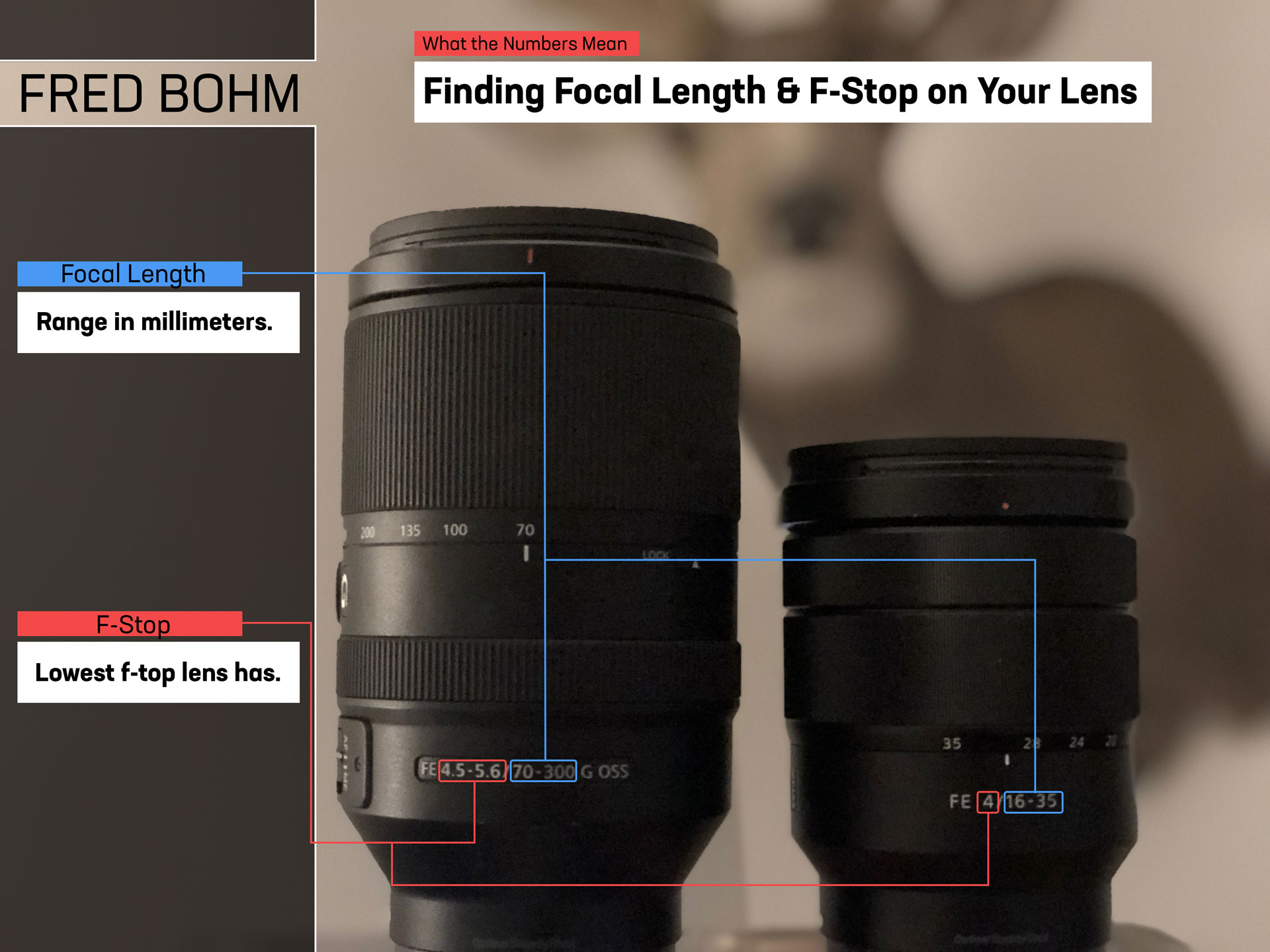
Here is where you can find the lens focal length and f-stop.
A wide angle will show more of the scene. It will also make the distances between objects appear further apart than an image shot with a long focal length (you can also read that as “zoomed in”). Using a wide angle lens will also give you a greater depth of field.
A long focal length will make a scene more compressed, or make it seem like there is less distance between objects. It’s a great way of pulling the background in closer to your subject. You can also get a shallower depth of field with a longer focal length.
We’ll work through some examples of when you might want to use different focal lengths according to different situations. When it comes to art, there are no hard set rules. But knowing why you’re doing what you’re doing is important so let’s try to get an idea of that first before we going breaking the rules.
Close-Up Shots
Ninety percent of my shots are close-ups. For me I just think they tell more of a story. Sunsets are well and great, but everyone shoots them and they won’t separate you from the crowd. Find a way of showing the emotion in a given photo and you become a master at storytelling. Having your subject standing out in a field blending in with his surroundings just won’t cut it. There are many ways of accomplishing this, but getting in there nice and close will certainly be one of those ways.
Get in there, see the pores on his skin, see the troubled look in his eyes. Use the background to help place the setting, but use your subject to relay emotion.

Keep the subject in focus and let the background help tell the story.
You can achieve a close up in two ways.
Standing a bit back from your subject and using a longer focal length.
Standing very close to your subject and using a wide angle.
I typically will shoot these shots with a longer focal length. This allows me to make the background appear closer to the subject. Don’t get me wrong, standing really close to the subject with a wide angle lens for a close up can be cool as well. Don’t go overboard however, a really wide angle can make a the subject look distorted.

This picture was taken with a 14mm lens. Notice that it has a great depth of field. This is mostly due to using a wide angle lens.
Example:
You’re five days into a hunt and the only shot opportunity was just blown by your hunting partner. Frustration levels are high, disappointment and doubt have crept in. You’ll never be able to recreate that feeling, so get that lens in there and capture that authentic moment. You can relay a slew of emotions to the viewer just by the look on his face. Make sure the weapon is seen in the shot, although subtly to relay that he is hunting. The background environment will convey the setting, whether you are hunting in deep timber for elk or spot and stalk hunting in the high country for mule deer. Capturing the surrounding elements are crucial in the story, but they need to be secondary to the subjects emotions. Meaning, capture it in his eyes and face.
Tip: Make sure the eyes are always in focus. An image is lost if the subjects eyes are blurry, so if using a shallow depth of field make sure the eyes are crystal clear in focus.
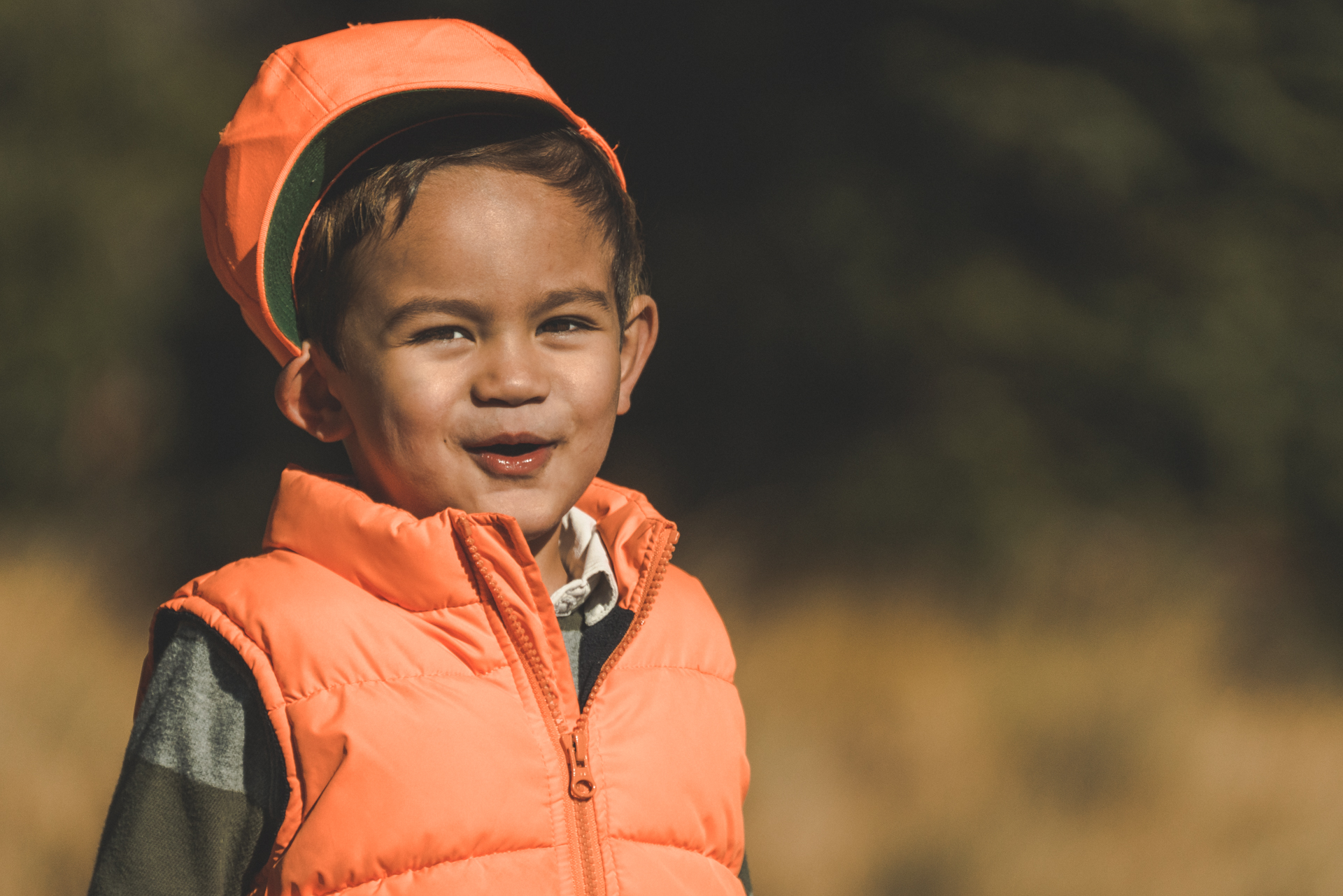
Make sure you keep the eyes in focus.
Close-ups can also show a subject in a light that has never been seen before. A close-up of the broadhead laying on your bows rest with the background element of sitting in a tree stand is way more exciting than another selfie of you duck-lipping it for the crowd in your tree stand showing off the kitty cat face paint pattern you work so hard on.
Or how about that dew about to fall off the tall grass while your Labrador works the pheasant fields in the background.
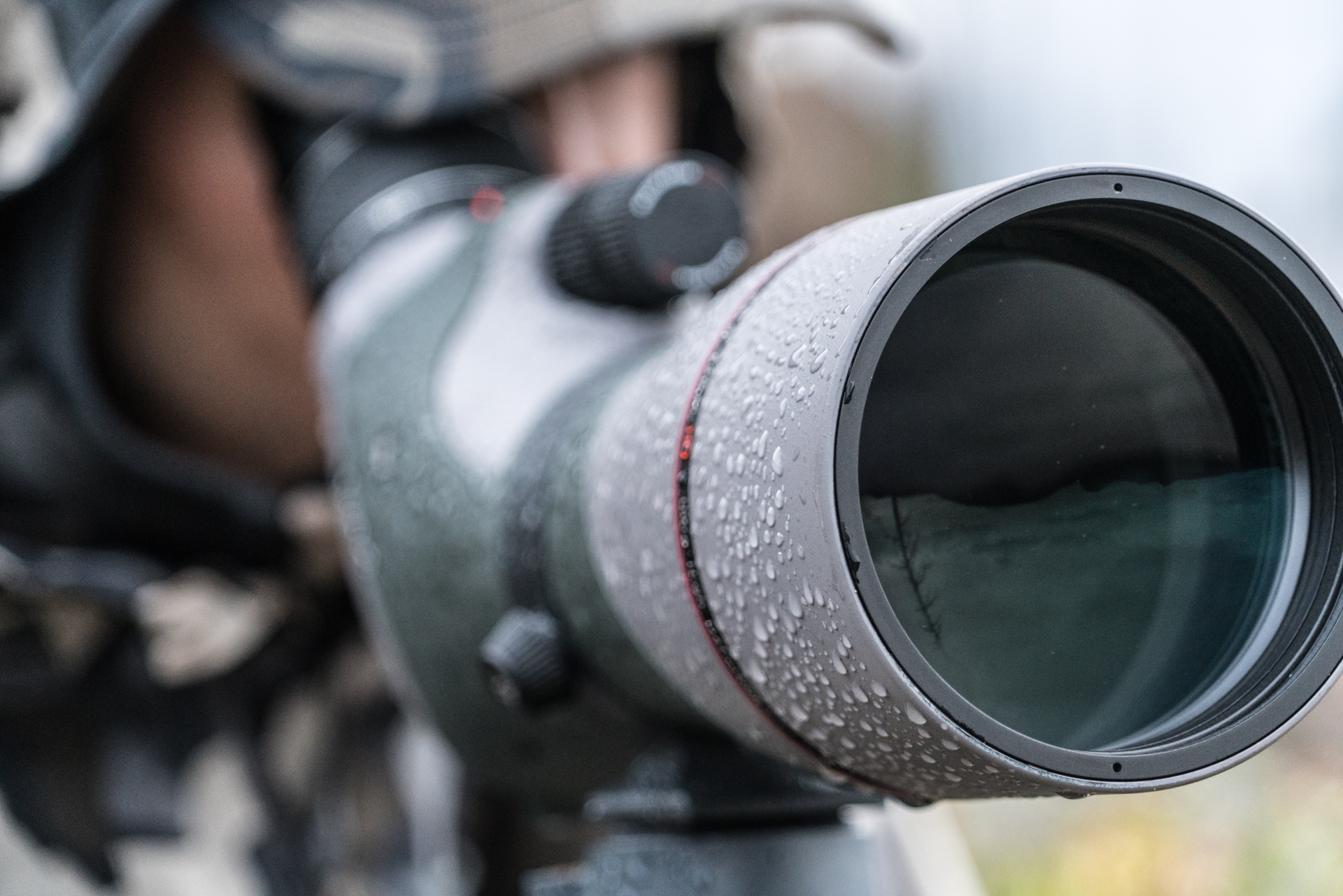
Getting close up in this shot helps tell the story. Seeing the water drops on the spotting scope helps relay the weather and misery that comes along with it.
Think of different foreground elements that represent the hunt and use background elements to reiterate what you are doing, but have it out of focus making it secondary to the main object.
Shooting close-ups can instantly change your game. Try it out. Go on a hunt and promise yourself that you’ll shoot nothing but close-ups for a couple of days and see how quick your photos improve.

Try to mix up your shots to tell a story.
Wide Angle Shots
Wide angle shots certainly have their place. What would a gorgeous mountain range be if you were only focused a singular tree jutting out of the side of it? How about a fly fisherman casting out below a roaring waterfall? It might be worth capturing the whole scene in this case, not just the wooly bugger he’s flipping out there.
A wide angle shot is often used to capture the beauty of the environment you’re in, whether there is a subject in it or not.

Wide angle shots allow you to capture more of the environment that the subject is interacting with.
Again for me, I always like to have a subject in the shot, interacting with the environment. This usually involves having them very close to the lens to separate them from the background, but keeping a great depth of field so that everything is in focus.
As with many rules, the opposite can also make for a terrific composition. Maybe you want the subject to feel insignificant in the vastness of his environment. Then by all means have them further away from the lens so that they feel small in the environment.
Warning. You need to find a way to have the subject stick out if you use the above scenario. Have them dress in bright clothing to stand out or above the skyline so they stand out above the horizon.
Putting it Into Practice
You read about it now it’s time to do it. Knowledge is worthless if not put into practice. Go out there and try four different shots. I’ll list them below. Use the same subject so you can compare how each picture makes you feel when looking at it.
Close up shot with a long focal length. Say somewhere above 100mm.
Close up shot with a wide angle lens. The camera will often only be a foot or so away from your subject. Less than 35mm.
Wide shot with a wide angle lens. Think landscape here.
Wide shot with a longer focal length.
Now sit there and analyze the differences between the four shots. All four of these techniques can be used for different situations and different moods. Find what does what and then use it! Create an image, don’t just snap the shutter.
Remember to hit me up on Instagram at fredbohm and let me see how you’re using these techniques.
Continue on to Part 4 - Angles, Framing, Rule of Thirds and Image Depth
// Fred Bohm

Depth of Field - Hunting Photography Series - Part 2
Part 1 - Depth of Field - Hunting Photography Series
We went through a 30,000 foot view on how to make your hunting photographs better, but as often happens with just a cursory look the basics are learned but the need for in depth detail is a must to fully understand and be able to implement it.
I will be doing a blog series on upping your game when it comes to taking great images while out in the field. Whether you’re an upland hunter, bowhunter, big game hunter or somewhere in-between, this series will help you take your photos to the next level. It doesn’t matter if you’re trying to beef up that family photo album or trying to work your way into sponsorships through Instagram.
A fully manual camera, preferably an SLR or one of the mirrorless variety will be crucial in order to obtain these types of photos. You can find my Camera Gear list here. This is just what I use, any of the major camera brand companies make amazing equipment and will work just as well.
Depth of Field
Mastering this technique of depth of field is a must for any budding photographer. Spend the time to learn this and you will take your photos from so-so to wow, just like that.
You may be asking yourself what the heck is depth of field and why the hell do I care? That’s a fair question. I’m going to keep it simple and in layman's terms to that you don’t just skip over this one and move on to the next, it’s that important!
What is Depth of Field?
Easy. Depth of field is how large of an area (from the nearest object to the furthest) is in focus within the image.
OK. So that made no sense right? Reading it is one thing, seeing it is another.
Take a look at these photos. They’re different right? They’re not. Well at least the composition hasn’t changed at all, but rather the depth of field.

Great Depth of Field
You see how everything is in focus? Everything is crisp and pretty much everything in the shot catches your attention just about the same.

Shallow Depth of Field
Now the second image, what’s different about this one? One object is in focus and everything else gradually blurs out as it gets further from it. Where is this forcing your eye?
Why and When to Use Shallow or Great Depth of Field
You’re going to start to notice something about all of these tutorials if you haven’t already. I will always be asking “why” we should do something. That is because great pictures rarely happen by accident. They are considered thoughtfully beforehand and then executed.
Shallow Depth of Field
So let’s start with shallow depth of field. When you make a spot of your choosing in focus and have the rest blurry, this forces the viewers’ eyes where you want them to be. It clouds out the insignificant elements in the photo and allows whatever you choose to be the important focus of the shot.
It keeps objects from blending into the background. It makes them stand out and be the hero of your story.
You often want to use this when you are taking a picture of a hunter and trying to relay emotion. His face is what matters and what it is saying, so make that the primary focus through a shallow depth of field and let the background become secondary.
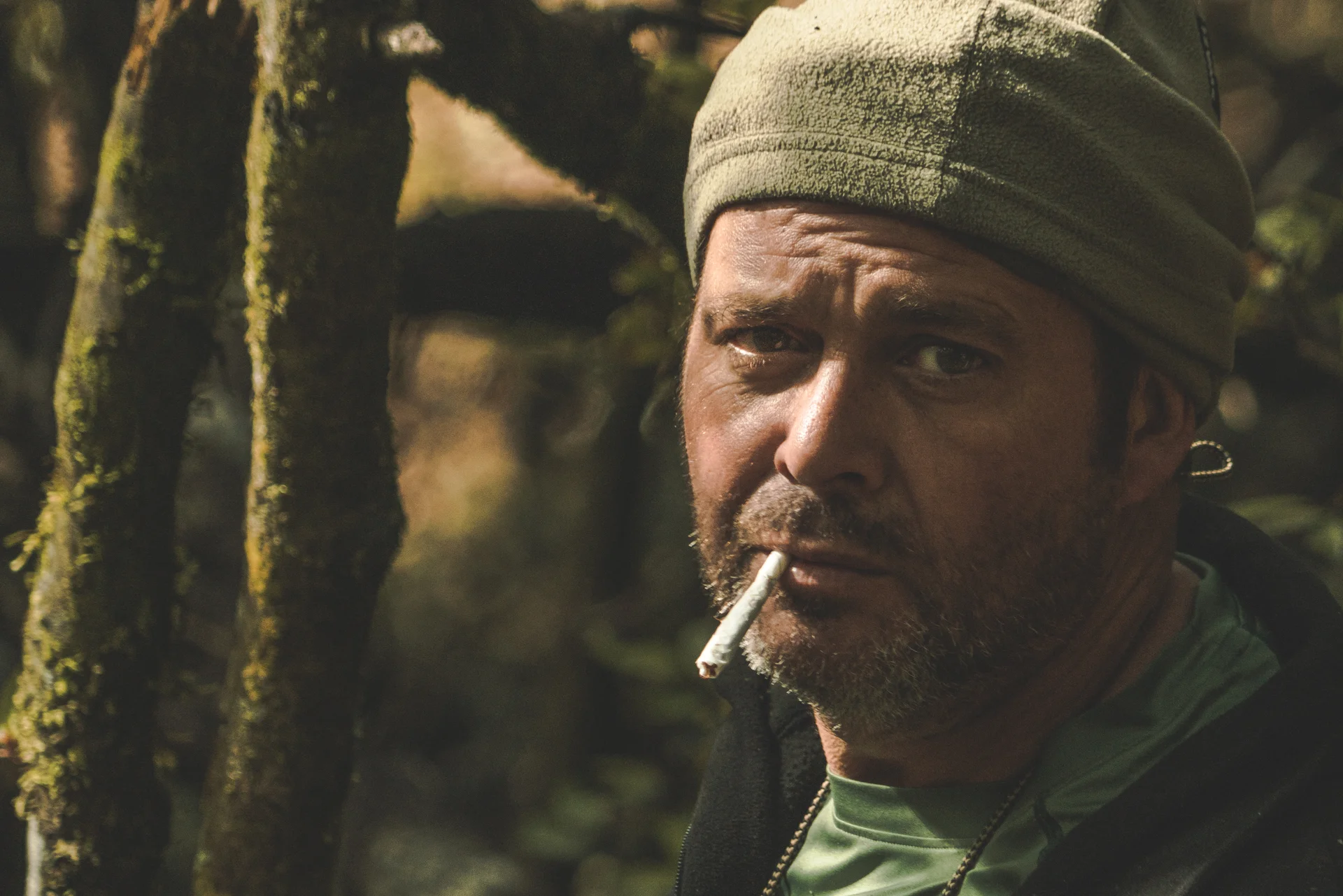
The eyes are telling the story here. All other elements are just there to solidify the subject into a setting.
How about that monster 4x4 mule deer you just shot, but it happens to be next to the sewer treatment plant? Not something you’re particularly looking to advertise. Use a shallow depth of field to make your trophy shine and turn that bucket of turds in background into a cool textural element.
Maybe you want to show off the cool new broadhead you’re trying out. Sure you want to see it on the rest along with the rest of the bow as well as the hunter. But the broadhead is the subject right?

The shallow depth of field in this picture is forcing your eye to look where the photographer wants you to look.
Put that in focus and let the rest fade away into a soft blur. We still can tell there’s an archer there and holding the bow that the arrow rests on, but they become secondary to the broadhead.
Great Depth of Field
If you’ve used auto settings on your camera or used your phone’s camera, chances are it was giving you the greatest depth of field possible.

Great depth of field lets you soak in everything in the image.
So when do we want everything in the image in focus? How about a landscape shot. You’re not trying to have one particular element compete for the viewer’s attention, rather you want them to sweep across the shot appreciating everything you captured.

The bright colors the subject is wearing as well as his upper body being above the skyline is enough to force the eye where you want it, no need for an extreme shallow depth of field.
Or maybe you have the subject above the skyline and close to the camera using a wide angle lens. The sheer size of him will force the viewers’ eyes to look at him first, thus the background isn’t competing for attention.
How To Create Shallow and Great Depth of Field
Great, we understand why we want it, now how the heck do we get it? As mentioned these tutorials are meant for cameras where you can control almost all of your camera’s settings. You will need to in order to be able to obtain a shallow depth of field.
There are three things that control the exposure of your camera.
Aperture (what we’re interested in for depth of field)
Shutter Speed
ISO
As you change any one of the above, you will need to compensate with the others to get the correct exposure.
But we’re talking about depth of field here so we are going to be talking about aperture. This is one of the main ways we can obtain a shallow depth of field. Focal length and distance the objects are from the camera and from one another come into play as well, but that will be for another day.
Aperture or f-stop is what controls the amount of light that the iris in your camera’s lens allows through. The smaller the hole, the greater the depth of field. The more the iris is opened, the shallower. You don’t really need to know this technical side of it, but if you’re a nerd like me you might be curious.
What really matters to you is the f-stop numbers. The smaller the actual number the shallower the depth of field. The bigger the actual number is, the greater the depth of field will be.
Let’s take a typical lens for example. It could range from let’s say f4.0 - f22. The “f” is in there to represent “f-stop”. The numbers are all that really matter.
An f-stop of 4.0 would give you a fairly shallow depth of field like in the picture below.

Using an f-stop of 4.0 for shallow depth of field.
This next picture has a great depth of field and has an f-stop setting of f22.
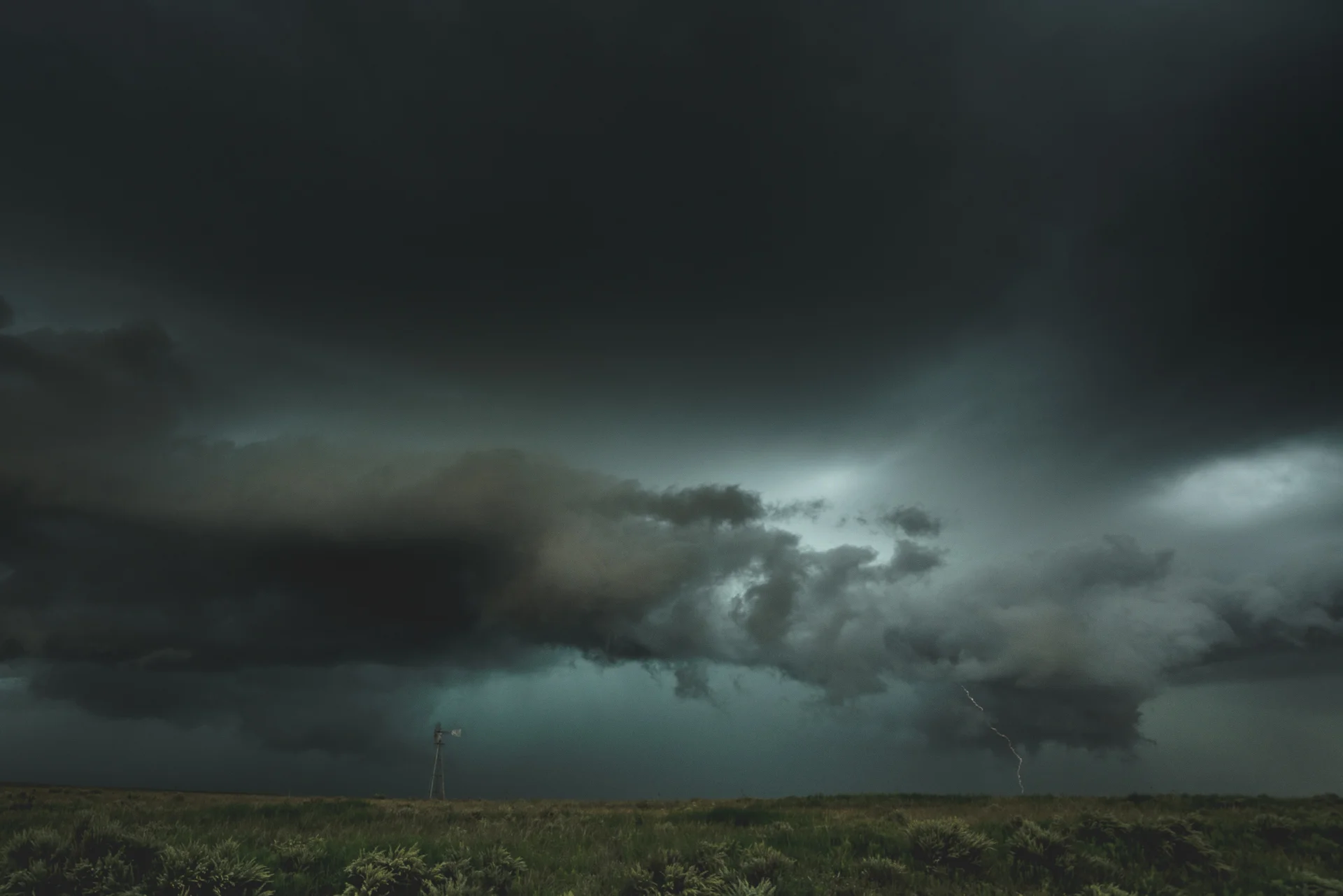
An f-stop of 22 for a great depth of field.
So as you can see you’ll want to use a shallow or great depth of field depending on what you are trying to accomplish. One isn’t better than the other, they just serve a different purpose.
A good exercise is to get out there and start taking the exact same picture with a shallow depth of field as well as a great depth of field. Don’t change focal length or anything else, just the aperture. What works for that particular image?
You can see the lenses I’m using for my pics on my Camera Gear page.
Find me on Instagram at fredbohm and tag me in your pics. I’d love to see how you’re applying depth of field to your photography!
Continue on to Part 3 - Close Up vs. Wide Angle
// Fred Bohm

The Art Self Control - Bowhunting Elk In Colorado's Backcountry
The herd of cows tear up goat country like hell’s gates just materialized at their heels. Along with them a five by five bull covering up the ass and with him my hopes of success for the season.
Joe stands alone looking over a cliff’s edge into the valley that held them moments before.
“You gotta be fucking kidding me. Did you need to sit on the edge and watch them?” I spew pure anger, “What good did that do? You know the wind is swirling. How in any way did that get us closer to killing these goddamn things?”
I was livid. I had to walk away before the words really started to boil.
Get it back down to a simmer at least buddy. No need to get nasty.
The anger takes on a life of its own. A dark place within festers, threatening to grow and become a life of its own. If I don’t control it a friendship will be lost.
I know I am projecting. That I’m really mad at myself for letting this happen. The blown stalks are stacking up and I need an outlet, a person to try to pawn this embarrassment off on. I happen to have someone ten yards away to hurl insults on and I take advantage of it.
Joe has been hunting elk for a few years, me much longer. I should know better and I should have made the call.
Instead I decide to be an asshole and push the blame to protect my fragile ego. I am weak and I know it.
You’re a scared little boy. Fucking control yourself.
“He was a pretty small five by five, eh?” I say.
My voice calms and I let the emotion wash off and absorb into the earth blow.
The consolation prize. Pretend it’s something that you didn’t want anyway. Pretend that the reason you messed up has nothing to do with your impatience and lack of skill but rather that he wasn’t good enough quarry for you anyway. Pretend that it was someone else’s fault. Anyone else's fault but your own. Lie to yourself.
The inner monologue wasn’t helping so I shut it down.
“On to the next one?” I say.
“On to the next one.” Joe repeats back as if nothing ever happened.
I could tell he was used to dealing with the intensity that can come from a blown opportunity. He takes the higher road and doesn’t come back at me like he deserves to.
We gather ourselves and head for a vantage point, trying not to notice the globs of fresh elk shit and other sign that even a blind man would see.

We push higher up, a common theme when we hunt together.
“Might as well give the valley a good glassing and see if there are any late wanderers headed back to their bedrooms,” Joe says as we walk.
We’re above treeline and the walking is easy. A game trail that could be mistaken for a well maintained hiking trail points us to the next valley over.
We pick a spot to sit and glass that offers us a shot opportunity at any window shopping elk that happen to pass by.
A few cows and a spike graze in the valley directly below. Nothing worth chasing but it’s a relief to know that our efforts haven’t cleared the whole mountain range of four legged animals.
The heavy clouds build up as we set glass to cross valley mountain in hopes of making anything huntable appear out of the still land.

The cooling air negates the effects of the thermals for that time of day and everything comes to a standstill. It’s dead silent as the mountains shut down their eternal wind making machine and drops it in neutral.
“They’re going to switch early today,” I say while continuing to glass.
“Yup,” replies Joe.
Now we just need something to chase.
As if on cue.
“Got those bulls from yesterday. They haven’t moved but ten yards from where we saw them twelve hours ago,” Joe says calmly.
“They’re near the valley floor. That must mean no one is down there chasing them,” I respond back. “How the hell can there be no one chasing them?”
“Dunno,” comes the reply. “I mean the backcountry army that has laid siege to this land must have read on some internet forum that they were using that avy chute to feed.”
Maybe this idea that the more brutal you make a hunt the higher your chances of success is backwards. Maybe we’ve had it wrong the whole time.
“That’s definitely in the cow zone, let alone bull zone,” I say with a twinge of excitement in my voice.
“It’s still eight and a half miles in man. Better than shooting one up here, but that’s a whole lot of elk to get out of here,” Joe responds bringing me back to reality.
“Two elk,” I correct.
“Huh,” he responds
“Two elk. There are two bulls down there. That’ll be two elk to carry out eight and a half miles,” I say.
“Right…” Joe responds. “With the way it’s been, lets just worry about getting one on the ground big dreamer. Let’s wait and make sure the thermals push down the mountain then we can make our way in.”
I settle back into the hillside and peel my eyes away from the two bulls feeding out in the open. I’m baffled by their audacity. They strut about as if they weren’t on public land and as if they hadn’t had carbon and lead thrown their way from the time their eyes opened to the world.
It must be exhausting being seen as a source of food, never knowing if there is something lurking for you behind the next tree. I feel sorry for their predicament in life for a minute, but know this was the hand they were dealt. Better them than me.

The thermals did what they have been doing since the beginning of time. There’s no free will, just science that acts as the hand of god and the wind changes to a consistent downhill pull.
“Looks like we can get in pretty close before having to play our hand,” Joe says as we take a last look at the lower part of the avy chute where the two bulls have just recently bedded back down.
“I’m thinking we can get within a hundred yards of them and do some quiet bugling and raking,” I say. “Nothing flashy, just something to gain their attention.”
“Agreed,” Joe replies.
We make our way down to the valley floor. No easy feat when you’re sitting fourteen hundred feet above and the contour lines look more like a solid line from a Sharpie rather than the well spaced lines I was hoping for.
Once on the floor it will be a hunt of faith. We’d have to push in close without knowing if they backed out. Such is the way of spot and stalk.
We creep our way through the random trees that have fought for solid ground in the swampy drainage that is the main artery of the giant mountains above.
Habit takes over and we both crouch low as we push our way forward. I know that it makes no difference, they will either see us or they won’t. Dropping a foot lower isn’t going to change that, but sometimes you negate the “shoulda, woulda, couldas” before they happen if for nothing else but piece of mind.
Communication converts over to hand signals. Navy SEALS of the backcountry.
We split out thirty yards apart, wanting to stay within sight in case one needs to call for the other.
The air is heavy in the thick in the shade of the pines as we approach our predetermined point of attack. I feel like a stalker hanging out in the shadows of an alley waiting for an innocent bystander to walk by.
We’re in position and we let everything go quiet for a while, letting our ears become accustomed to the deafening silence.
Minutes roll by and I can now hear the flutter of tiny songbirds, the far off rush of the stream below and the blood in my own ears.
I grab the bugle and blow an introductory note into it. Nothing dramatic, just a wake-up call to let the locals know that a newcomer has arrived. Some light raking on a nearby pine to add to the realism and then I go silent.
The constant breeze in my face has me feeling confident as the sun begins to slip away. I don’t see or hear them, but I know they are there.
My eyes scan the open park as if trying to will something to appear.
And then he just materializes. He doesn’t walk out, he doesn’t come in running, but rather just appears as if a wisp of fog is blown away to reveal his presence.
The ambient background sounds are overpowered by the rushing pulse in my ears and the heavy breathing of my lungs.
Control the situation before you do something stupid.
I pull up my rangefinder as slowly as my patience will allow. One hundred and eight yards.
The battle has started and I clearly don’t have the upper hand. He moves along a rounded ridge and I can tell by his body language that he knows something isn’t right. He’s expecting to see some fur behind the vocalization and when that doesn’t appear he walks a perimeter of perceived safety to try and suss out the dilemma.
I know I have to act or I’ll lose him. Sometimes doing nothing is the best thing, but this isn’t one of those times.
Joe has been dead silent behind me, so my guess is he can’t see what I’m seeing. He has no idea that we have a visitor.
I squeak out a quick cow call, full well knowing it will give away my position. But something has to be done.
The gamble is worth it as I hear the cracking sticks from Joe’s movement behind me. He throws out a few cow calls, pleading with the bull to come in.
His attention snaps to where the sounds are coming from. Slowly the yards are shaved away.
He’s bright in the open field of the slide area, me dark below the heavy pine limbs. He struggles looking in, trying to catch a glimpse of the cow causing this inner turmoil within him.
Trust your survival instincts and you’ll live. You’re mating instincts will betray you.
The pull is too strong and he continues towards the darkness. He sees my slight movements but they aren’t enough to overpower his urge to breed.
At fifty-five yards he turns broadside and pauses. He looks back from where he came in case the need for an escape route arises.
I know I’m pressing my luck. I also know that at fifty-five yards he has no chance of surviving.
By the time he comes to his senses it is too late for him. His urges betray him, my fanatical training on the other hand doesn’t.
He catches the arrow in the bulk of his body that releases the tell tale “thud”.
He walks off sick. He shows no sign of feeling the impact, but knows his body isn’t reacting to the demands of his brain.
I lay my bow in the pine needles and watch him walk away.
The sun fades and along with it his life.
My fists pump into the air, expelling the elation of something long sought finally being obtained. The years, the miles, the sore back, the time away from family. Everything balls together and punches me in the face.

I look back at Joe. He has glass to his eyes but it isn’t focused on the bull laying in a pool of its own blood.
Shit. What did I miss?
My head swivels to where he was looking. My binocs go up and in it is the full frame of the second bull, obviously curious as to what all the commotion is about.
I keep my eyes pinned to the glass, full well knowing that the wheels of motion have already been set into place. At this point I’m merely a spectator.
A train locomotive goes roaring high above my shoulder. The impact is breathtaking.
The animal’s head snaps back as if it was rear ended by a texting teenager in their mother’s soccer van.
He takes three steps and is uprooted. His feet go up in the air and position themselves like the tree limbs of some morbid fairy tail.
“This didn’t just happen,” I say as Joe approaches.
We both stand in the fading light looking stupid.
“Two bulls down?” he says.
“Two bulls down,” I repeat.
// Fred Bohm

Bowhunting Colorado Pronghorn
You’re waking up tomorrow morning and you’re killing an antelope.
This wasn’t a pep talk, this wasn’t what I hoped I would do, this is what I was going to do.
I’m not cocky when it comes to killing animals. Far from it. I usually know it will take the whole season, praying to every god and deity that comes to mind and knowledge that a heaping portion of luck will be needed in order to walk out of the woods successful.
Not this year. Not on this hunt.
As my head hit the pillow in the back of my truck the night before the opener, I knew with complete certainty that an antelope would be dead before noon the next day.
How it would happen I did not know. But now being now and then being then I’m here to tell you how and when (I think I just made Dr. Seuss proud right there).
During the drive in all the typical spots are loaded up with pronghorn. I take this to be a good sign. Slowing down, I put the truck in park to see if they are still skittish after nine months of R & R.
As I sit back with glass to my eyes, they momentarily look up at me with a fading interest and then go back to feeding.
They don’t know my intent, this was very good. That or the ranchers have been doing me a solid and brake checking them throughout the off season to dull their senses.
I cruise the dirt roads like a teenager on main street and find similar results. With everything being just how I had hoped, I pull into my camp spot.
The Block target comes out and the bow does the same. Some last minute carbon confidence boosters are set into motion as I slam home arrow after arrow from various distances and contorted positions.
Everything seems to easy, almost effortless. I run through my game plan as
I pack my bag with gear for the morning.
I have a feeling that it would almost be absurd if I didn’t kill on my first stalk tomorrow. Like all these years I had been telling myself that bow hunting was hard was just something that I had made up in my head. That tomorrow would prove all that to be wrong.
My head hits the pillow and my eyes weigh heavy as the dry lightning off in the distance lulls me to sleep.

My eyes open a minute before the alarm jars the silence of pre-dawn.
Killing time.
I sip coffee that causes the roof of my mouth to peel as I wait for the sun to creep up enough to make my spotter an effective extension of my eyes.
Nothing in the immediate vicinity.
A short stroll turns up nothing. Foot leather was out, tire rubber was in.
I hop in the truck and make my way around the predetermined circuit I have in mind.
After a few coffee spills and numerous head bounces off the windshield later, I spot two antelope sky-lined in the distance.
I don’t slow down as I know this was a dead giveaway to me being a hunter. One watches me while the other feeds.
The truck eases to a stop behind a hill. Out of sight, out of mind seems to be the thought process behind speed goats.
After a short walk I belly crawl up a rounded hill and use a yucca bush to conceal my final approach. As I look over I see the second of the two bed down just in time before he conceals all but his horns.
There is no play from this side, but after looking at my map the contours appear to be just enough for a concealed backside approach. The wind will suck, but these aren’t mule deer or elk. With eyesight as good as it is, they often become overconfident and don’t place as much weight in their other senses.
The bigger of the two will die.
This is the last thought I have as I lift myself into the truck and circle my final approach to the landing zone.
I take my bow and the decoy, knowing that at this time of year a bachelor group of bucks can often be curious to an uninvited arrival.
I use what few landmarks I saw to get me in close and then depend on my glass to do the rest.
At about 120 yards out I see the tips of two separate horns. In a rare event, I am able to see them before they see me.
Never has a hunt worked out this smooth before.
Before my luck changes I decide to prep the decoy. As I am doing this I feel the wind shift and bite into the back of my neck.
I’m not the only one who notices it. One of the bucks is up. Not running, just up.
I slam the decoy’s legs into the dirt and keep low.
The sequence begins.
Nock arrow. Twist peep. Engage the release and get your rangefinder ready.
The bucks are up and I notice a third decided to join the party.
They walk towards me, wanting to properly introduce themselves to the newcomer. Through a yucca I spot the one I’m after. He’s considerably larger than the other two and the one that will be dying momentarily.
They come in and halt on a dime. I peer over the back of the decoy that is rocking in the breeze.
Sixty yards, broadside and looking to die.
I draw back under concealment and thump into the wall as I pull through the valley.
I settle into a kneeling position and all three are staring at me like they are seeing a long lost relative.
The vanes catch a hold of air and start the arrows rotation during the approach. It buries deep into the antelope.
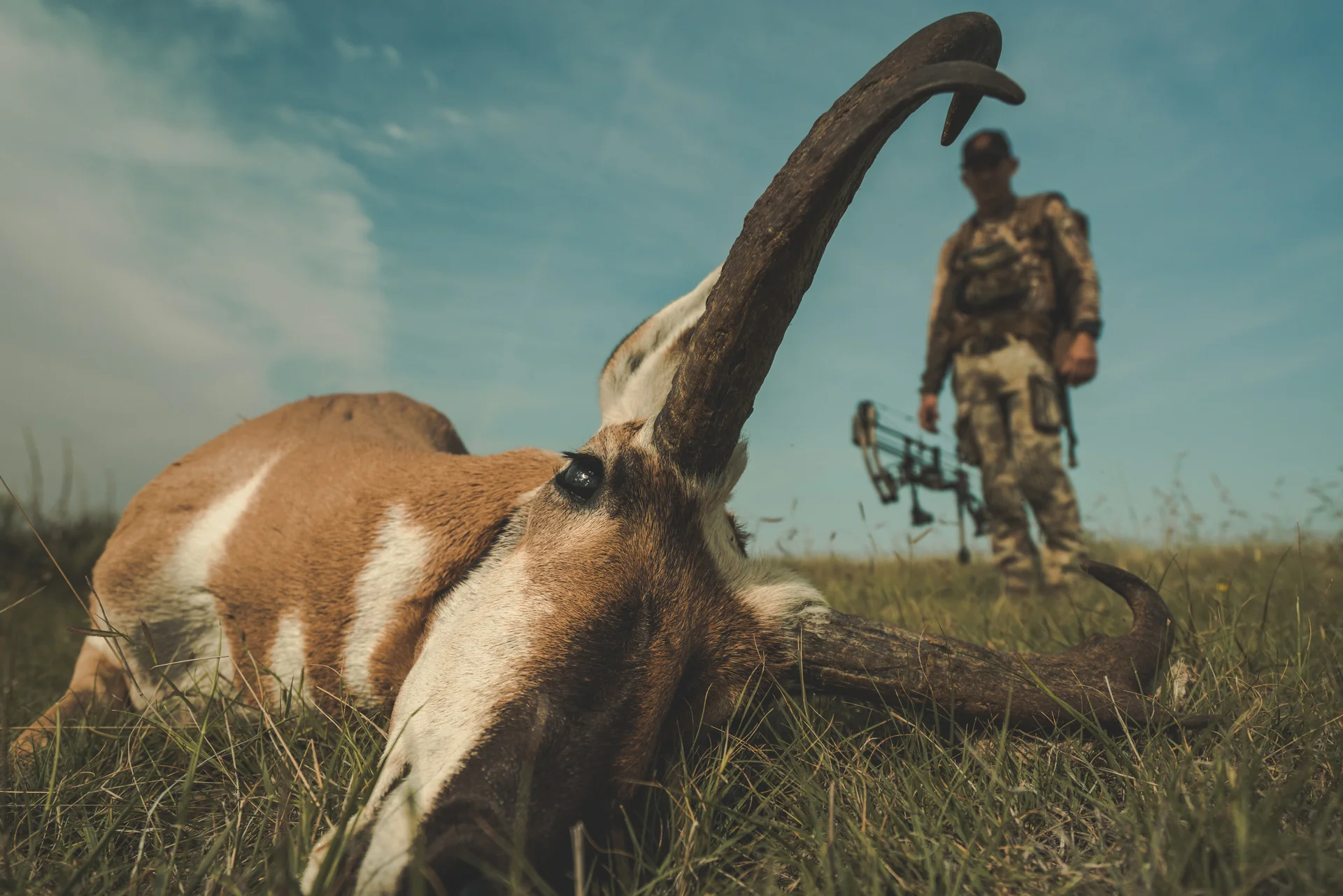
He proceeds into a death spin, running three full laps around an imaginary race track only to pile up fifty yards away in a cloud of dust. His friends stroll away giving me the notion that this wasn’t the first time something like this has happened in front of them.
In a world where you’re always the prey, friends are often a disposable commodity.
I made the FaceTime call home. The woman and kids are still in our bed as we walk up to the antelope.
My son is ecstatic about seeing the animal only previously described to him now materializing before his eyes. He’s happy that I’m happy, but mostly he’s happy that I’ll be coming home.
“Well that was quick,” came the response from Hazel. “What do you plan on doing with the rest of the week?”
“I don’t know,” comes my honest response.

Killing on opening day doesn’t happen to me so I hadn’t prepared another plan. With elk season only a week and a half away, maybe it was time to start visualizing another opening day success story.
Or maybe I would start praying to the hunting gods to allow for a repeat.
// Fred Bohm

How to Take Better Hunting Photos - Hunting Photography Series - Part 1
So you’re looking to take your hunting photography from impressing grandma at the nursing home to having every hunting company fighting over you for sponsorships? Well I have no clue how to get you to the later one (or me for that matter), but I can help you up your game. To get you to a point that you have something you will be proud to show at the end of the hunting season.
Snap a photo and you’ve taken a small segment of time and deposited it into your life’s savings account, able to be withdrawn repeatedly and at the time of your choosing. You take something that your feeble memory would otherwise alter or forget and you give it permanence. And if you capture that moment in a way that tells a captivating story you have something that others would be interested in viewing as well.
You may be looking back at last year’s hunt and saying to yourself, “I have none of the above. I have what looks like a half assed selfie of me standing in the woods. And I use the word “woods” lightly, it could actually be mistaken for my backyard. The only story I was telling is that I can stand up straight and slap an awkward smile on my face, or if I’m super talented some duck lips and my ass pushed out.”
I’ve been there. It’s good that you recognize that. Now you can move forward and create the photos that you’d be proud to post.
Photography has become insanely popular over the past years due to both the ability to get an amazing camera in your hands at an affordable price as well as the ability to show off your hard earned work to thousands of people with social media like Instagram and Facebook.
Back in the day you had to process film which was both expensive and didn’t give you immediate feedback. Enter digital cameras and everything changed. You now look back at the photo you took seconds ago and determine if it was a good shot or not, whether you need to take another one, try a new angle or move on to the next shot. Instant gratification in a world that not only expects it, but demands it.
Whether you’re looking to just advance your skills for your own personal satisfaction or trying to get noticed online, it’s hard to argue that becoming more proficient in photography has any adverse effects.
For those of you aspiring to the later of the two, social media can get you in front of a massive audience. That is if you can stand out from the crowd. The negative side to the ease of taking and posting photos online is obvious. Everyone is doing it. It is easier than ever to blend in with the crowd.
Another selfie of you sitting in a treestand? Great. Another sunset over the mountain? Super. If you’re goal is to get noticed, I’m sorry to say you’re failing miserably with those types of photos.
So how do you stand out? The same way you would in any aspect of life. Be different.
A great way to do this is to look at photographers online that you follow and would love to emulate. Then ask yourself some of these questions:
What is the subject doing in the photo?
How close-up is the shot of the subject? What angle is the shot taken at?
Are they using a shallow depth of field? If not, why?
Where is the subject in relation to the background?
Is there a foreground element framing the shot?
What in the composition is conveying emotion?
How did the photographer tell a story through the image?
Get into their minds and try to understand why they are doing what they are doing. A good photographer isn’t just lucky every time they go out and shoot. They take the time to compose the shot according to framing, angles, lighting and a multitude of other things.
I’ve compiled a list of game changers for me after analyzing the photos I’ve taken over the years.
Taking Better Hunting Photos
Take the Time to Stop and Take Pictures
So obvious, but almost never done. This could be the most important of all. You’re not going to get great pictures if you don’t have any to begin with. Every time you think to yourself “Man, that would be a great shot,”, force yourself to stop and pull out the camera. I promise you will thank yourself later.
Never convince yourself you will get the picture later. You won’t. The moment will be gone forever. You can’t depend on that perfect misty morning to happen again, the sun flaring through the trees just perfect or your gun dog shaking water off after a dip in the creek. When it’s gone it’s gone. Promise yourself you’ll capture it when you see it.
Buy a Peak Design Capture camera clip. This thing alone doubled the pictures I took after I bought it. It allows you to clip your camera on your backpack’s shoulder strap and gives you easy accessibility at all times. You won’t have to dread stopping and rummaging through your backpack to pull out your camera.

Lighting like this isn't around for long. Commit to taking pics when a moment like this comes along.
Pixels Are Cheap.
Shoot often and liberally. This is almost like suggestion number one. But now that you have your camera out in hand, shoot a ton of photos. Move angles, shoot from down low, up high. You never no what picture will capture the perfect expression on your subject’s face.
Get Up Close and Personal
The easiest way to fall into mediocrity with your photographs? Stand back from your hunting buddy and take a picture where he blends into the background. No emotion, no forced perspective and no fun.
Shoot close-ups. Get in there close. See the stubble on his face. Capture the light reflecting off his or her eyes. Show emotion. Make them the subject and let the background tell the rest of the story. But don’t let them blend in. You can achieve this by...
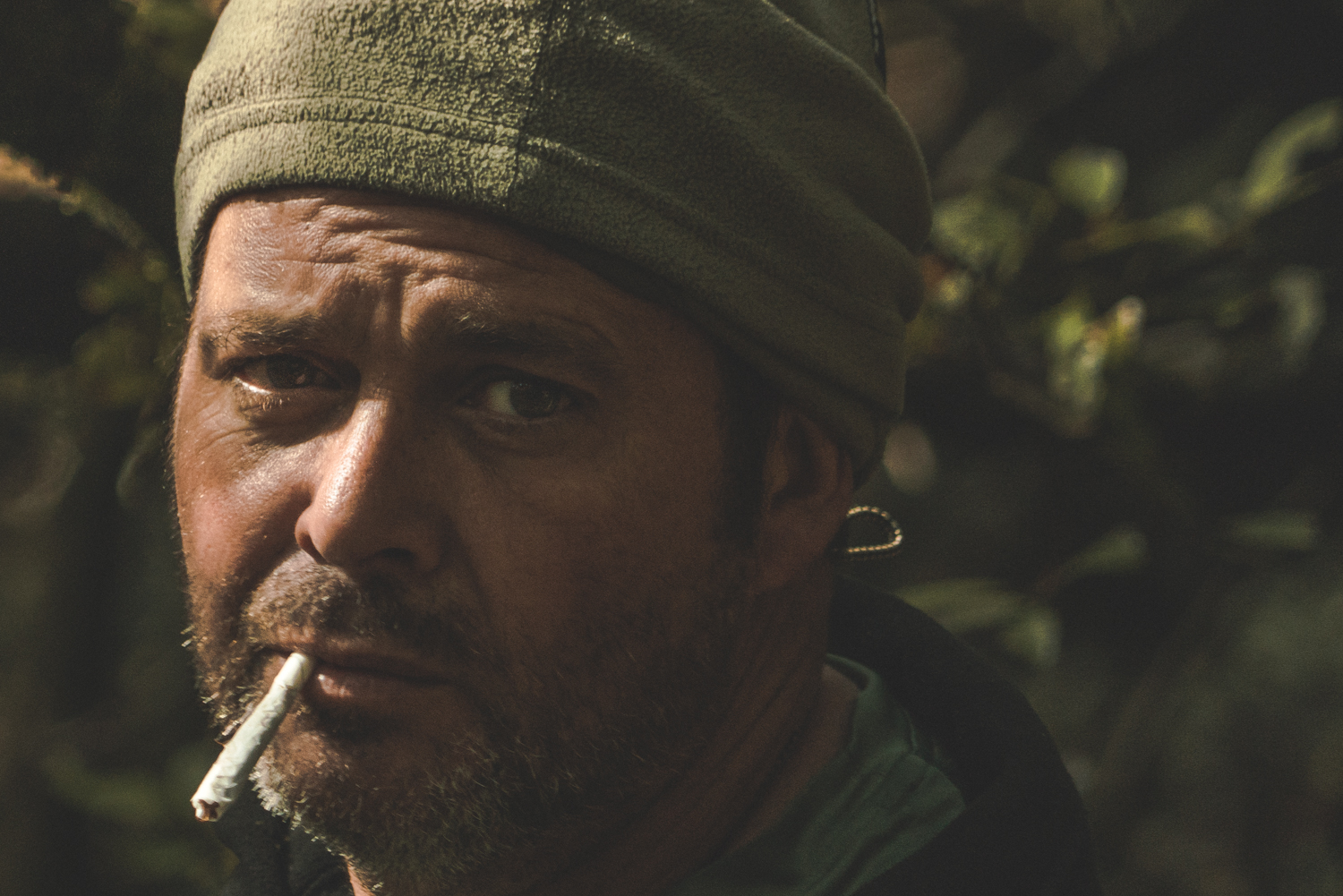
Get up close and personal.
Shallow Depth of Field
Force the viewer to look where you want them too. One of the best ways of doing this is through a shallow depth of field. Your subject is nice and crisp while the secondary element of the picture is out of focus. The viewer’s eye will naturally go to what is in focus.
Using this technique is one of the easiest ways to separate yourself from the crowd.
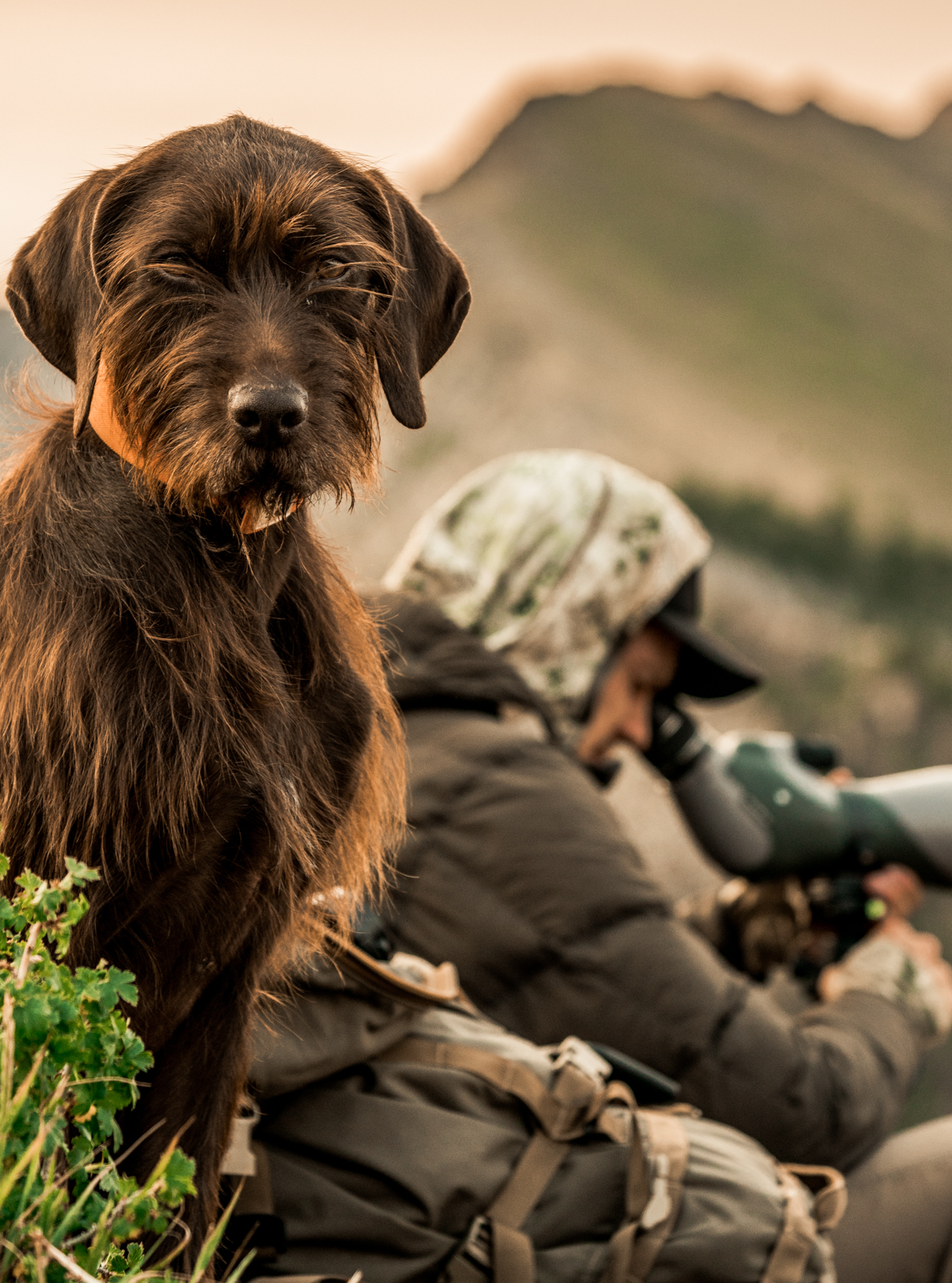
Force the viewer's eye where you want it to be. Then use interesting background imagery to help support the story.
Rule of Thirds is More of a Suggestion, Not a Rule
The rule of thirds has its place, don’t get me wrong. But when everyone is using a rule it becomes the norm. It also can take away from your creativity when you think you need to adhere to strict rules. This is photography, the only rule that counts is getting a spectacular photo.
When using the rule of thirds, make sure you face your subject towards the empty space or you will create an awkward tension that something is coming up behind him or he is looking at something of screen that the viewer can’t see. Or if you are looking for that tension, do exactly this! Remember there are no rules, but know what you are intending your viewer to feel.
Remind the Subject You’re Not There
You’re not taking family photos, you’re trying to capture the essence of the hunt. Having your subjects act as natural as possible and not looking at the camera goes a long way into making the shot believable.
The above is easier said than done. Likely your hunting partner is not an actor whose sole purpose is to act natural in front of a camera. The average person get weird and act awkward when a camera is pulled out. They are self-conscious and don’t know how to act. This is where your job as a great photographer comes in. You need to sneak photos in and take them of them when they are not expecting it. If they know your camera is out start pretending to shoot a picture of a tree your standing next to, then whip the camera around after they’ve lost interest in what you are doing and snap those pics. Whatever it takes to have them act natural.
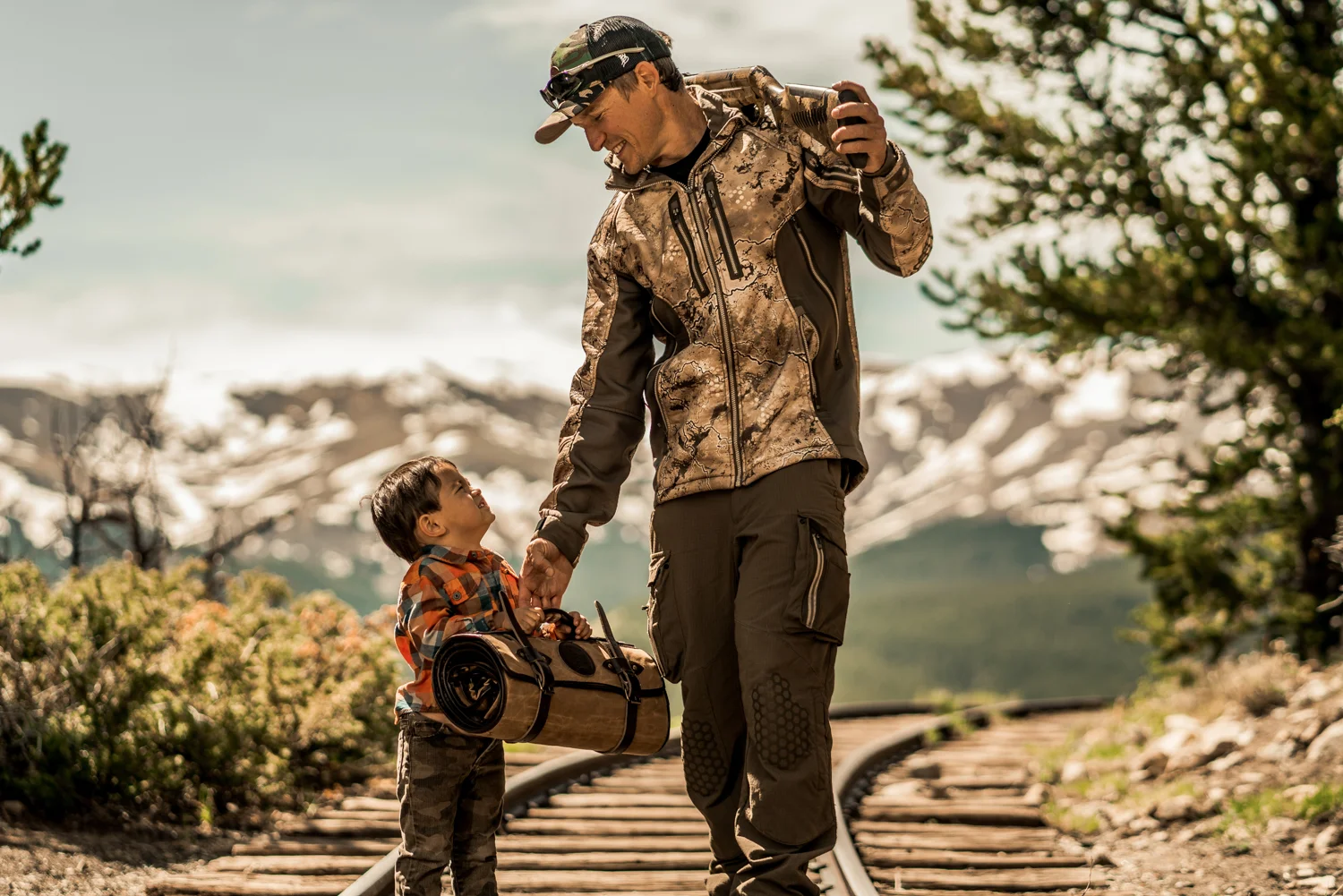
Interact with kids and make them feel like they're playing, not standing in front of a camera.
Framing Your Trophy
You can really make your trophy stand out by getting the antlers, face and your head above the skyline. This way the backdrop won’t be competing with your trophy. He’ll be the center of the show. If the background is boring, use a shallow depth of field. If you are in front of a beautiful backdrop, don’t be afraid to get more of the image in focus to show off the amazing setting you were hunting in.
Wide angle and arms out. But please, don’t take this to far. Hunters can smell B.S. from a mile away. Using a wide angle lens and separating yourself from the trophy with your arms out will make the animal and it’s headgear appear larger than it is. Now that this is the norm, if you shoot with a regular focal length your trophy will feel average. Use the wide angle with caution. Don’t overdue it.

Get those horns/antlers above the horizon.
The Golden Hour(s)
You absolutely can and should shoot throughout the day and if you’re looking for night shots, well then at night as well. But and this is a big ‘but’, an hour after sunrise and before sunset can often take a picture to the next level. Nice warm tones and long, non-harsh shadows appear at this time.

Golden hour and sun flares. An easy way to spice up a shot.
Interesting Pictures With Sun Flares
Most people will try not to shoot their subject with the sun in the sky behind them. It creates harsh shadows and makes the subject to dark. Try having the sun peak through areas of the subject to highlight them and create interesting sun flares on your lens.
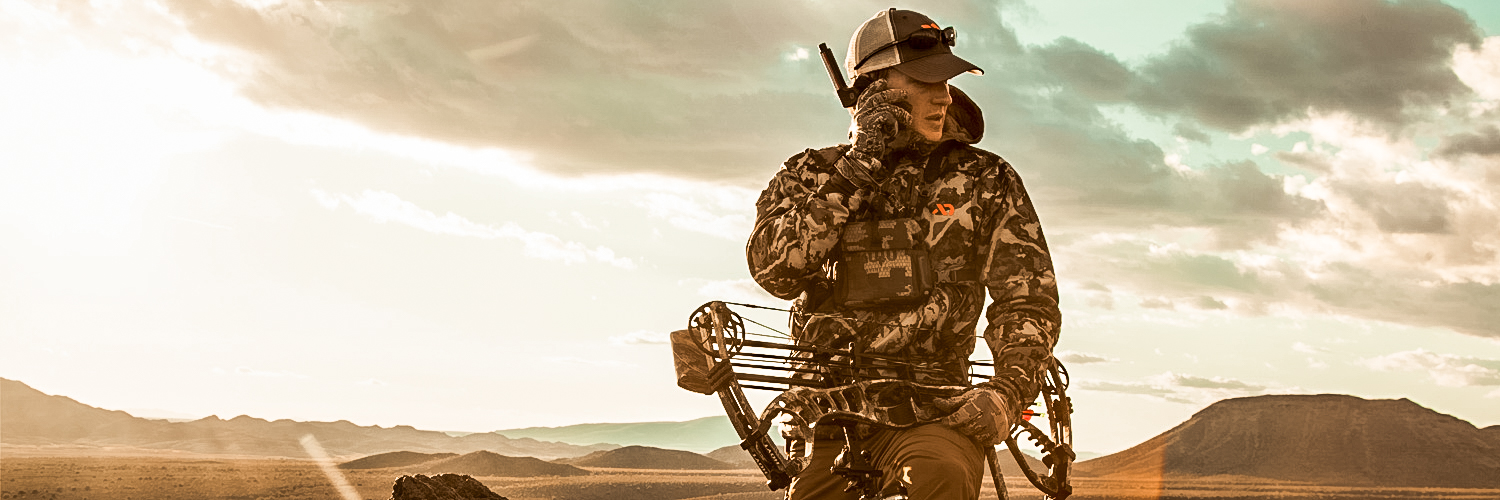
We do more than just hunt when we're hunting. Make sure to show that as well.
Angles, Angles and More Angles
95% of the pictures I see on Instagram is taken with the photographer standing dead level with their subject. The thought never crossed their mind to squat down, get above or use foreground objects to frame their subject. You will. You want to be better and you want to be different. Run around the subject shooting pictures then look back through those images and see what works best. That’s instant feedback from your camera. Use it!
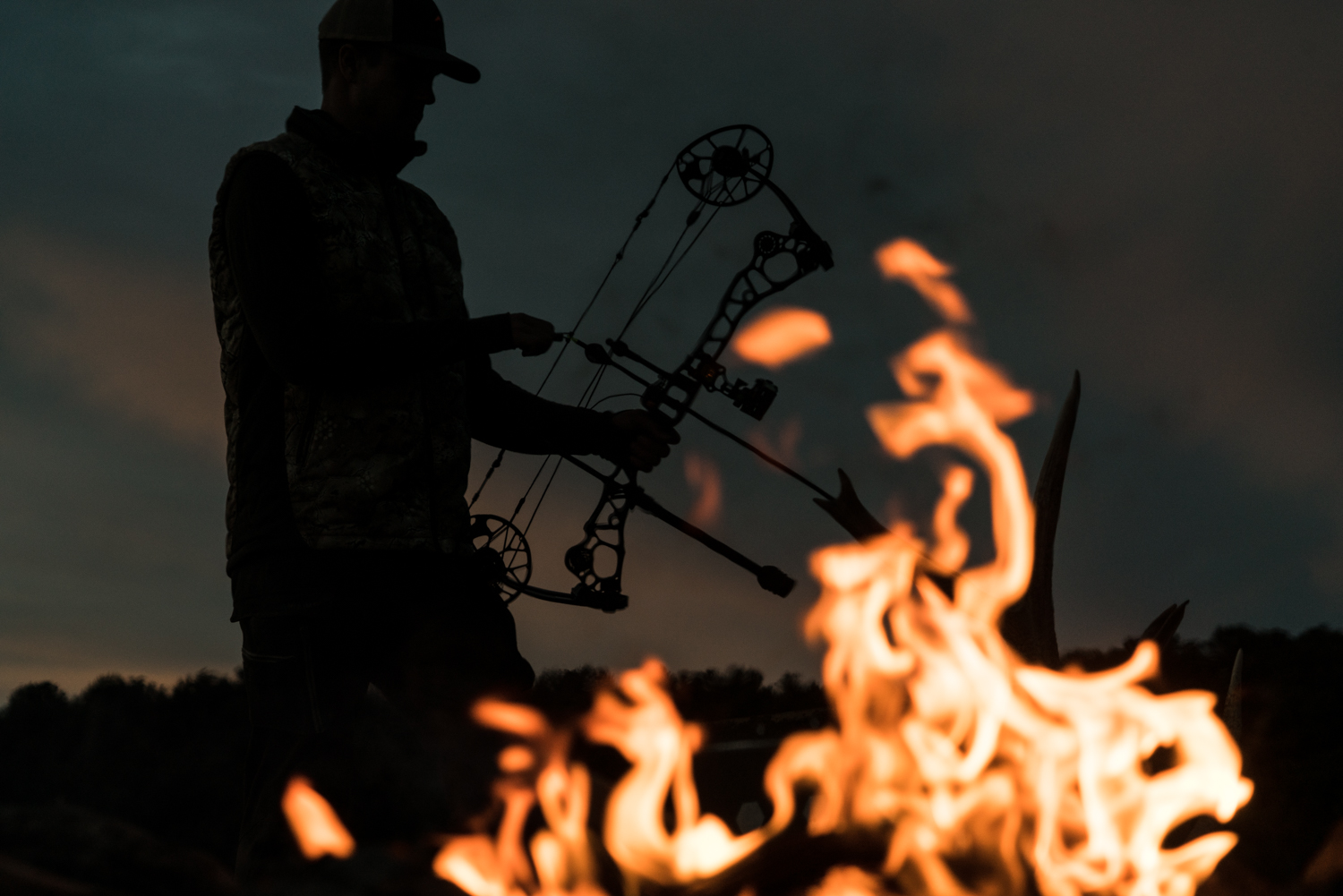
Camp fires are cool. Campfires with something else going on? Extra cool.
Framing Shots and Using Foreground, Subject and Backgrounds
Here is one of the other major factors that separate the big swingers from the pee-wee league. Depth and Framing. This is absolutely critical.
Framing. Use whatever is available to frame your subject. Tree limbs, tree stumps, the corner of a tent. Get creative. You’re using this in the foreground in order to build a natural “frame” for your picture.
Foreground, Subject, Background. Frame the foreground as talked about above. Then keep your subject in focus as the focal point of your composition. Lastly make sure the background is helping tell the story of your photograph. Are you in the mountains? Well then by golly you best have some towering mountains in the background.
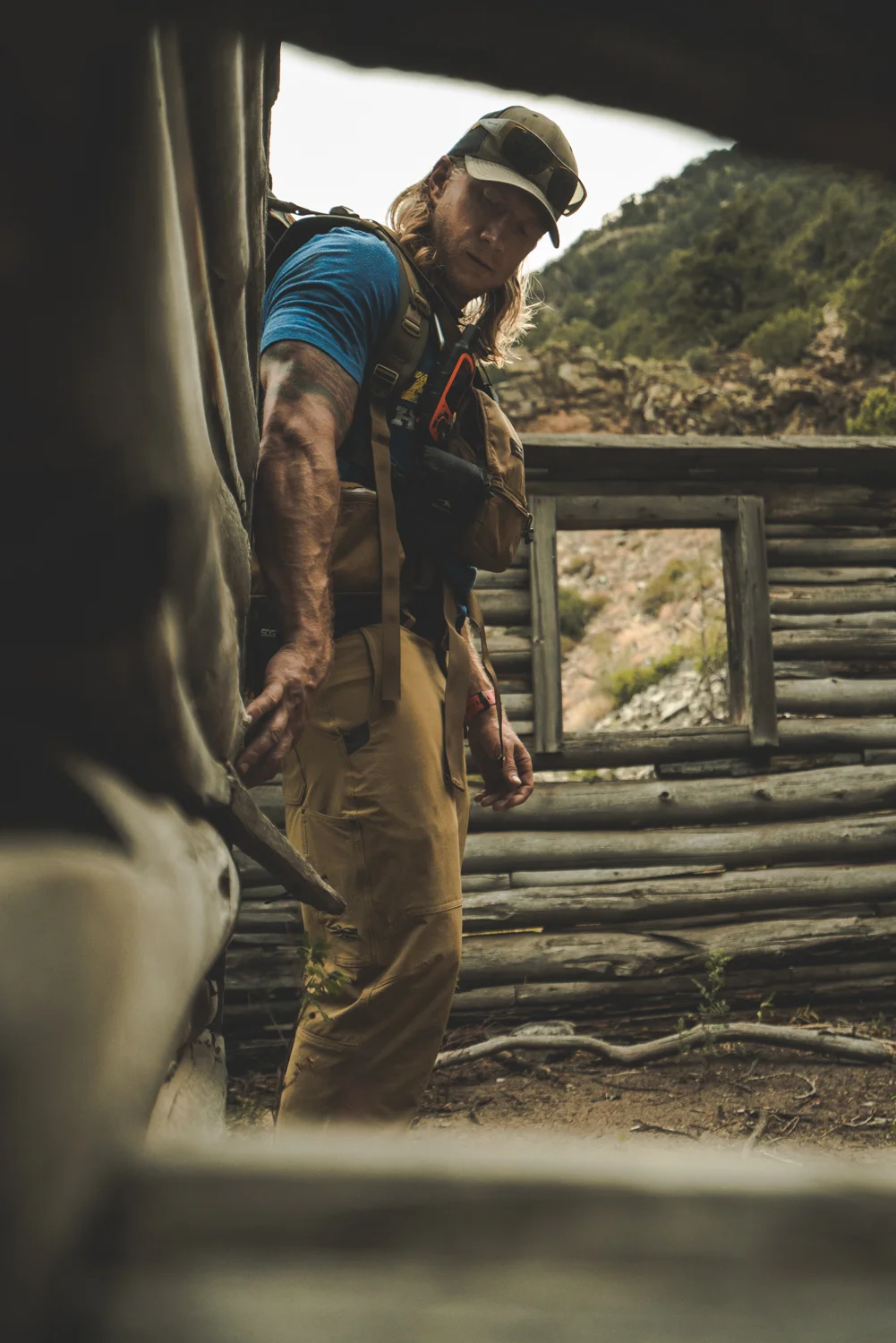
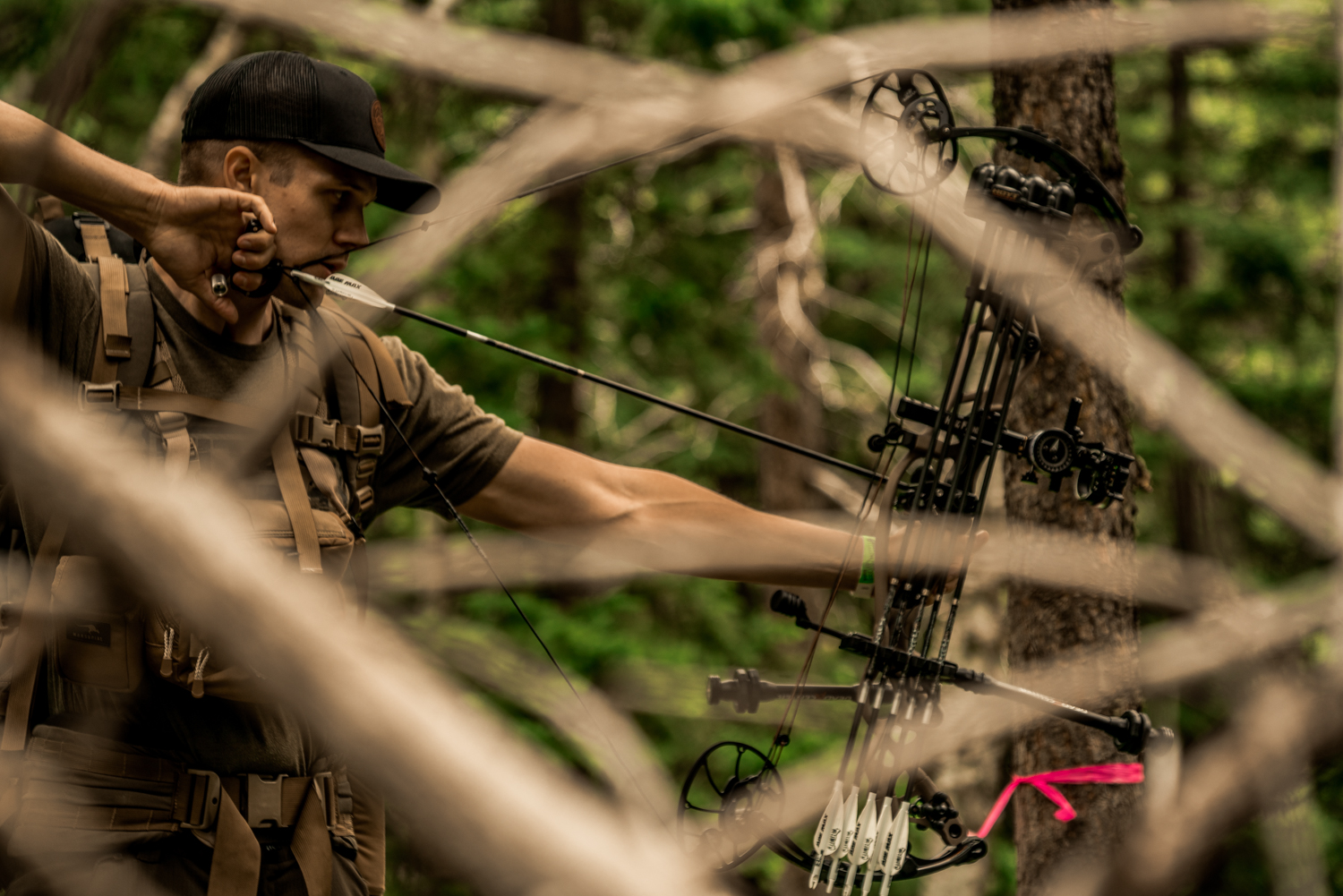
Capture Action
Pictures of people standing around is just about as interesting of the action of standing around… boring! Capture movement and imply action in your shots. You may want to slow down your shutter speed to allow for motion blur. Maybe a fast shutter speed to freeze your hunting partner jumping off that boulder you needed to get down from.
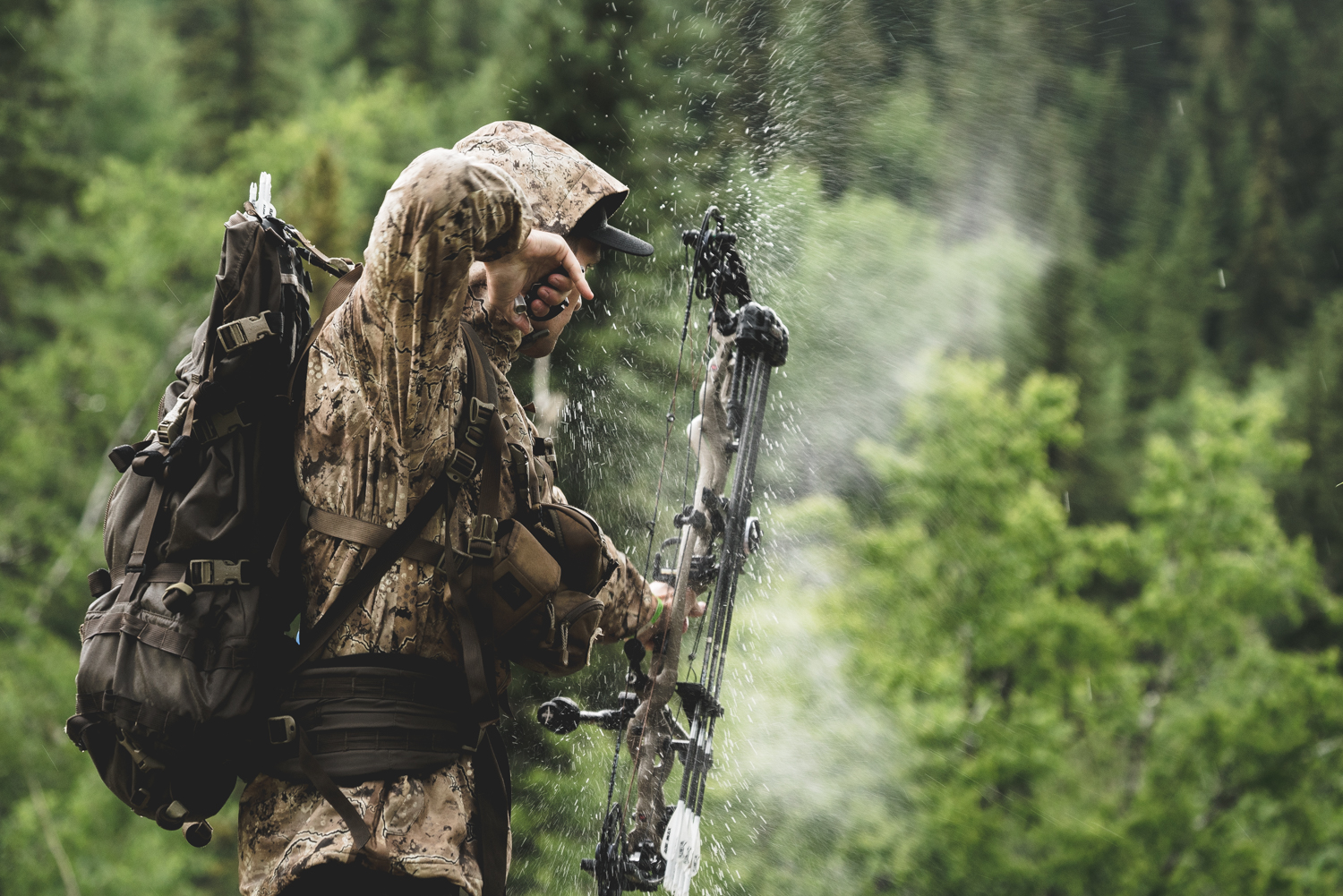
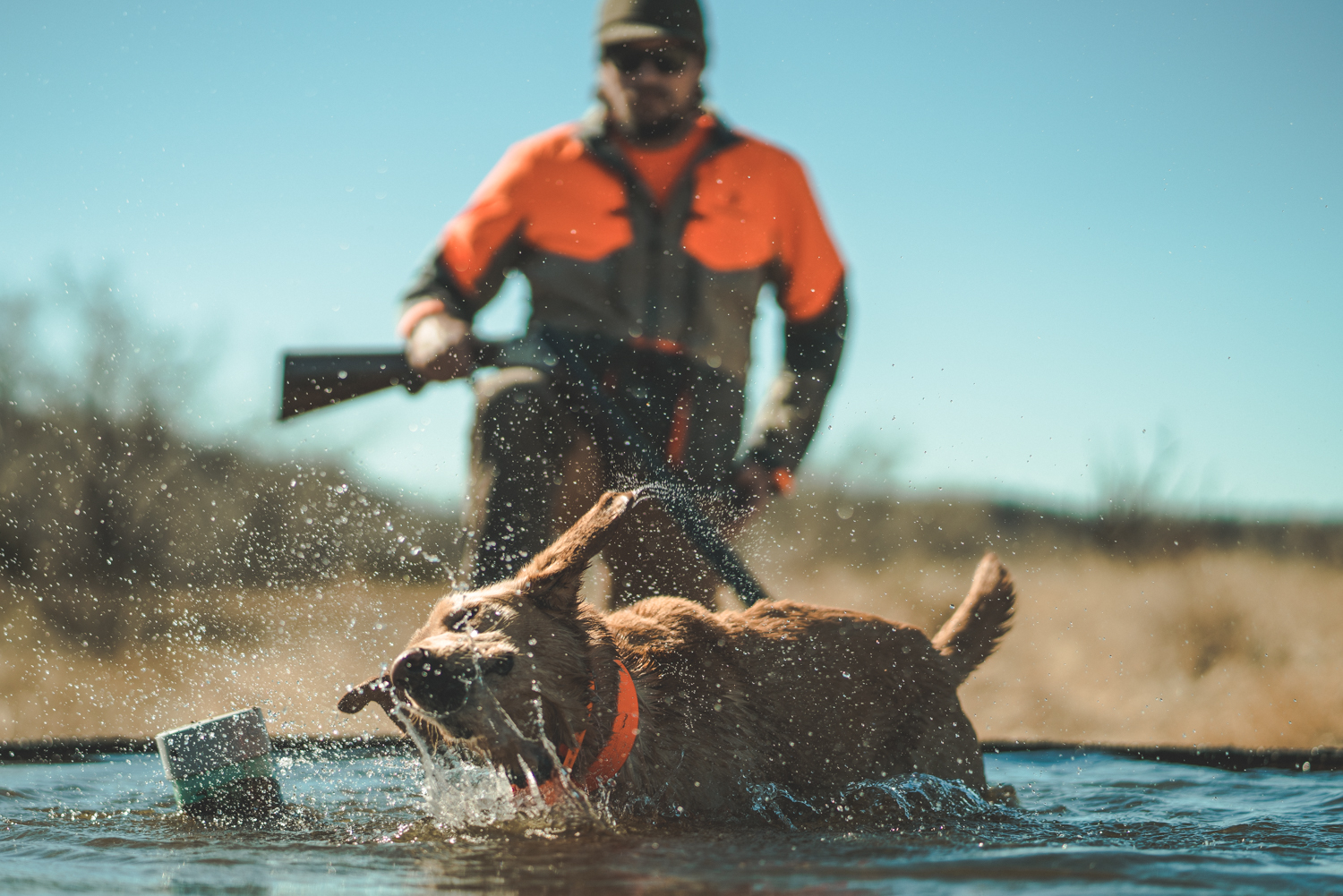
The Shot Doesn’t End After You Snap the Shutter
The image captures the raw image for you and is the foundation of a picture. However don’t underestimate the power of post production work. Lightroom and Photoshop are your friends. Learn them and you open a whole new world of telling a story.

Raw image from the camera.
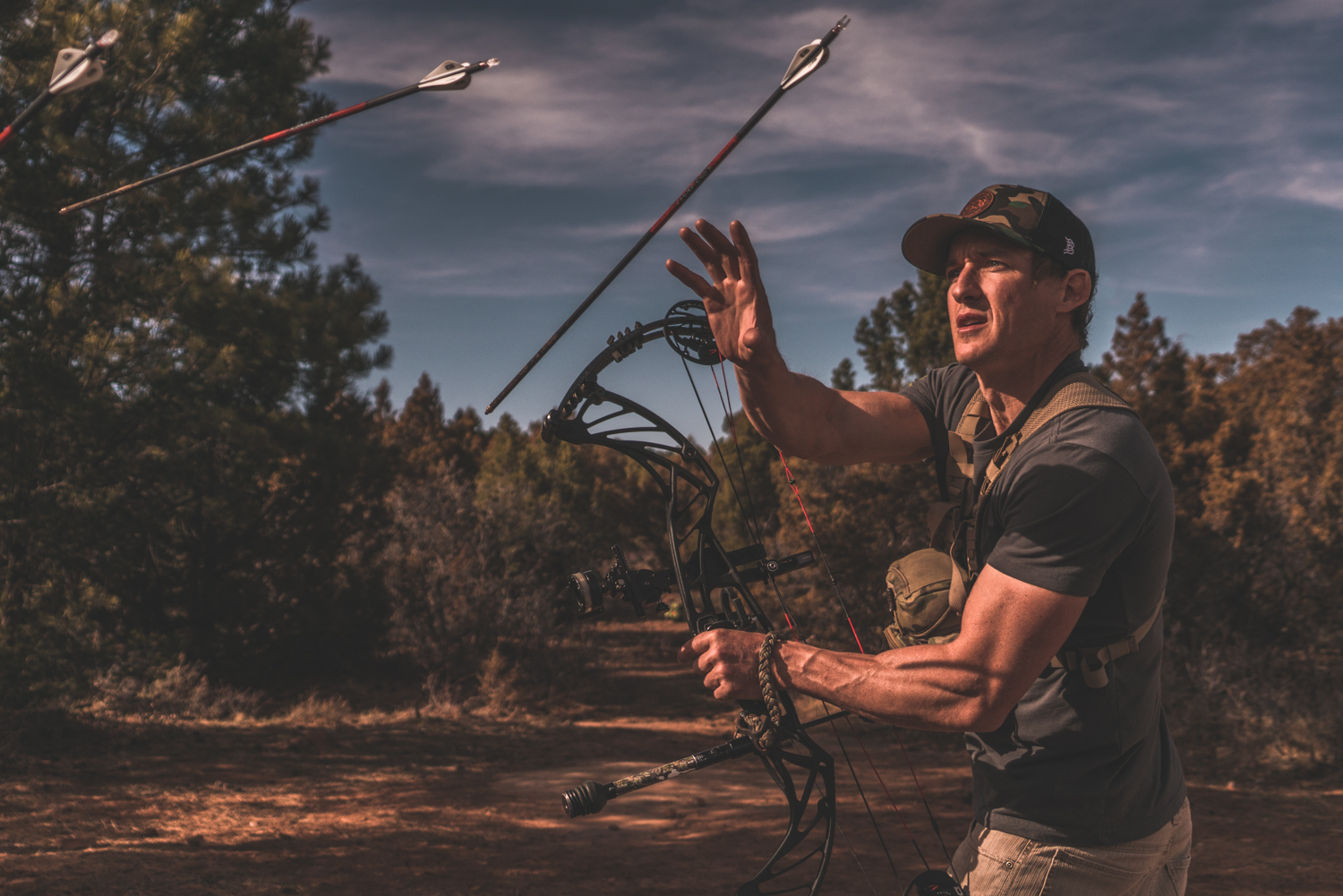
Image after color grading and composited.
Emulate Pro Photographers
I follow photographers I love on Instagram both to be inspired and to get ideas. I see what is working in my eye and then I type up a shot sheet on my phone for my next hunt. This way I have a slew of ideas to work with and don’t get caught up by taking the some old shots. Look for angles you like, different ways of using lighting and how they are framing their subject. Get inspired!
Get Your Work Seen
Never has this been easier. With social media, especially Instagram, never has it been easier to get noticed by Ω the attention of viewers. This point again reiterates why you need to stand out. Find your own style and work your tail off to refine it.
We have a special and unique job as photographers. We get to tell a story through one image. There is no voice over to move the story along, no music to set the mood. Just one image to try to do all of that. I find that exciting. It leaves a lot more open to interpretation from your viewers, but don’t be mistaken, you want to tell your story through that photo.

Tell a story through the image. Everything you have in the image should be lending itself to the story. If not, cut it. It's a distraction.
Here’s a list of what I use —> Fred’s Camera Gear
Use the above suggestions to help you do that. What elements can you add to your photos to create this story?
I’d love to see how you guys are telling your hunting stories. Get a hold of me on Instagram at fredbohm and send me some of the pictures you’re taking.
Continue on to Part 2 - Depth of Field
// Fred Bohm

Analog Elk Scouting in a Digital World - Why You Should Be Scouting
"Why do you spend so much time scouting for elk? You saw them last year, just go to that same spot?" These are often the remarks when another Instagram post goes up about an upcoming scouting trips or from friends who are headed out to BBQ for the weekend instead of the woods.
In my ears I hear, "Why try at all?"
Elk hunting is so much more to me then the days I actually have my bow in hand. It starts months before that day and in all actuality probably never ends.
There’s two ways to hunt in my eyes. Full on or half assed. There is no in between. Either you want it or you just want to be able to talk about it.
This is why I spend my free time schlepping a forty pound backpack around the wild lands of Colorado and whatever other states will let me chase their four-legged creatures. If
I’m going to do something, I’m going into it pedal to the metal with the brake lines cut.
So is scouting absolutely necessary? To me the answer is obvious, a resounding YES!
But the reasoning may not be as obvious as you might think. As with many things in life, it’s not always what you seek that ends up being the real treasure. Sometimes it’s the unseen benefits that are the true rewards to your effort.
Here are some of the reasons you need to be out there wandering the mountains and honing your skills.

You’ll Find Where the Animals Call Home
Well this one is obvious isn’t it? But hell, this is the main reason we’re out there to begin with. All that pre-scouting sitting behind your computer needs to be put to the test. It’s one thing to pour over maps online, it’s another to commit to planting yourself there on opening day.
In a world where we can scout from the comforts of our own home (why lie, I mean office) we’re becoming extremely dependent on technology to solve all our problems. It’s got its place and can give you a strong starting point as to where to begin scouting, but it’s a far cry from the real thing.
I can’t tell you how many times I thought I’d be busting the next elk kegger the upcoming weekend while cruising the maps on my computer only to walk into an elk ghost town with binoculars in hand and wobbly legs from the hike in. The translation from computer screen to real life is sometimes awfully disappointing.
So if you’re going to be lazy, expect a lazy man’s results. And “But Elk-Killa_69 from huntinglocations.com told me that it was a hotspot!” is not an excuse. It is however a direct indication to your laziness.
Get out there and see what’s producing. Then wear the buttons out on your GPS unit/phone app by placing waypoints on all pertinent information.
- Where are the cows bedding and feeding?
- Where are water sources?
- Look for escape routes like saddles and pinch points where you can set up ambushes
- Mark all wallows you come across
- Camping areas that give you a vantage point yet won’t disturb the elk
- Rub lines
- Heavily used trails
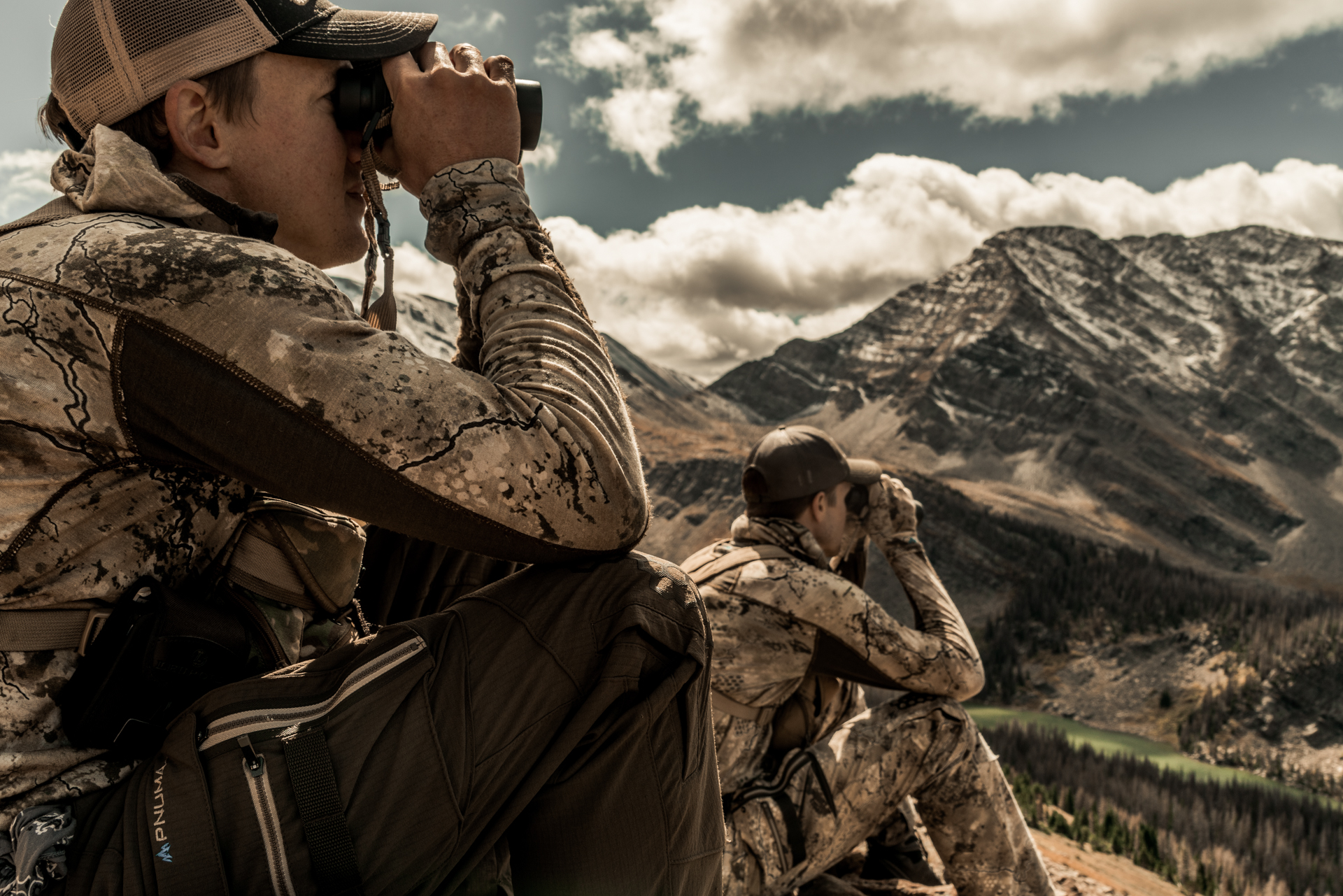
Learning Animal Behavior
You get to see first hand how these animals act in their natural environment before the camo invaders lays siege to the land. Though it is probably more important to know how they are going to act under pressure because that’s when you’ll be hunting them, it’s also invaluable to know what their natural patterns are.
Animals (including us) like routine. It makes them feel safe. They will stick to these patterns until it is absolutely necessary to deviate due to pressure. By learning when and how they like to move you’re setting yourself up for success. Even if you’re not learning the exact patterns, you’re learning how the animals like to behave in general, which could be just the information needed when you’re setting up an ambush in a few months.
Understanding How You’ll Perform Mentally and Physically in the Backcountry
I’ll preach this one all the way to my deathbed. You need to know how you’re going to perform when you’re in the backcountry. Whether that be alone or with a hunting partner this is a great time to see how you’ll perform when you’re alone or if it’s time to ditch that partner who whines every time the angle gets steeper than a parking lot.
If you’re used to the backcountry, then skip ahead as this will be preaching to the choir.
But if you’re new to this game, this little bit of advice can mean the difference of staying in and getting the job done, or tucking your tail between your legs and generating a litany of excuses as to why you bailed early.
Scouting season is your test period. Your bootcamp so to speak. You’re going to learn a lot about yourself during this time. You’re far away from the modern world and all the conveniences that comes along with it.
And it’s quiet. So very quiet.
Some love it. Some hate it. We’ve become so used to the flashing lights, honking horns and constant grab for our attention in today’s world. Not so here. Nobody is trying to sell you anything, nobody is liking your latest witty meme on Instagram and to be honest, nothing really cares about you out here. You just exist.
It may sound like paradise. But when you’re actually in it, it’s all consuming and it can freak some people out. This is the time to figure out if it does and also the time to find out how to combat it.
I’ve written an article on this previously that pinpoints all of these issues so I won’t be redundant here. I’ve attach a link so you can have a read.

Test Equipment
You just spent all that hard earned coin on a backpack, tent, boots and solar powered speaker loaded up with all your favorite Justin Bieber hits right?
Well what if that backpack digs bloody holes in your back, the tent leaks like an Iraqi submarine, your filp-flops offer more support than the $350 pair of boots you were marketed into and you realize how bad Justin Bieber sucks and now you’re stuck with him on repeat?
If you’re committed to a nine day backcountry hunt you might just be walking out six hours later. Now you have to explain to your wife and friends why you couldn’t man up and make it happen.
The scouting trips are here to help you keep your man card. Two day tests of your equipment is the perfect time to suss out the winners from the losers.
If the tent sucks sell it and get something you can live with. Boots are a fickle creature, so the review you read on them being “the second best thing that has ever touched my feet” might be fine for the guy who wrote it, but then again he might have webbed feet that can handle wide boots.
You see where I’m going with this. Test everything before you decide to take it in for the real deal. You’re getting a trial run here, take advantage of it. I’d test everything if I were you, but here’s a short list of absolutes you must tests before committing:
- Boots
- Tent
- Water filtration
- Clothing
- GPS and/or map app for phone
- Power supply for electronics (I know, I know. But I’m a realist. We all use them)
- Optics
- Backpack
- Food (this one is extremely important to test or you may need to double your TP)

Technology Has A Place
Love it or hate it, but it’s a part of all of us. There will be those that resist and that’s fine. Each his own. But I can honestly say I haven’t come across a hunter that didn’t have some form of technology on him.
And there is no denying it. It can be an extremely beneficial part of our scouting. Lets go over a few of them and how we can use them to our advantage.
GPS
Besides the obvious of keeping you pointed in the right direction, GPS unit or map apps for your phone have crazy benefits.
Coming back to a tent in the dark after a long day of hunting or scouting can feel like trying to finding my kid’s toy he decided to leave on a shelf at the grocery store. It may require grid searching and/or calling in the Navy SEALS for assistance. Drop a pin on the tent and this never again becomes an issue.
When firing up my GPS and having a look at the GMU’s I hunt you might think you were looking at Yelp map. There are pins all over it. I mark everything. Water holes, wallows, saddles, springs, bedding areas, good feed, rubs and the list goes on.
I know my memory is extremely poor if altogether non-existent. I don’t depend on it to remind me where that wallow is that I should be sitting on if the mid-day temps start to rise.
Use this technology while scouting and you’ll rarely have the “what should we do today?” issues when hunting.
Game Cameras
Those whitetail guys where on to something when they starting using these little gadgets. Though you will be committing to a lot more when taking them into the backcountry with you. First there’s the weight issue. Also if you end up setting some up, you best be committed to hunting that spot or you’ll be making an unplanned hike in to retrieve them.
The information they give you however can be invaluable. You can potentially pattern their movements by finding high concentration areas along with times they like to use that location.
Know that and you got a good chance of putting one in the dirt.
Communication With Family
I’ve got kids and I spend a lot of time in the mountains. This one is not an option. I use a sat phone or my Garmin InReach to be able to communicate with the family.
This is a small concession to make if it means being able to live this lifestyle or not. Besides, I miss my kids’ voices and I want them to be a part of the experience even if it’s in a small way.

Give Yourself Some Time Off From the Hectic World
Remember one of the reasons your out here to begin with. To unplug.
There are those of us that still contain the urge to interact with our natural environment. Not the one that we created but rather the one created for us.
The more time you spend in it the more that primal urge feels natural coursing through you. We become closer to the animals we walk with and we refine the instincts that once was required to keep us alive.
Not all are privileged enough to do what you do and have the urge to do it. We are the last of our kind. The instinct that still courses through us is what got the human race to the place it currently resides. Without it we would have been part of the 95% of creatures that are on the extinction list.
Scouting is just an excuse to spend more time doing what has been done for hundreds of thousands of years before us. Be human.
So enjoy. Feel alive. And stay safe!
// Fred Bohm

DIY Hunting New Zealand - An American Bowhunter's Post Mortem
I could give you a nauseating slew of inspirational quotes here to motivate you to prepare for a trip like this, but if I have to write a “failing to plan is planning to…” Opps. You see? I almost did it.
So. Planning. You bet. You’re not going to pull off this trip without it. But I’m here to be the ray of hope in what can seem like a monumental undertaking. Let me stop you right there. It’s not. Especially as a bowhunter.
To tell you the truth, it was way easier than I built it up to be in my head. New Zealand is a hell of a lot like America, just with less people and a badass accent.
Let’s go over some of the similarities.
There are lefties and righties that seem to be as divided as we are. I’ll give you a quick bit of advice. If you’re riding in a cab and have no clue if the cabby cries everytime she runs over a bug or not, don’t bring up the fact that you own a firearm cleaning products company. I may as well of been waving an AR-15 out the window, cigar in mouth, bottle of Jack Daniels in the other hand and pissing American excellence all over her back seat.
The people are nice. Genuinely nice. Much the way they are here. They do however use the word “cunt” a lot. Get used to it Snowflakes, I know it may hurt your sensitive feelings, but you can virtue signal all you want when you find wi-fi and can update your social justice warrior blog on these heathens.
The terrain was very similar to hunting out west. If you feel strong in the mountains here, you’ll be just fine there. Don’t get me wrong, they’re big and freaking intimidating, but that documentary “Lord of the Rings” over-exaggerated it. There weren’t any stone giants or dragons or lava spewing mountains with eyeballs hovering over them.
And the differences:
There’s a different mentality when it comes to hunting animals (for the most part). Not better, not worse, but different. You’re a product of your environment, right? In the USA we have native species that we almost blasted to extinction. But we’re savvy and we learned from our mistakes and now care for our wildlife like you should any renewable resource. Well New Zealand ain’t the USA, far from it. The animals that you hunt aren’t native species so they are all marked creatures according to their government. If the hunters don’t kill them, their Department of Conservation will. I found a gaggle of dead tahr laying in the valleys from what I could only imagine was a helicopter outing by the boys at the DoC. Animals are often shot and left behind as a means of population control. Not ideal in our eyes, but absolutely necessary for their ecosystem.
The Kiwis decided to go rogue along with the Brits and drive on the wrong side of the road. I know, I know. Why can’t everyone just follow our lead? Driving was about twice as stressful as it was to drive through the slums of Manila because of this, but it kept me off my phone, paying attention to the road and may have indirectly made me a safer driver when I returned home. Barring any head on collisions, it could do the same for you.
Helicopters are used like we use ATVs. They’re everywhere and are constantly used to get hunting into the backcountry. They don’t have roads up every valley like we do, so the only real option to get into many of these areas is by chopper. Plan on using them.
They like rugby, like I mean really like rugby. I’d have a better chance of winning the silver in women’s synchronized swimming then I would telling you how the hell the game is played. I’m pretty sure I saw that a ball was used in there somewhere. Actually I’m sure of it. You can take that knowledge to the bank. If you plan on spending any time in the pubs, it might be worth a Google search on what’s what in the game before you go.

What To Leave Home
New Zealand is a lot like the USA when it comes to availability of food and equipment. This means there is no need to bring stuff that will take up space and weight in your luggage that you could just as easily buy there.
The major cities that you will be flying into will have some type of camping store as well as a full sized grocery. You can leave your Mountain House (and the rot gut it causes) at home as they have alternatives you can pick up. Fuel is also easy to find for your stoves. That’s a huge bonus as they’ll tackle you at security if you try to sneak it on the plane anyways.
Any little odds and ends you forgot to pack while you were “just having a few beers” the night before your flight can be remedied when you get there.
What You Will Absolutely Need
Here’s a list of what I’m glad I brought:
Rain gear. It’s a freakin rainforest over there so don’t get caught with your pants down without rain gear. Also bring a rain cover to keep your backpack dry.
Power converter/adapter to charge all of your equipment. They use a supercharged 230/240 volts, we use wimpy 110 volts. Don’t fry your electronics because you’re cheap and don’t want to buy a converter.
International cell phone plan. All major carriers have fairly affordable international plans these days. Coverage is about as good over there as it is here so having your cell phone will be super handy.
Backup archery tackle. D-loop, string, broadheads, arrows and anything else you can think of that might break on you. A backup bow would even be better. There are some shops over there but they are few and far between and it could really ruin a hunt if you have to go find one. Their roads aren’t straight highways like ours, it takes forever to get anywhere so plan accordingly.

New Zealand’s Godsend - Hut Systems
Coming from a background of being a dirtbag hunter, I’m used to sleeping on the ground and giving up all creature comforts in order to be successful on my hunts. New Zealand threw a beautiful wrench into that system. Their huts. Wood stove burning, soft mattress having, four walls and a roof, oh so glorious huts. Never have I slept so well and been more excited for the hunt after a good night’s rest.
Some are first come, first serve. Some you can book out in advance. All must be given the utmost respect. They tend to be immaculate when you walk into them and they sure as hell better be that way one you leave them.
Many are located in prime hunting real estate. You can bring camping gear with you and spike camp out of the hut, using the shelter as your basecamp.
What to Expect From the Hunting
Honestly, from my experience hunting is hunting. Some days animals fight to jump in front of your arrow, other days you struggle to find your own shadow. It’s the same thing in New Zealand. I had days go by where I didn’t see a single critter. I was also able to pass on a dozen fallow hinds in a day and take a couple tahr over a few more.
I didn’t expect there to be as many hunters as there were. Hunting is as deeply ingrained in their culture as it is in ours. And the numbers of hunters show it. Expect to see other people on public land and expect the animals to react as any heavily pressured animal would.
A special not about red stag. Take all those pictures of what appears to be tree roots attached to a deer’s head and throw them out the window. Those giant red stags you see on the internet are not wild animals, 99% of them are raised on farms and then placed in front of hunters. If shooting livestock is your thing, have at it. But don’t expect to see those giants hulking around the forest on public lands. I’m just trying to keep expectations realistic so no one is disappointed by what the internet claims a “red stag” to be.

Biggest Takeaway to Be Successful in Hunting New Zealand
I will spill the MVP award.
Use the internet to find and talk to locals. And most importantly have something to offer them in return. Trade hunts, bribe them, offer them your firstborn. But get in with the locals and you will severely diminish your frustration level.
I both solo hunted on this trip and hunted with locals. I can tell you right now that I probably would have come home empty handed had it not been for the local talent guiding me on where the animals were and how they act. It’s just the way of it.
Local knowledge of the geography and megafauna is paramount to success. Sure you can get lucky and hap upon an animal, but when spending this amount of coin hunt in a foreign location do you really want to leave it to chance?
New Zealand is an absolute Mecca for hunting. Practically no seasons to worry about, massive amounts of public land, a small population of people and some of the most beautiful country a man or woman could expect to ever hunt.
This place won’t stay hidden for long. Get after it and respect the hunt as you would your own GMU. Drop any questions you have below in the comments and I’ll answer them the best I can.
// Fred Bohm

The Failed Con Artist - Bowhunting Bear in Colorado's Backcountry
“There are three kinds of lies: lies, damned lies, and statistics.”
When you’re blessed with a pile of guts you don’t simply walk by it. You kneel down and thank the gods above for the gift of a reeking, globulous mass. Let that pile turn in the sun for a few days, so much so that it would knock a buzzard off a shit wagon, well then you got liquid gold.
Two days previous I saw this gift unwrapped for me while glassing elk across a deep valley.
“I got one,” said Joe.
I followed the angle of his glass to a steep avalanche shoot about two thirds of the way up the mountain. Of course it’s two thirds of the way up the mountain, everything is always two thirds of the way up the mountain…
“He’s either semi-retarded or he’s trying to give himself a head rush,” I replied as I spotted him.
“Yea, I’ve never seen an elk bed with his head downhill like that,” came Joe’s response.
We waited to see what would unfold. Would he move? Was there something wrong with him?
After a few minutes we realize that there was certainly something wrong with him. He was dead.
Two archers appeared from behind a tree and with one raising a bow to the air in celebration, it was obvious that the animal was sleeping the long sleep.
“That sucks. We were just hunting there yesterday,” came the disappointment from Joe’s mouth.
“Doesn’t suck for me. I’ve got a bear tag in my pocket. That elk is going to turn into an all you can eat buffet in about two days,” I shot back to him.

Standing above the almost picked clean carcass two days later I realized that the bait for the trap was perfect, however the geography wasn’t.
The damn avalanche shoot is a wind tunnel.
The bears had been there, but no matter the angle of my approach there was just no way of getting the wind right. The cliffed out edges of the steep shoot was perfect for cover. I could have been doing back-flips and riding a unicycle and they wouldn’t have seen me approaching.
But that damn wind. No matter how I approached they always slipped away a few seconds before I peered over the edge.
“Same thing as yesterday man. By the looks of it you were all but measuring out a room in your house for that bear skin rug,” Joe commented over another gruel like dinner of Mountain House. “You were all but there before they split.”
I could tell Joe was getting a fair bit of amusement of my early morning trudges up the side of Mt. Everest. I’d glass back at him a mile or so out sipping coffee and occasionally looking through the spotting scope at the spectacle unfolding.
I started to feel that tag in my pocket weighing me down like the albatross. We were here to hunt elk, but when presented an opportunity like this you don’t just walk by.
“Don’t even look to see if they’re there tomorrow. Just go. They’ve been there the last few days religiously. Just get up there well before sunrise and most importantly before the wind starts to swirl,” comes his advice.
Easily said when you’re the guy sitting behind the glass. Spending a third morning up that death slide wasn’t as appealing to the guy with the boots on the ground.
“Suck it up buttercup. Isn’t this what you train for? Isn’t this what makes you an ‘athlete’?” he laughs, knowing what I’m hesitant about.
Ugh. Everyone’s an ‘athlete’ these days. I wonder if chess players have picked up that moniker as well or are us hunters the last to grasp onto that word.

The morning doesn’t come easy. Six days into the hunt and my shoulders and hip are telling me to throw in the towel and head home to a comfortable bed.
What’s on the menu for breakfast this morning? Oatmeal and protein powder? Freakin sweet! I was hoping to have that again. Everything’s coming up Fred.
Stop whining. This is voluntary you big baby. Nobody said you had to leave your warm home stuffed with every type of food imaginable to come out here and live with the squirrels.
I recognized this was self induced suffering, thus falls out of the realm of complaining.
Damn you logic.
I head out into the abyss. My headlamp creates a forty yard bubble of awareness, other than that an all out animal orgy could be taking place beyond it and I wouldn’t have the slightest clue.
I cross the valley floor, soaking my boots and pants up to my knees in the tall, wet grass. I know a thousand vertical feet above me are two bears scraping whatever remnants of meat are left on the elk hide.
There’s not much left of that thing, this will be your last chance to use that gut pile before they wander off to steal their next meal.
My bow is tossed up on my shoulders as I shut my brain down to what’s to come.
I don’t know much in life besides that one foot goes in front of the other. The rest will sort itself out.
The wind stays in my face as the mountain grade gets exponentially steeper. I click off my headlamp and let the sliver of moon help lead the way.
By now I know the route well. I’m one avy shoot over from where two bears of stuffing their faces with the guts of what was a six hundred pound animal.
And you want to sit there and shoot them with a pointy stick? How hasn’t natural selection take you out already?
I look back a mile or so across the valley floor to see Joe’s headlamp moving about like a firefly.
Looks like he’s setting up for the show.
The fire of his Jetboil pierces the dark. Stadium seating for the drama/ tragedy that’s about to unfold.
I dig into the climb and let it sear my legs for a bit longer as I crosscut the mountain. The rock outcropping that was my destination glows white from the pre-dawn light.
Young aspen trees that haven’t developed the years of wisdom to know any better poked through the fractured rock. They make perfect handles to help fight gravity up the last bit of ungodly steep angle.
My pack slides to the ground and an arrow comes out of the quiver.
Wind. Check.
Audience watching from a spotting scope. Check.
Enough daylight to see what I’m shooting at? Well not quite.
I periscope my head over the edge of the cliff. There’s a perfect view of the avalanche shoot and all it contains. The problem is it’s still a bit too early to tell if there’s anything wandering about.
I hunker down and pull on the hood of my jacket. The early morning cool is having its last bit of fun with me before the sun chases it away.
I’ve never shot a bear before, they’ve never been high priority for me. But there’s something about a bear skin rug in front of the fireplace and some exotic meat in the freezer that’s pulled my attention away from the rutting elk.
He’s not laying in front of your fireplace yet buddy. Get your head in the game.
The sun starts to rouse from its slumber. I peek back over at where my fading memory of the elk carcass laid.
Brown. That’s a good sign.
My mind reacts and dumps an extra helping of adrenaline in my system. I can feel it wash its way through my core and into my extremities. Any other time it would be a welcome change to my aching body, but not when I need to count on my limbs to act as directed. Adrenaline has a funny way of taking countless hours of practice and flushing it down the toilet.
Breathe. You know that’s the only way to fight this, so do it.
My nerves settle as much as they’re going to as I clip on my release. On last check through the rangefinder. Thirty-five yards.
Even in my adrenaline-drunken state that should be no problem.
I stay crouched and pull my binos up to see exactly what he is doing. And by the looks of it he’s splayed out on the carcass.
So tired from gorging yourself that you couldn’t even walk to bed?
I try to make out his vitals through my glass. After spending close to fifteen minutes staring at him, my eyes start to pull the contrast out of his contoured lines.
Head. Body. And legs tucked underneath. Not the most common sleeping position, but that seems to be the theme of the animals around here.

I check over to where Joe is watching while I still have the glass to my face and I can see he is now fully emerged in the soap opera that’s unfolding. Leaning forward, eyes pressed to the glass and pointed straight at me.
Showtime.
I stand and draw at the same time.
Level your bubble. Thirty-five pin gap right on the crease. Pull through your shot.
The arrow arcs slightly and begins its spiral. I peek to the side of my riser, though I know that I shouldn’t.
The dull thud of a hit that only comes from an arrow piercing hide.
I watch for the explosion of a creature woken from sleep by the reaper asking for his last wish.
He must not have any because he lays deadly still.
Spine shot? You should have at least seen a little movement.
My binos go back up in attempts to solve the mystery, but nothing changes.
I whip the binos towards Joe, hoping to see if he has any insight on what just happened. He’s pumping his arms in the air, punching at the gods above.
Alright then. I guess he’s dead.
I gather my gear and slowly walk towards the pile of brown. The sun peaks its head out from towering mountains that has been keeping it at bay as long as it could. As I get closer something doesn’t feel right.
I nock and arrow, not understanding why my body went on high alert.
My previously launched arrow looks like a javelin sticking out of a corpse at a forty five degree angle. It’s not moving which I take to be a good sign.
I move around a small pine brave enough to call an avalanche shoot its home in attempt to get a better view of my would be rug.
“Oh wow. Oh man. You’ve really outdone yourself this time,” I say to myself as an embarrassed smile creeps over my face.
I walk over and pull my arrow out of what should have been a bear. Instead its the carcass of a three day old rotted elk.
I look around sheepishly as if I’m expecting someone to be watching me eight miles deep into the backcountry.
Shit. Joe. A witness.
I hurriedly put my binoculars to my face. He’s packed up by now and making his way down the opposing mountain. Undoubtedly he’s rushing his way over to take a look at my trophy and help with the aftermath.
I scramble for ideas on how not to look like the fool that I am.
I never killed a man and I probably shouldn’t start now. But I wonder if he takes bribes.
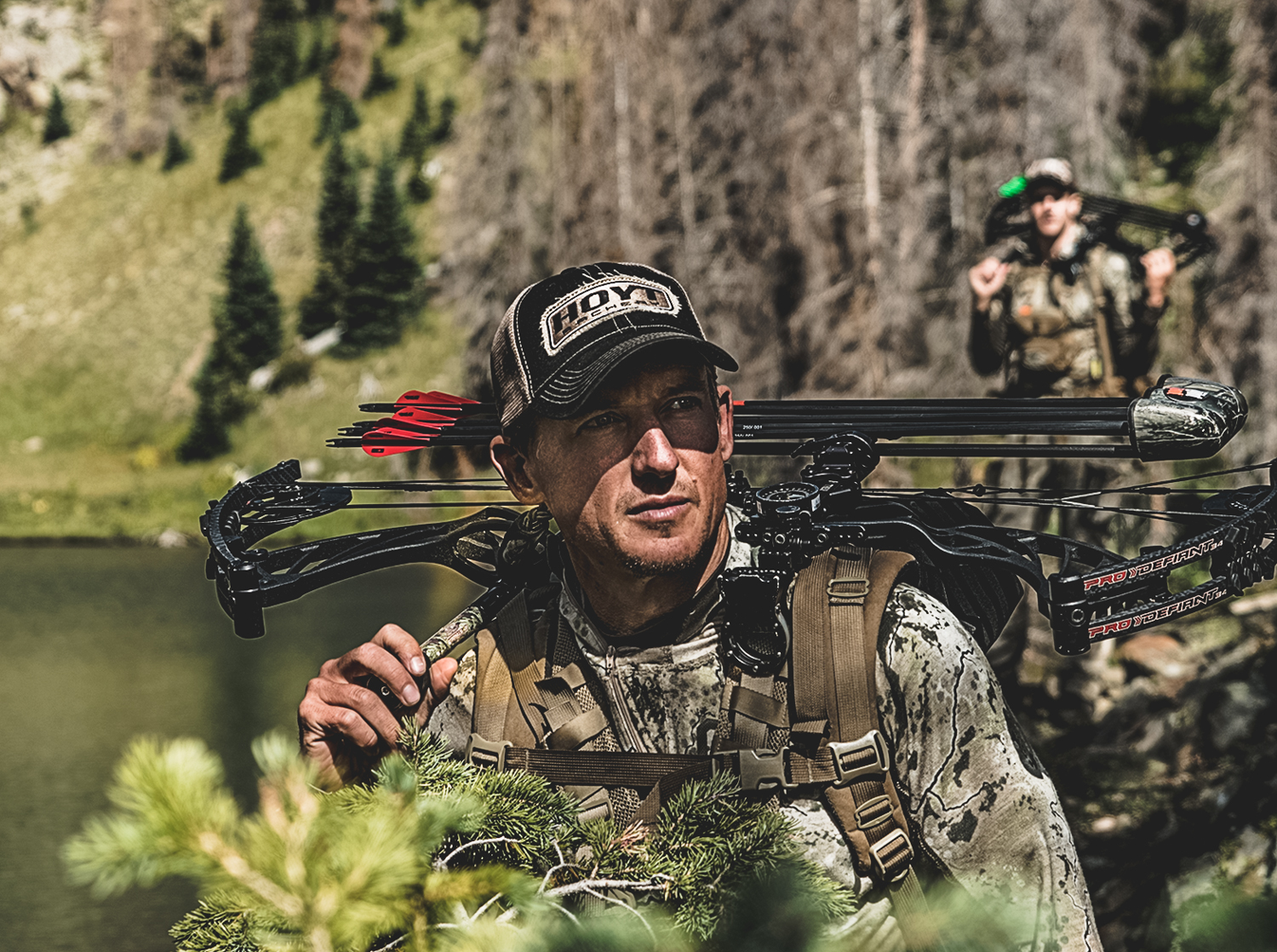
I pull my arrow, sling my bow on my shoulders and make my way down the mountain and into the valley. My brain is running on overdrive and trying to figure the perfect lie that won’t get me caught.
I see Joe making his way towards me in a trot.
“Dude! I saw you at full draw! It was perfect. I saw everything go down,” he exclaims in between short pauses to suck in air.
Well not everything.
“Yea,” was all I could manage.
“Well?! How big is he? You must have hit him perfect, I didn’t see him move an inch!” comes the excited comments.
“Oh yea, he didn’t even blink an eye. The arrow went exactly where I aimed,” I say trying to buy time for the feeble part of my brain that comes up with lies to kick in.
“What’s the deal man? You don’t seem to excited?” he says. By now he knows something is up.
“Well. It wasn’t an bear that I shot. But an elk.”
“What?! I didn’t see an elk?” comes his reply. He’s thoroughly confused.
“That’s because there wasn’t one. Or rather it was a dead one. Remember that carcass I was sitting over?” I say sheepishly.
A laughter starts deep within him. Not just quick “Ha!” but one that starts from the marrow of your bones in your feet and works its way through the skeletal system and is vomited out of your mouth.
I sit there and take the well deserved abuse.
If only I were a good liar.
// Fred Bohm

The Cousin of Death - New Zealand Tahr Hunting
You take the pain because you ask for it. You love it because others don’t. Complacency and lethargy is the cousins of death, the searing burn that comes from the effort is your muscles telling you, we are still here, we are still fighting the good fight, if only for a little longer.
Stop looking up, keep your head down and eat the pieces of the elephant, don’t try to jam the whole thing in your mouth.
My toe kicks another step into the soft scree, initiating a mini avalanche, sounding like a million gold coins sliding down a dragon’s hoard.
One step up, slide a half step back. The metaphor isn’t subtle at that moment, rather it slugs me over the head like a baseball bat. It’s no different than my life’s path. The mountains tell the truth, or I’ll adjust my perception to make it so.
Eighteen hundred hard earned vertical feet lays below me. And the mountains still tower over, offering up her treasure if I have the will to overpower her. The barrier to entry is high in her game.
But her skin was brittle, peeling away with little more than the weight of a human being.
It’s like wading your way into a storming ocean surf. Your advance constantly being halted by mother nature’s commitment barometer. She’ll let you pass, but not before she knows you really want it.
The real kick in the crotch is that you willingly did this less than ten hours previous. And now you’re back at it. Repeating the motions, but weaponless this time to save weight… After all the deed has already been done. Now all you need to do is finish the job. The easy part is to think back to how you got yourself here, the harder part is completing the task without the adrenaline infusion of the chase.
Three shots rang out. The first followed by the chaos of a known miss. Reload, frantically try to relocate, a smooth pull of the trigger and the reward of a cantaloupe thump from a hit. He’s now walking, not running. A good sign.
A smoking cartridge cartwheels through the air to make room for another. I wonder if these brass bottlenecks know the importance of their existence and how easily they can end one life to sustain another.
One more punch to my shoulder followed by that sweet sound. He stumbles off to be swallowed by the mountain.
That was then, this is now.
Toe in and hope this sucker doesn’t slide burying me in a rock tomb. Go for the finger of rock protruding out of the gums of the mountain like the shattered teeth from an unfortunate recipient of a kick to the face.
The walking gets easier if not more dangerous with the semi-solid rock. It doesn’t slide on you, but if it decides to shed a layer it’s taking you with it in no uncertain terms.
I make it to the spot where one life form was irrevocably changed forever. The spot where with a simple pull of a trigger you would be absorbing one life into your own. I find it odd at that moment that I find the importance of my own existence more important than his. It’s a fleeting thought, as I know self preservation is at the core of every living thing. I’m no different. My life is more important than his and that’s just the way of it.
Not much time is spent on looking for where his body betrayed him and leaked out his life through a penny sized hole.
I know his trajectory well and know the spot where he spent the night alone with his last few breaths wasn’t far away.

Leveling off my ascent, I adjust my altitude and follow the contours of the the mountain. Series of short bursts are used navigate over the scree, looking similar to a boy trying to cross a river without getting his shoes wet.
I peer down the gut of two tentacles of jagged outcrops.
Nothing. Must be the next one.
Another burst of speed to cross the landslide zone and to the relative safety of the next outcrop.
He’s got to be here.
And he is. The grey monotony of of rock is broken up by a thick patch of waving brown hair, alive from the wind, but what lies beneath certainly is not.
I heel into the rock and work my way down to him, taken back by the sheer mass of the piled up animal. A tank of a creature with four short legs to power it through the mountains.
I look out over what his last view must have been. I wouldn’t complain in the afterlife if this was the last thing I saw before I took the plunge.
My camera comes out of my pack to record this short portion of my life. I like to capture the truth of what really happened, not what my ever lessening memory decides to make of it over time.
It’s beautiful, surreal and terrifying. The first two make sense to most people, the last often needs explanation. This exact moment, this exact thing I am doing right now is why I was put on this earth. And to know that one day I will no longer be able to do this whether from dissolving health or unseen circumstances drives deep into me.
The camera snaps a few photos, guaranteeing I can look back to this as it happened.
I sit for a moment and tell myself to soak it in as this may be the last time you ever see this place on earth.
But duty calls and the animal that I killed needs to be broken down.
The camera goes in its case and the knife comes out of his.
I unfold the blade, check its sharpness and stand over the tahr as I make a long slit up his stomach.
Thunk.
Oh shit.
My eyes immediately move to the empty spot where my camera had sat moments before.
No no no no nonono.
I stop myself short from launching off the small cliff I’m standing on. A small black case no less round than a bowling ball picks up momentum and uses it to free itself from the constraints of gravity.
Stay in the case. Please stay in the case.
By now the speed has added significant vertical lift to each bounce.
The camera is obviously smashed to bits as if it were a bag of ice being broken apart by repeated poundings on the ground… but maybe it will hold stay in the case and a least give you back the SD card.
The SD card. The DNA of this trip. It holds all the memories of three weeks packed into a lifetime in its thumbnail sized existence.
Hold together.
The mountains aren’t listening or at least they aren’t taking requests at the moment.
The bag bursts. The contents within race in opposite directions as if they were magnets repelling one another.

My eyes looks for the body that holds almost all visual information from my entire trip to New Zealand. But it is useless. The whole ensemble is now nearly a thousand feet below me in a shredded mess.
My heart sinks.
The cycle is complete. The physical pain is now complemented by the mental anguish.
You’re alive, you have the experience, but damn it, this sucks...
// Fred Bohm

Thirty Yard Hut - Hunting Bull Tahr in the New Zealand
“In country like this, we are just as likely to shoot one off the front porch of the hut as we are up the valley.” I said naively to my newfound Kiwi friends, Campbell and Nigel, as the helicopter took off into the sunset like a cliche spaghetti western.
Before the words left my mouth I wished I could take them back. After all I was a stranger in a strange land hunting something I’ve only seen on Youtube and exotic magazines (not that kind you pervert).
We settled into the five star hut and prepped our gear for the morning. I felt like I was in someone’s home this place was so nice and well kept. I happily kept my camp gear in my duffel as at least for the first few days we would be using the hut as base camp until we could get our feet under us and figure out where the tahr would be making their appearances. Then if we needed to camp up higher, so be it.
“Right, we’ll just sit here and shoot them out of the windows like little kids with a Christmas BB gun..” I hear the reply. I knew that tahr hunting could be considered one of the most brutal hunts there is, but still… The terrain looked the part.
I faded into sleep to the rhythmic snores in the background and told myself to keep my expectations in check. This wasn’t going to be a pronghorn hunt in the plains. These are serious mountains with animals that liked to use them as their jungle gym. This was going to be hard, make no mistakes about it.
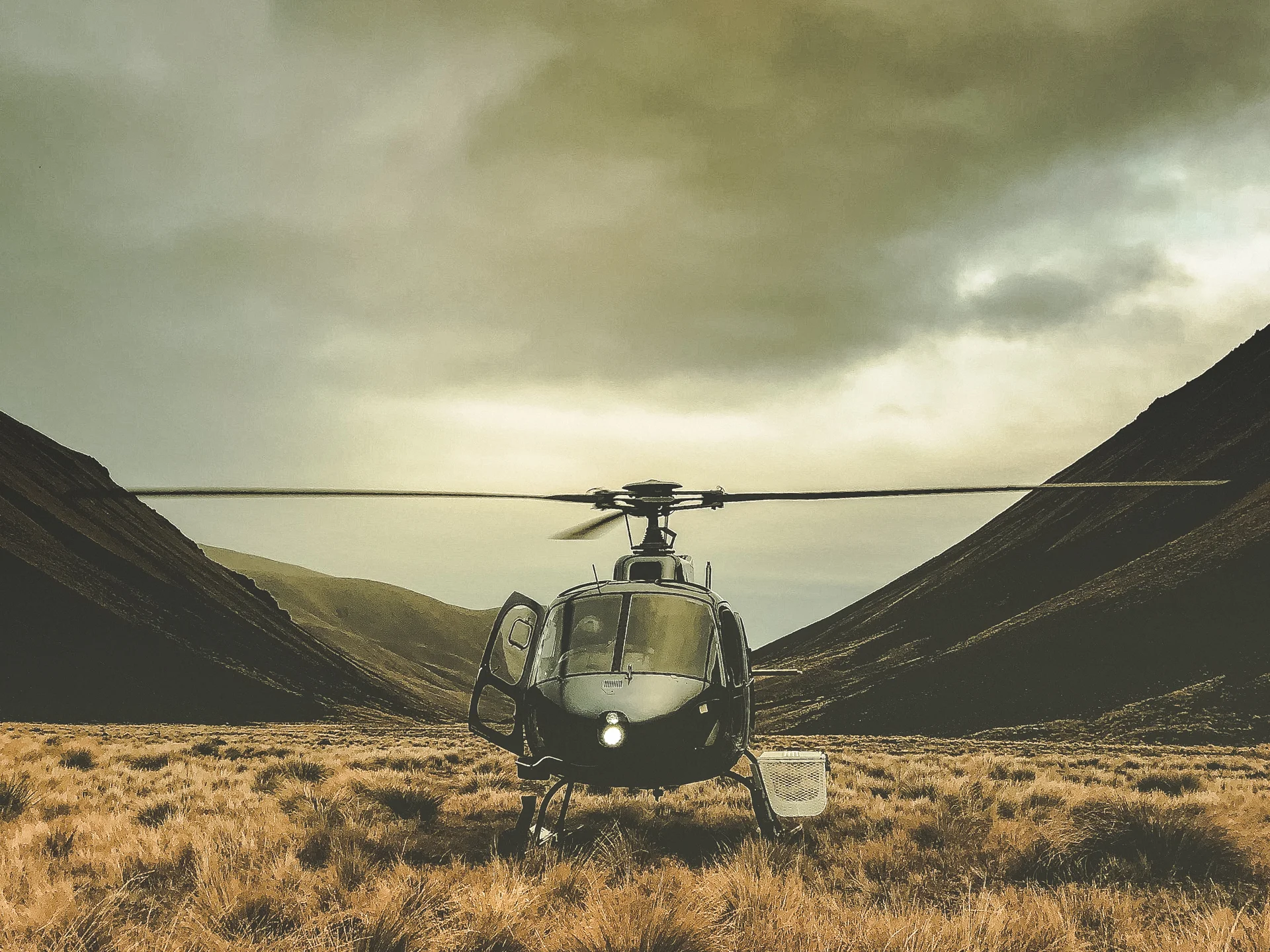
The sun hadn’t made its appearance yet and my legs burned from the approach. Climbing ladders would have been more appropriate training than running hills. This terrain was dirt under your fingernails steep.
We dropped our gear on the only flat plateau we could find. I leaned against my bag and let the lactic acid seep from my legs.
Almost instantly tahr were surrounding us, though the only thing that made them a visual reality was the optics to our eyes. Even with the enhanced vision they were mere specs in the distance. It was time for the pros to hold a summit.
I sat there with binoculars to my eyes as Campbell and Nigel started their deliberation. I felt out of place in the way a private might feel in the presence of generals. To open my mouth and give advice was not only out of place, but potentially harmful to the mission.
So far the only advice I had given was a blanket statement of “I don’t know, he looks big to me.” Perhaps I was feeling the pressure of just getting something on the ground. Two weeks in and I was questioning my pickiness. It’s one thing to hold out for a trophy animal, it was another to walk home empty handed.
I know. You have to pass up the good ones to kill the great ones. You also have to have something to show for a three week trip to the opposite end of the world. That’s just the way of it.
My new found Kiwi friends continued to try to come to some type of consensus as to what group of tahr we were going to make a play on. You see, the thing is it’s not just like you charge after the first group you see. Nothing is close. I mean the animals are far away. Like really far. So you better make sure you have a chance at a stalk before you go skipping off and lobbing shots at them.

I could tell the Kiwis were pretty damn serious by how they were analyzing the terrain and using hand motions to simulate how this mission would go down. And believe me there was a mission. Under no uncertain terms, Campbell and Nigel had an objective. A very unselfish one I might add.
“Let’s get this cunt a tahr.” Was the first thing I heard out of Nigel’s mouth that morning. By process of elimination I had deduced that I was that “cunt”. I had also deduced that it was meant in an affectionate way, either that or the guy was going to throw me off the first cliff we came across. You can never tell for certain how the American Empire is seen in other parts of the world.
The deliberation continued behind me as I swept the talus strewn mountain sides for any moving objects.
Chuwbacca on all fours was growing in size in my glass.
“Tahr,” I said, “I got one. And he’s charging us.”
By now I figured I’d worn out my consistently incorrect guesses as to every tahr being a “big one” so I left that out.
“Where?” Campbell asked.
He followed the line of sight from my binoculars and was on him in seconds.
“Oh hell, that’s a good one. I mean a really good one.” he said into his optics.
Thank Christ.
“And with the line he’s on we don’t have much time to get on him.” Nigel added in.
My education in tahr hunting was about to get accelerated.
“Grab your bow and let’s get after him.” Campbell said without hesitation as he slung his pack and suppressed 7mm Mag over his shoulder.
I stuffed the garage sale I had around me into my pack and threw my bow up on my shoulders.
I looked over at Nigel, “You flagging me in?”
“Yup.” he said, his eyes never leaving his glass.
“He’s cutting down into the valley floor. And he’s in a hurry. Cruising for ladies would be my guess.” Campbell said to me as we left our perch and set a trajectory to intercept the shaggy goat.
“Looks like he’s heading for the hut. Might be a good landmark.” I said in response.
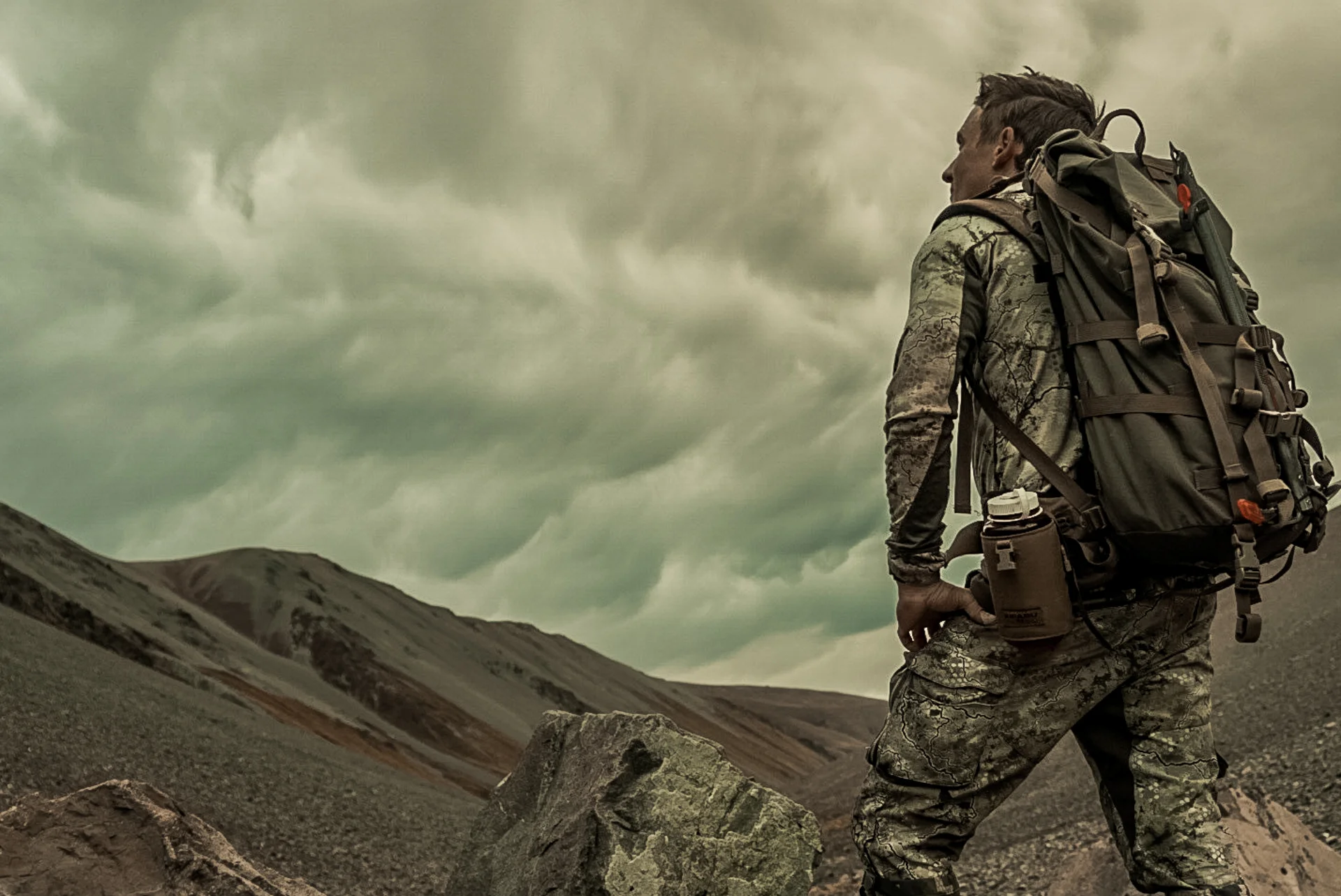
The tahr was about five hundred yards off and obviously had other things on his mind.
God I love hunting the rut.
I sympathize with his distraction as we worked our way through the loose scree.
We slipped into a cut that allowed us to move without being in eyesight of the tahr. While one of us advanced ahead the other would glass back at Nigel for the latest update to our prey’s whereabouts.
“You going to try a shot with your bow?” Campbell asked as we continued our advance.
I could see the concern on his face. He knew I was two weeks into this trip and I had put nothing in the dirt as of yet.
I was on this trip for me. There were no outside pressures that would require me to come home with a trophy in hand. But to say that I was OK with coming home empty handed would be an outright lie. We can lie to others about what hunting means to us so we can act like we are on a moral high-ground, but there was no lying to ourselves.
“Something is going to die today and I don’t care what weapon is sending the lethal shot.” I respond without hesitation.
I saw the relief wash over Campbell.
By Nigel’s reckoning and relayed hand gestures the tahr was headed to the valley floor. And by the birdlike pace that his arms were flapping, we needed to kick our asses into high gear.
We picked up the pace as I tried to steady my heart rate, knowing that there wasn’t going to be a whole lot of time to get set up and throw some lead his way.
“There he is.” came a hushed whisper, “Three hundred yards out. You ok with that distance?”
My head swiveled while I checked my surroundings.
“I think we can get closer.” I said with as much confidence as I could muster.
There had been a lot of time at the range over the past years, but that time was spent flinging carbon, not lead.
We shuffled off, hoping that in his testosterone infused state he wouldn’t take notice of us.
As we move I noted that we are on almost the exact path we took from the hut a few hours prior on our way up to our glassing spot.
“He’s headed directly at the hut.” came the puzzled statement from Campbell.
We pushed on, ducking behind a slight rise in hopes of obscuring ourselves until absolutely necessary.
“She shoots straight,” said Cam as he unslung his rifle.
One arm reached out with the cheat stick while the other was open, waiting to receive my bow.
The feeling of selling out washed over me. It had been a long time since I had downed an animal with a gun. For whatever reason I had felt the need to kill the animals I hunted with what was obviously a much more primitive and self inflicted handicap over the years. I liked the challenge, I liked the brotherhood, but right now I was liking the idea of exotic meat and a trophy better.
“Being a sellout means you have to have strict standards,” I mumbled to myself as I laid down prone and flipped the bipod into position.
“You see him?” Campbell asked while he kept close watch of him through his binos.
“Yea I got him.” I called back through the sound of rushing blood in my ears.
Squeeze man. This might be your only shot on the trip. Blow it now and you know how that anger will rise.
I felt that internal battle rising in me. The darker side of my inner voice calling out. The one where I attack myself for failure. An ugly side that once unleashed can only be resolved by extreme physical exertion or time.
Stop thinking and start acting.
“Take your time,” I heard from behind.
I felt like I had had the crosshairs on his shoulders for hours. That he was a stone statue waiting to be cracked open.
The shot is not going to get better than this, the conditions can’t get better than this… Squeeze that trig….
“Boom!” the gun yells as I try to get my eyes back on the target.
Is he running or is he laying down? I wonder to myself.
He isn’t anything. He isn’t there.
“Where’d he go?” I asked Campbell as I racked another load into the chamber.
“I dunno.” Came his response, clearly as lost as to what happened as I was.
“Let’s wait a few minutes as see if he goes tearing off somewhere.”
A laid behind the scope scanning the valley floor. Looking for a furry shag carpet limping along. I was surprised when my cross-hairs panned across the symmetrical shape of the hut.
“I think he’s down for the count somewhere over that little hill that leads to the hut.” Campbell said as I started to rise up.
“Let’s go have a look, shall we?” I responded as we made slowly made our way toward the last sight of impact. My upland hunting roots instinctively sprung up in me as I carried the rifle like a break-barrel, waiting for a flush.
Nothing moved.
“He should be right here”, came Campbell’s puzzled statement.
We inched our way forward, getting ever closer to the hut.
“You’ve got to be kidding me…” I mumbled.
“I’ve never seen anything like that in all my life…” came Campbell’s response.
There not thirty yards from the hut laid 7,698 miles of travel, two weeks of sweat equity and months and months of dreaming about this moment.
“Could he have died closer to the hut?” Campbell asked in disbelief.
I looked around at the towering mountains that hovered over the valley. I looked at the peaks where these animals reside, to avoid the uncommitted. I looked inward at my false expectations of this hunt, how physical effort doesn’t always equate to success. How sometimes we have this equation in our head that goes something like this: The more effort I put forth, the more I deserve the reward and the universe works on this effort=reward system.
It doesn’t.
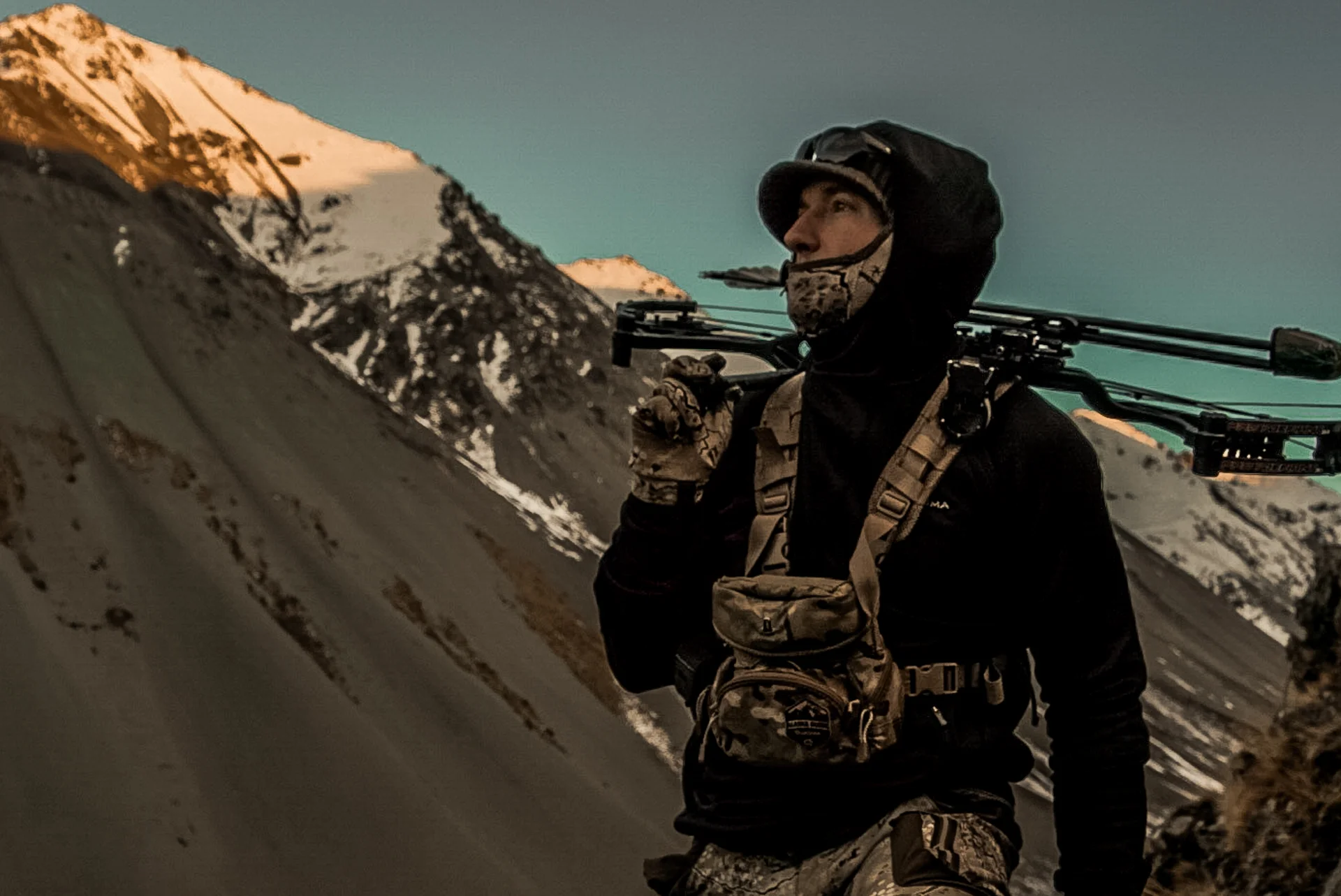
“Well this is going to make for an easy pack out!” Exclaimed Nigel, still huffing and puffing from the long descent from his lookout.
His huge hand patted my back in congradulations as we all stood there in shock.
“Well… Yes, a rational person would think that.” I said with a sheepish grin as I pulled my camera out of my backpack. “But you see, I need a picture with a mountainous backdrop, not a cozy little hut.”
I then proceeded to give them a lesson on why to never invite a photographer on a hunting trip as we hauled the tahr back up the hill.
“Bloody Americans”, came the playful grumble out of Nigel as he pulled the massive creature onto his shoulders and made his way up the hill.
// Fred Bohm
Next Up | Don’t let this hunt fool you. It ain’t easy in the Southern Alps and the next tahr hunt would prove that to me. It also proved to wipe out two weeks of photographs. More up on the next post...

DIY Bow Hunting in New Zealand - Part 2: Equipment List
“The things you own end up owning you.”
Damn right, so make sure the things you own you want to be an extension of you. Aside from pulling the trigger on buying plane tickets and finding a place to hunt, this is the most important part of planning your trip to bowhunt New Zealand.
Two checked bags totaling one hundred pounds that will be your lifeline. One carry-on that will be loaded down with your most expensive and heaviest of gear. This is it boys and girls, choose wisely.
The Packing Strategy
We’re making burritos here right? Jam as much crap in there, tighten it down and hope the tortilla doesn’t split at the seams. Simple! Slow down partner, if you’re planning this trip you’re obviously parting with some serious coin and dipping into those finite vacation days. It’s time to slow down and think it through.
I’ve attached my spreadsheet that I use that includes all my necessary gear as well as how much they weigh. Better yet, I break everything down into what bag to pack it into. You can steal spreadsheet and plug in your gear as you see fit. Maybe you can care less about camera gear, get rid of it and pack in those extra Twinkies you can’t do without. It’s your party big guy so don’t let me spoil it!
Here’s what we know:
Bow Case - Hopefully you have a case that carry your bow (and perhaps a spare) as well as some extras. Archery tackle and clothing to keep your weapon protected is crucial here.
Extra Big Duffel - You’ll pack your soft goods and gear that isn’t fragile in here. Keep some extra room so on the trip home you can pack in the backcountry protein you acquired.
Carry-On - Here’s where I carry some of my heaviest gear as they don’t weight this bag. Also this is where my fragile gear goes, the stuff I don’t want the gorillas below having a shot put contest with. IE. Camera equipment, optics, electronics, my teddy bear.
Download Excel Spreadsheet Here


The Pointing Flusher and Flushing Pointer - Upland Hunting With Birddogs
I could see the muscles straining throughout his corded torso. They threaten to deceive his training and ruin all that he has worked for. The devil on his shoulder encouraging him to explode forward, ignore the bond he has with this human playing God and let loose the instinctual demon within.
“Sit.” Comes my calm voice.
My eyes work off in the distance to the rigid dark brown pudelpointer, Braker, who has gone rigor mortis.
A whimper of disappointment leaves my lab’s throat but he holds up his end of the bargain and concedes while his brother from another mother leads the show.
A pang of guilt hits home as I start to walk off towards Braker.
I look back to reassure myself, but knowing it is unnecessary to do so. Sage my ever loyal lab would be exactly where I asked him to be. Unfailing and unwavering in his commitment to please me.
“Damn it,” I say to myself. I hate when I feel inferior to my dog. That type of loyalty has brought a tear to my eye in the past and threatens to do the same now.
But I have a job to do. Braker has earned the right to be the center of attention and I can’t let guilt get in the way of that.
I slowly approach from behind and downwind of him. These quail have been cutting into the heavy winds all day and I’m hedging my bet as to what direction they think the safest evacuation route is.
“Whoa Braker, whoa.” I soothe him as I near. Unlike Sage, I’m a bit more nervous about my pointer’s intentions. I know from past experience he is closer to human than dog. Often he gives into his wants, with my involvement in the hunt being an afterthought.
I inch nervously ahead giving it about a fifty-fifty chance as to whether I am going to put the birds up or his impatience is. I know in the back of his mind he suspects Sage will come careening into the center of the covey to steal his hard-earned find.
He holds true.
The quail scream into the wind and in a rare showing of marksmanship by twin barrels take the same in lives.
Before I finish “Bra…” he’s off in the direction of the first puff of feathers being taken into the wind as easily as dandelion seeds.
I look back over my shoulder knowing that I would be receiving a scowl from my tried and true retriever. Sage a student of the finer things in life is steady to wing and shot. Braker, well Braker is his namesake to the T and rarely lets a thing like discipline slow him down.
“Amateur hour. I know.” I say in an apology to Sage.

Braker has the first bobwhite. Half the feathers in his mouth, half stuck to his peculiar dog beard. He comes racing towards me and I know he has no intention of stopping. Like an Olympic relay racer there is no slowing down for the hand-off.
He spits the bird out in my general vicinity and heads out for round two.
However this time it doesn’t go so smoothly. He tries to get downwind of where he thinks the second bird fell, but the scent is lost in the covey’s former grocery store and he doesn’t have the advantage of a freshly wounded and flopping bird as a visual aid.
Sage lets go a grunt that is the tell tale sign of his annoyance with such incompetence. I know that he could make short work of this situation, but that would be breaking the rules.
The rule of finding the birds first? They’re yours to retrieve. Well that’s as long as I do my part, which is not always the case.
I let Braker take his time and lean against my smoking Citori, knowing this could take a while.
He eventually picks up the scent and with it the dead quail, then prances back with the obvious intent of pissing off Sage.
Kids…
Now don’t be fooled, it wasn’t always like this. I have yet to find anything more frustrating in hunting than the initial phases of teaming up a pointer and flusher. I about exhausted the urban dictionary and it’s array of four letter words trying to get these two to work together, but in the end it was time and vocabulary well spent.
The conflict of such a setup may or may not seem obvious to some. Their rudimentary philosophies of how a bird should be properly handled is on opposite ends of the spectrum. In football, placekickers and nose tackles don’t have the same job and for good reason.

The Pointer’s Argument
From the pointers perspective he could feel rushed and territorial on his point. It can be difficult enough to have them hold steady with a hunter walking up behind him. They are just as tempted by the adrenaline rush from sending tightly held birds skywords as we are. Now throw a flusher in the mix that has no restraint or respect for the birds personal space and you have a pointer waiting to develop bad habits.
If they feel they have the chance of losing the birds to some boot-sniffing brush buster, you can place a bet with house odds that they are going in for what is rightfully theirs.
How did I resolve this? Have my lab sit as soon as the pudelpointer goes on point. This requires you to pay attention, but you’re hunting over a flusher so you should always be on edge. If your flusher is trained well he’ll sit tight and let the pointer do his job.
The Flusher’s Testimony
The major problem to overcome was keeping my flusher within shooting range. When hunted alone he knows that if he outranges my 20 gauge, his mouth will go featherless. This gives him the incentive to hunt close. But when I threw my pointer in the mix the competition between them was too fierce. He wanted to roam out as far as the pointer, which is not practical for a flusher for obvious reasons.
I had to call him back in range time after time. Only after he learned that if he worked different areas than what Braker had already navigated, he could stay within range and still outwit him. Being that he finds seven out of the ten birds sent into the air, I would say he’s doing a fine job.
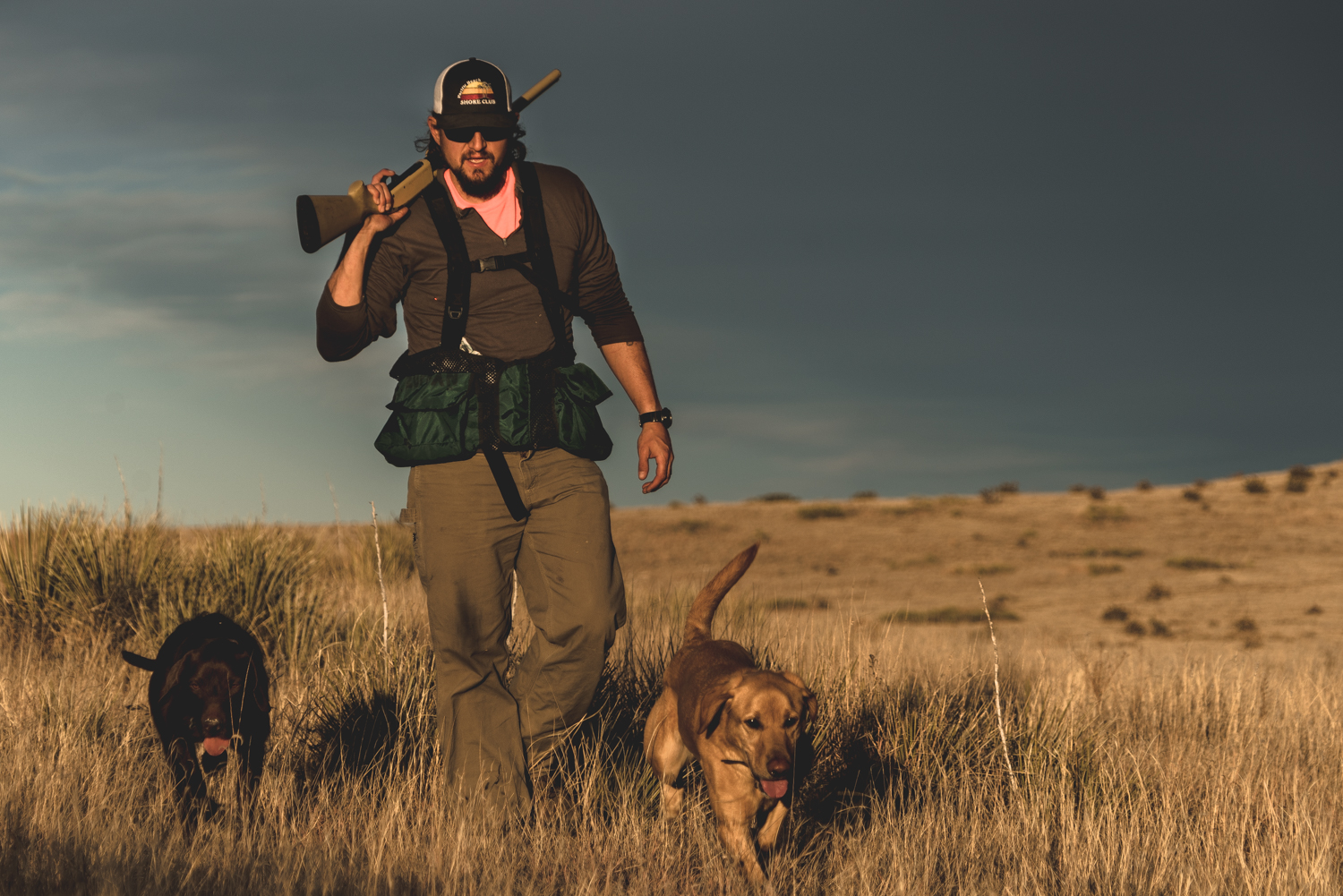
The Verdict
I will start off by admitting this was not a combination for everyone. It was certainly unintentional from my end; Sage came from pointing lab lines and I never thought for a minute as a pup that he wouldn’t eventually point. Just like you can’t force your kids into a particular career no matter how hard you plead, the same applies to a dog. Eventually you come to respect and then love that they chose the path that they did.
I benefited above and beyond getting a dynamic hunting team. The training process retrained me in what I thought was possible from our hunting buddies. It also taught me the patience and understanding sure to have rivaled Mother Teresa and in doing so dramatically expanded my sailor-like vocabulary of words I’m less than proud to know.
If you’re up for the challenge, this can be one of the most exciting ways to hunt birds. You get the best of both worlds; the enjoyment of watching the precision that only a pointer can provide and the white knuckle excitement that is inherent in flushers. And as a added bonus, you’ll expand your vocabulary beyond what you ever dreamed was possible.
// Fred Bohm

DIY Bow Hunting New Zealand - Part 1: Pre-Plan an Unguided Hunt
Making the leap into the unknown. Traveling for the sake of experiencing something new and with the intent of purposely changing one’s perspective. Easier to do today than ever because of technology, but still there is that residue of instinct in us to remain in one place, to stay where we are comfortable and where we know what dangers are nearby. Better to know the devil you know than the devil you don’t.
I decided I wanted to shake hands with the devil I’ve never met by bowhunting the Southern Alps of New Zealand. Now granted, it’s not like I’m exploring some unknown region in Papua New Guinea with the potential of getting my head shrunk by the local tribesman, but it sure as hell does involve a bit more legistics than tossing my bow in the truck, grabbing food on the way and jumping over to the next state for a hunt.
So I did what any smart person would do. I bought the plane tickets first before making much of a plan at all. Commitment. That’s the hardest part, the rest you’ll figure out along the way.
OK, now I know what country I’ll be hunting in, but now what? That’s about as useful as saying, “I’m going to hunt the United States.” Yea great slick, there happens to be millions of acres you can wander through but you might want to narrow it down a bit.
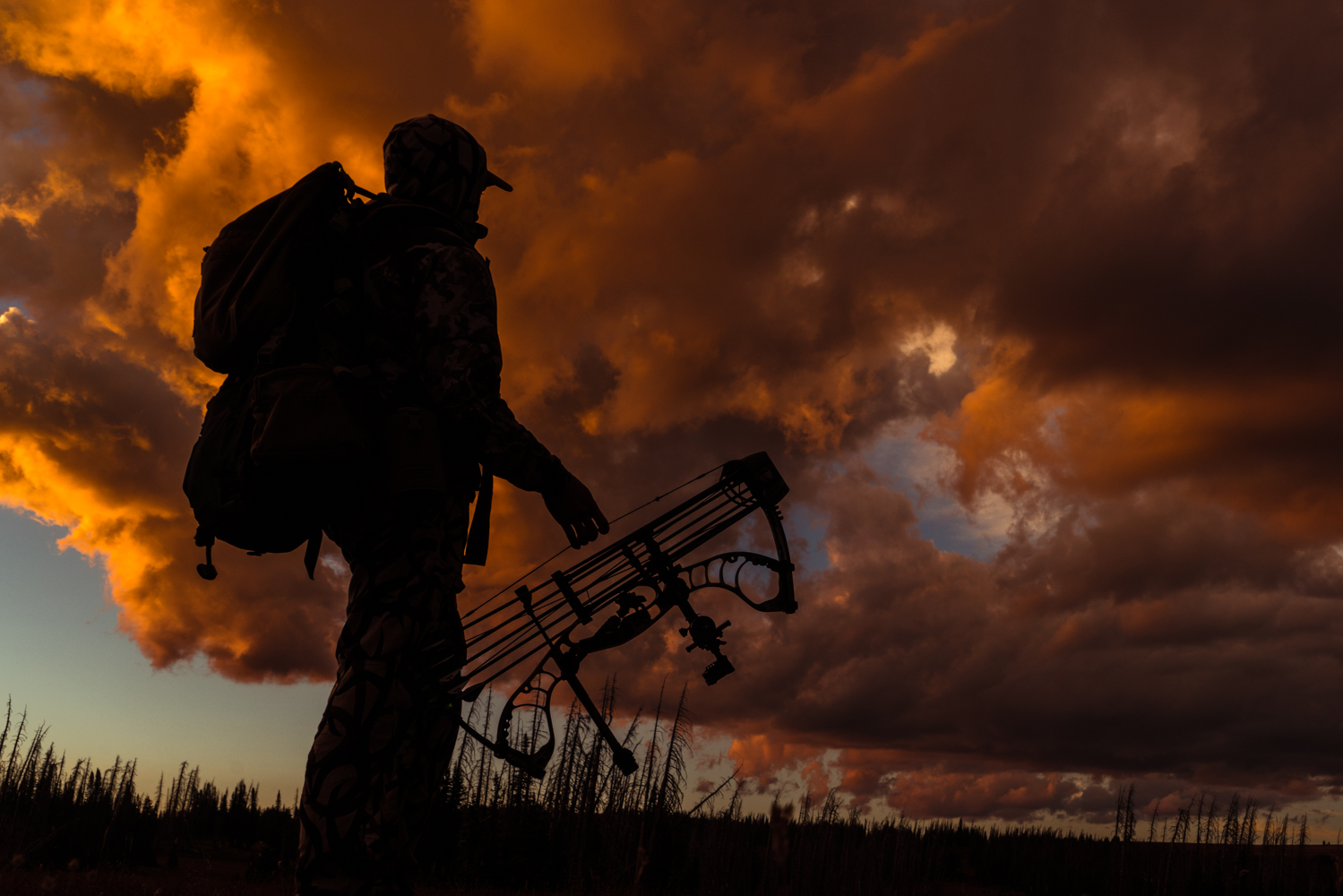
What species? Are you looking to chase the infamous red stag, fallow deer or how about tahr? High or low elevation? Backpack or truck hunting? Bow or firearm? What time of year is best? What gear are you going to need? What’s the permit system entail?
The questions are endless. It’s not hard to fall into “paralysis by analysis” when trying to plan a trip out of the country. Try to answer all of these at once you’re just as likely to get a case of the “fuck its” and giving up on the trip all together.
I’ll try to break it down as simple as possible in a three part series, giving you the info I come across as I find it. This one will cover the pre-planning it will take to make the trip a success, however you define it. I’ll also do one on the gear I’ll be taking as well as a post mortem when I return so you can learn from my mistakes.
This isn’t meant for the guys headed over to New Zealand on a fully guided hunt, chasing monster stags behind high fences. If that’s your deal, good for you, you’ll find resources on plenty of guide’s pages. This is for the DIY hunter trying to do this on a budget.
Here are the things I’m working through/have worked through to get this hunt off the ground.
When to Hunt New Zealand
This will depend on what you plan to hunt and the assumption that you’ll be trying to catch the rut. Know that there are other times you may want to hunt New Zealand, but this will cover the rut. Remember their fall is our spring, so a good time to go will be sometime in March through June. Here’s a breakdown on rut activity according to species.
Chamois: May and June
Tahr: May and June
Fallow Deer: April to mid-May
Red Deer: Late March through April
Rusa Deer: July to August
Sika Deer: Late March to early May
Wapiti: Mid-March to late April
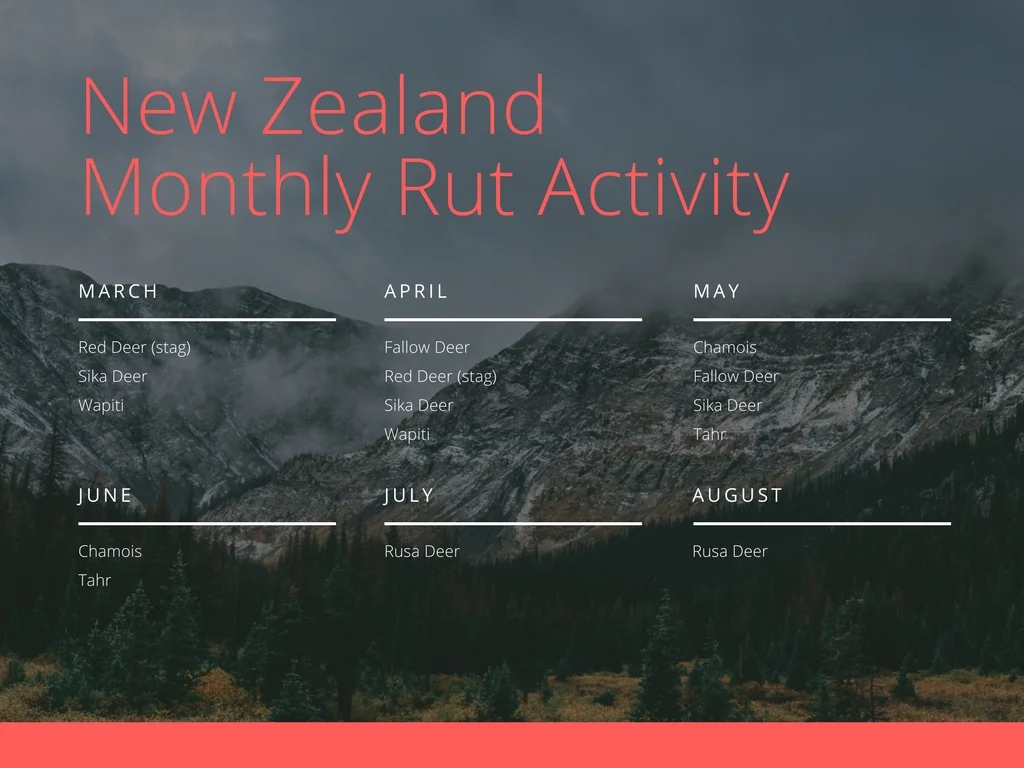
Buy Plane Tickets
I didn’t do this way in advance, just two months before leaving. A huge help for me was Google Flights. If you’re a bit flexible with timing this site can help you get the best deals on plane tickets around.
Car Rental
It’s actually easy to set up a car rental. Any online service you typically use (Expedia, Orbitz, etc.) can get you set up. The prices seem comparable to the USA. Careful though, apparently they still use lances or swords over there, because these guys drive on the left hand side of the road (that’ll give you something to Google while you’re bored at work).
Find Where You’re Going to Hunt in New Zealand
This one was a bit trickier. Here’s some ideas:
New Zealand DOC: Great resource that gives you all the public land available (which is substantial. They even go as far as letting you enter the species you want to hunt and then recommending spots to hunt. A great starting point.
Local Advice: Local advice is the best advice. Here’s the rub, who the hell wants to tell you their favorite spots to hunt. This is where you need to be willing to part with some of your own. Nothing in life is free, and this certainly applies to good hunting locations. I talked with people on forums who were visiting the USA to hunt. I advised them on areas I knew well and they reciprocated. Here’s where the Golden Rule comes in. Don’t be a dick. Make sure you hold up your end of the bargain when the time comes.
Permits and Flying with Weapons
- Since you’re bowhunting life is a lot easier. No firearms permits are needed. Safely pack your bow and you’ll be set.
- If you are hunting with a firearm there is some great information from Big Game Hunting Adventures here.
New Zealand DOC Permit: It’s free, but you’ll need to carry one on you while hunting. These permits are for open hunting areas. Note: there are restricted hunting areas (much like our limited entry hunts) that you’ll need to apply for in our fall time if you want to hunt those areas.
Passport
Probably don’t need to explain this one, but I’ve had trips delayed because I was a knucklehead and forgot my passport expired.
A preview as to what will be in the next segment. Gear, gear and more gear. This will be an extensive list that will be considered carefully. You only get so much weight when flying and you’ll want to be mobile when you’re there. I’ll break down all the gear I will be taking, how I pack it and why I’m taking what I’m taking. Look for it in the near future. Sign up to my Newsletter to get it sent straight to your mailbox.
// Fred Bohm

Backcountry Hunting - The Art of Being Uncomfortable
“Will you meet with him?” an old buddy from my former life as a motion designer asked over the phone.
“We don’t have to hold hands or kiss afterwards do we?” I replied back sarcastically. I felt like he was trying to set me up on a date. I wonder if he knows I’m married (to a woman) with kids.
“He just wants to talk bow hunting. He’s new to it and the lack of success has him frustrated. I’ve seen your pics, you’ve caught stuff. He just wants a little help,” came his reply.
Being that my old friend was in the advertising industry, you’d think he knew what editing and “selective” visuals were. My kill to days in the field ratio was outright embarrassing. Not every model you see on Instagram looks like that when they wake up you know… selective freaking editing.
“Yea sure,” came my reluctant reply. Being he was a friend and having a soft spot for those in the struggle, I agreed to meet up.

I sat at the a local brewery sipping the latest hops infused concoction. Another mediocre beer in the sea of the mediocre brewery craze. Just add more hops than the next guy and you deserve a gold medal these days.
“Fred?” I heard over my shoulder.
I turned on my stool to what I took to be a skinny-jeaned lumberjack straight out of the Pacific Northwest. All the trimmings of one at least. My eyes instinctively go to his hands. Those hands never held a tool in their life. Great.
I spent a short stint in Brooklyn (Williamsburg to make matters worse) some years back for work. What I learned was to be a woodsman you need to drink PBR, wear flannel, carry a hatchet on your hip and to NOT spend a single moment in the dirty, scary, disgusting woods. Deep in the heart of the city is where lumberjacks are born.
“Heeeeyy,” came my drawn out response. I knew I was in for it.
After five minutes of the typical pleasantries, I felt the need to get on with it.
“So backcountry bowhunting? How’d you do last year?” I asked. I wanted to see what I was working with.
The floodgates opened. If felt half psychiatrist, half high school adviser.
After the typical excuses as to why he didn’t see anything came the pleas as to how to make the hunt more comfortable and enjoyable. Not successful mind you, but more comfortable. Interesting.
I had three choices.
- Lie to him and tell him it gets better.
- Get blackout drunk and hope through my inebriation and therefor slurring of words he would slink away from the conversation and head back to his logging camp.
- Bluntly tell him the truth.
I pushed my beer away and opted for a combination of one and two.
A summarization was in order to make sure I got it right.
“OK. So you don’t like being cold or dirty? You’re terrified of bears? You don’t particularly like hiking? You rank sleeping in as high on your priority list?” I asked. “Why do you want to hunt again?”
I tried but failed miserably to keep the amusement out of my voice.
“Everybody says it’s the healthiest, cleanest meat out there,” came his reply.
Oh wow. A lumberjack and a Crossfitter.
“And working out is the best way to stay thin, but liposuction is always an option.” I muttered under my breath.
“Huh?” came his response, leaning in as he obviously didn’t catch what I was saying.
“Nothing,” I quickly tried to recover.
I went on to tell him that all the things he hates about backcountry hunting is the precise thing that us backcountry hunters love about it. We embrace the suck.
“So is it hopeless?” He asked. “Should I just give up on it?”
“That’s up to you my friend. It depends what you want out of it. Are you using it for a growing experience? Essentially are you using it to find something out about yourself and better yourself as a human or do you just want the clean meat and the ability to say you’re a backcountry hunter?” I responded honestly. “Do you want to be uncomfortable for the sake of making the your everyday existence more comfortable?”

Now I know this was an extreme case. But it did give me the opportunity to sit back and reflect on what we’re doing out there. Acquiring meat, right? Horseshit. There are WAY easier ways of getting clean, healthy meat. For one, spend less time hunting and more working your job in order to be able to afford Whole Foods obscene prices for organic, grass fed animals.
Those of us in it know it’s so much more than that.
We make the situation harder than it needs to be in order to test our mettle. We do un-ordinary things to make the ordinary more bearable.
That might be the why, but how about the how?
There are many things that contribute to the success of a hunt. Let’s throw luck out the window, as it is something that we can’t plan for and can’t work at to acquire more of it (spare me your “Luck is when opportunity meets preparation.” speech in the comments section. I get it. I use other people’s quotes all the time to feel clever as well).
I won’t beat training into the ground. There are more marathon hunters in the backcountry then there are hunter hunters in the backcountry these days. Believe me I know, that’s typically the first thing they are quick to tell me.
So, what’s left? Hunting skill? Sure, but before we can get to that we need to stay in more than a day to acquire it. Let’s talk about how to do that.

How to Stay in the Backcountry
Wow that title sounds stupid. I might as well have named it “How to Breath and the Advantages of Doing So”.
Sounds simple, however I would bet it is the single biggest factor as to why people aren’t successful in the deep. I wrote an article a few years back about it that still applies today → Solo Backcountry Hunter
Instead of regurgitating previous information, I’ll instead try to be useful and talk about one of the specifics in there and what I have spent a lengthy amount of time with this introduction to get at.
Here’s the summary in one sentence: You need to be ok with being uncomfortable to be ok with being a backcountry hunter.
At first being ok with it will work. But to eventually embrace and really enjoy it, you need to be more than ok with it, you need to look forward to it.
Humans love comfort. Look back since the beginning of time. Besides just trying to survive in a world that was trying to kill us, what were we doing? Trying to get comfortable. We made fire to stay warm. We made weapons to make acquiring food easier. We created modern houses with heat, running water and soft beds to get comfortable. Nine to five jobs? To comfort us into thinking our futures are secure. Watching television? To distract us long enough with other people’s problems so we don’t have to think and fix our own. I can go on like this forever, but I won’t. Let’s just say that I firmly believe that most conveniences we have created is to allow us to be more comfortable.
When we volunteer to hike miles into the mountains and give up all the comforts that the modern day gives us (Well most, we still use tents, legit clothing and instant coffee. Come on, I’m not a total sadist.) we make a conscious decision to be uncomfortable. It’s part of the appeal. We give up the conveniences of the world as we know it for the TEMPORARY discomfort of a simpler, more primal existence.
And that big bold word in the previous sentence is the key to it all. The key to the art of being uncomfortable. The key to staying in the backcountry and the key to the city of success.
Much like life, it’s all temporary. Being cold, wet, sleep deprived, scared of critters, achy, lonely. Whatever is making you uncomfortable while in the backcountry is only temporary. Take comfort in that.
What isn’t temporary is giving up and the psychological effects it will have on you. That I promise sticks with you and defines you as a human.
Leverage this knowledge. Repeat “it’s only temporary” while you’re waiting out that mountain shaking lightning storm, the deep loneliness that you feel will last forever or the fear of the unknown.
Leverage that and walk out of the woods on that predetermined date with the knowledge that you’ve lived with discomfort and you could do it again. Hell, maybe next time even welcome it.

“I want to learn to be ok with being uncomfortable.” Came the unexpected reply. For a minute I almost forgot someone was sitting next to me.
Hazily I came back to it.
“Well you’re starting off on the right foot”, I exclaimed, “those tight jeans seem to be the perfect training tool.”
OK. Numbers 1 and 3 were covered, I gave him a little bit of truth as well as being blunt. Maybe I added a little of #2 in there as well for my own sanity.
// Fred Bohm